Replacing a Failed or Misted Rooflight
- Fixed quote before we start
- Roof never left open overnight
- 10-year workmanship guarantee
- Fixed quote before we start
- 10 years workmanship guarantee
- 25 years fitting rooflights
- Skylights only, not a general roofer
Replacing a failed or misted rooflight in Worthing
This is the most common call we take, and on this coast it comes earlier than it does inland. Salt shortens the life of everything exposed on a roof, so a unit that would have another decade in it at Billingshurst is often finished at Goring.
The first job is not ordering anything. It is working out what has actually failed, because three completely different problems present as the same damp patch on a ceiling.
Read the symptom before ordering the cure
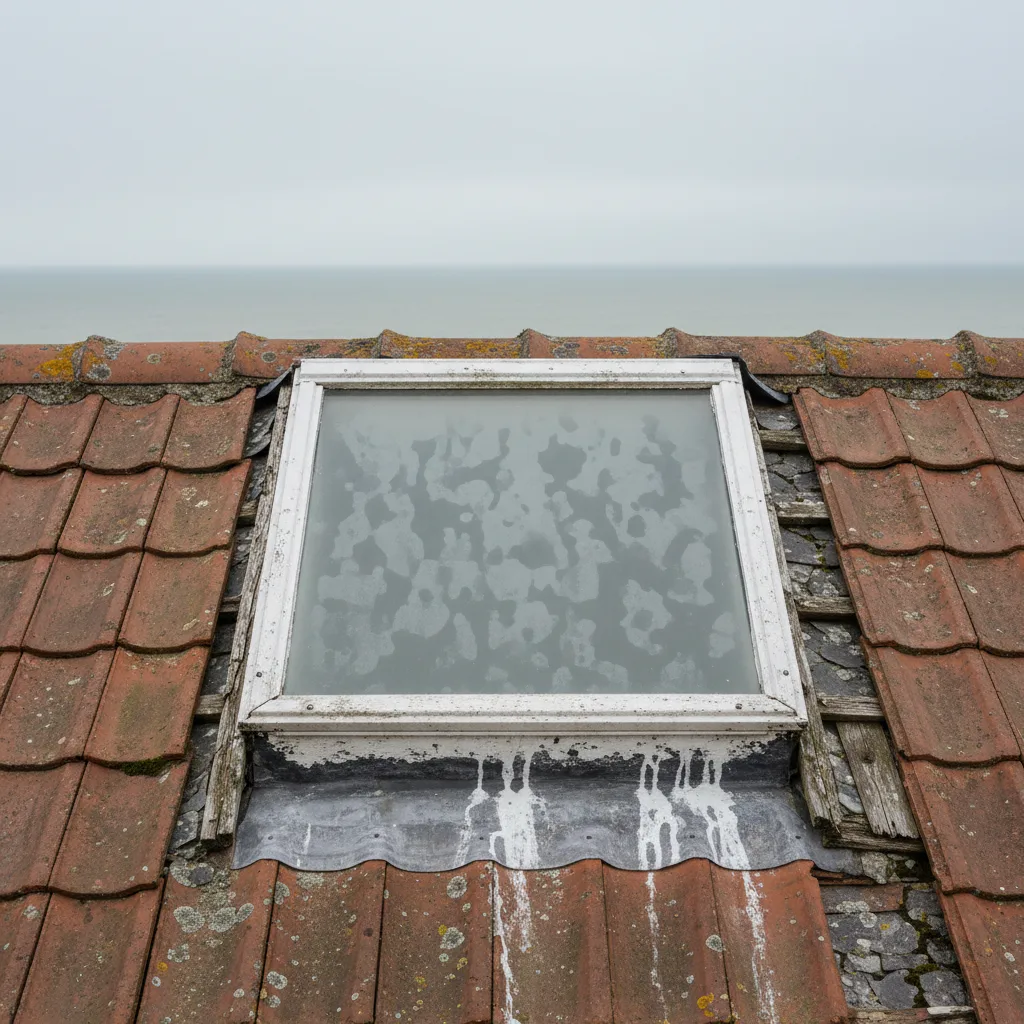
Misting between the panes is unambiguous. The sealed unit has failed, the cavity is breathing, and moisture is condensing inside the glass where nobody can reach it. It does not recover and it cannot be cleaned. It is worse in sun because the trapped air expands and pumps more moist air in as it cools.
A damp patch that appears during and after rain is a genuine water path, and it is almost never the glass. It is the flashing on a pitched roof or the kerb termination on a flat one.
A damp patch that appears in cold dry weather, and is worst on a frosty morning, is condensation inside the roof build up. Warm moist room air is getting past the vapour control layer, meeting a cold surface and condensing in the insulation. Replacing the rooflight fixes nothing at all, and we have been called to correct that mistake made by somebody else more than once.
Rain leaks follow rain. Condensation follows cold. It is the first question we ask on the phone.
| What you see | When it happens | Most likely cause | What it needs |
|---|---|---|---|
| Misting between the panes | Any time, worse in sun | The sealed unit has failed and the cavity is breathing | A new sealed unit, or a whole unit if the frame has gone too |
| Damp patch on the ceiling | During and after rain | A genuine water path, usually the flashing or the kerb termination | The weathering detail corrected, not the glass replaced |
| Damp patch on the ceiling | Cold dry weather, worst in the morning | Warm moist air reaching a cold surface. The vapour control layer is not sealed to the frame | The build-up corrected at the kerb. New glass will not touch it |
| Water running down the inside of the frame | Cold weather, in a kitchen or bathroom | Surface condensation on the frame itself | Ventilation, and a frame with a proper thermal break |
| Draught, or the unit will not close on to its seal | All year, worse in wind | Perished gaskets, or a frame that has moved with the opening | Replacement. A thirty year old frame is at the end of its life |
| Staining on the plaster reveal only | After driving rain from one direction | The underlay collar was never dressed to the frame | The kit re-detailed at the head and sides |
Most of what is reported as a leak is not one. The distinguishing question is nearly always the weather it happens in: rain leaks follow rain, condensation follows cold.
What a chalked frame is telling you
On the coastal strip the frame usually fails before the glass does, and it announces itself long in advance.
Powder coating is a polyester layer baked onto aluminium. Ultraviolet light and airborne salt break down the resin at the surface, the pigment is left loose, and the frame goes matt and pale. Run a finger down it and it comes away dusty. The colour has not faded: the surface has degraded.
Chalking is cosmetic in itself. What it tells you is that the unit was specified for inland exposure and has been sitting in salt air for years, which means the gaskets, the fixings and the seal are all further through their life than the calendar suggests. A chalked frame at Middleton-on-Sea or Rottingdean is a prompt to plan the replacement rather than an emergency.
Pane replacement or whole unit
Where the frame is genuinely sound, square and recent, a new sealed unit into the existing frame is the smaller job. It fixes the misting, it disturbs no weathering detail, and it is not normally notifiable.
It does nothing for the frame. The thermal break, the gaskets and the ironmongery stay exactly as old as they were, and on a unit much past twenty five years those are the next things to fail. A new pane in a tired frame is money spent twice within a few years.
Our rule of thumb is the frame’s age and condition rather than the glass. Under about fifteen years and sound, replace the pane. Over about twenty five, replace the unit. In between it depends on exposure, and on the coast the answer skews towards the whole unit.
Replacing into the same opening
Most replacements go back into the existing opening, which keeps the job to a day and avoids any structural work.
On a pitched roof that means stripping the covering back around the position, taking out the old frame and kit, setting the new frame, dressing in a new flashing kit matched to the covering, and putting the covering back. On a slate or Sussex peg tile roof we salvage and re-lay what comes off rather than substituting new material, because new slate against weathered slate is visible from the street for years and a hand made peg tile is not replaceable from stock.
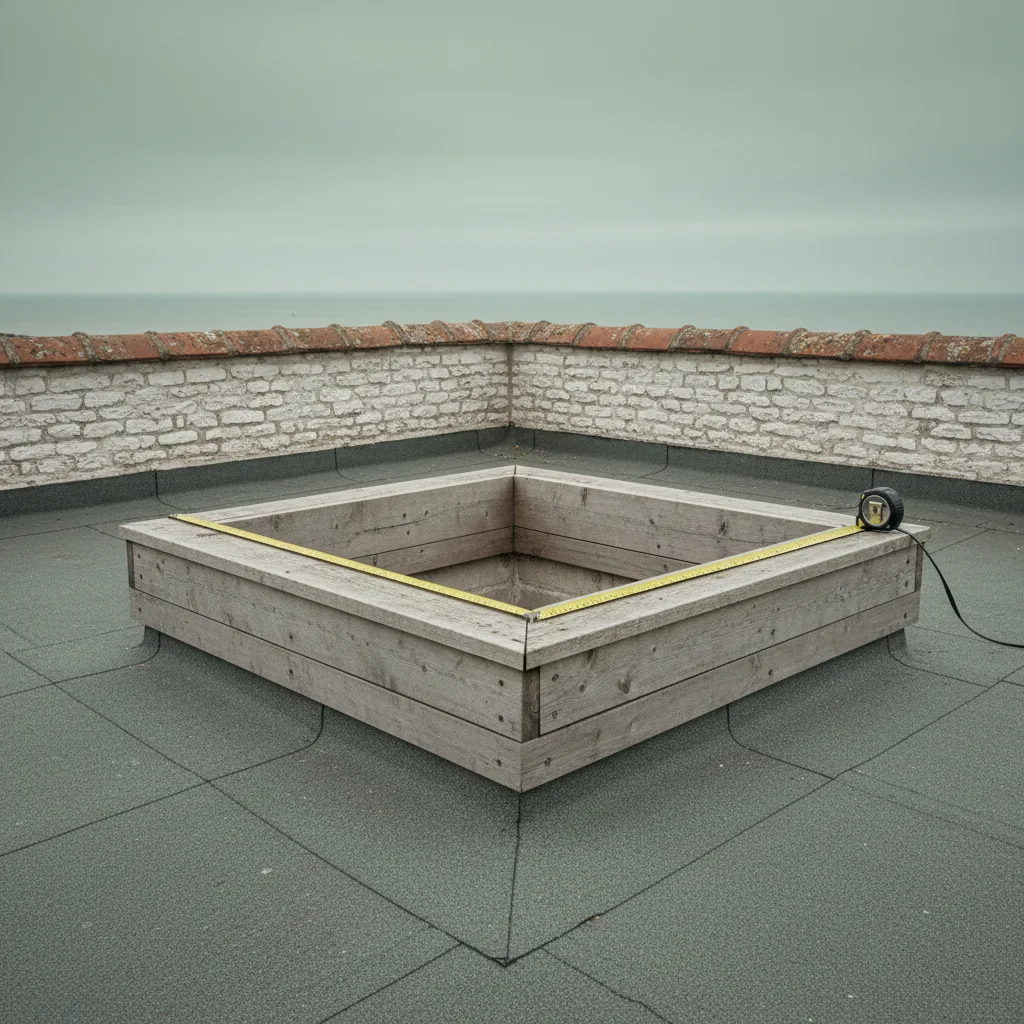
On a flat roof the unit lifts off the kerb, the kerb is inspected, and the new unit goes back down onto it. That inspection is the part that decides the job, which is why we will not price a flat roof replacement over the phone.
What we find when the old one comes out
A unit that has been failing for years has usually been letting a little water past for some of them. The timber around the opening is where that shows: the trimmer, the head of the opening, and on a flat roof the top of the kerb.
Soft timber has to be replaced. It is not optional and it is not visible until the unit is off.
We flag it at quotation as a possibility, with an indication of what it would add, wherever the risk looks higher than usual: an old unit, a known leak, a coastal roof, or any sign of staining on the reveal inside. Saying it in advance is the whole point. Discovering it on the day and presenting a bill is how this trade earns its reputation.

Replacing a dome with glass
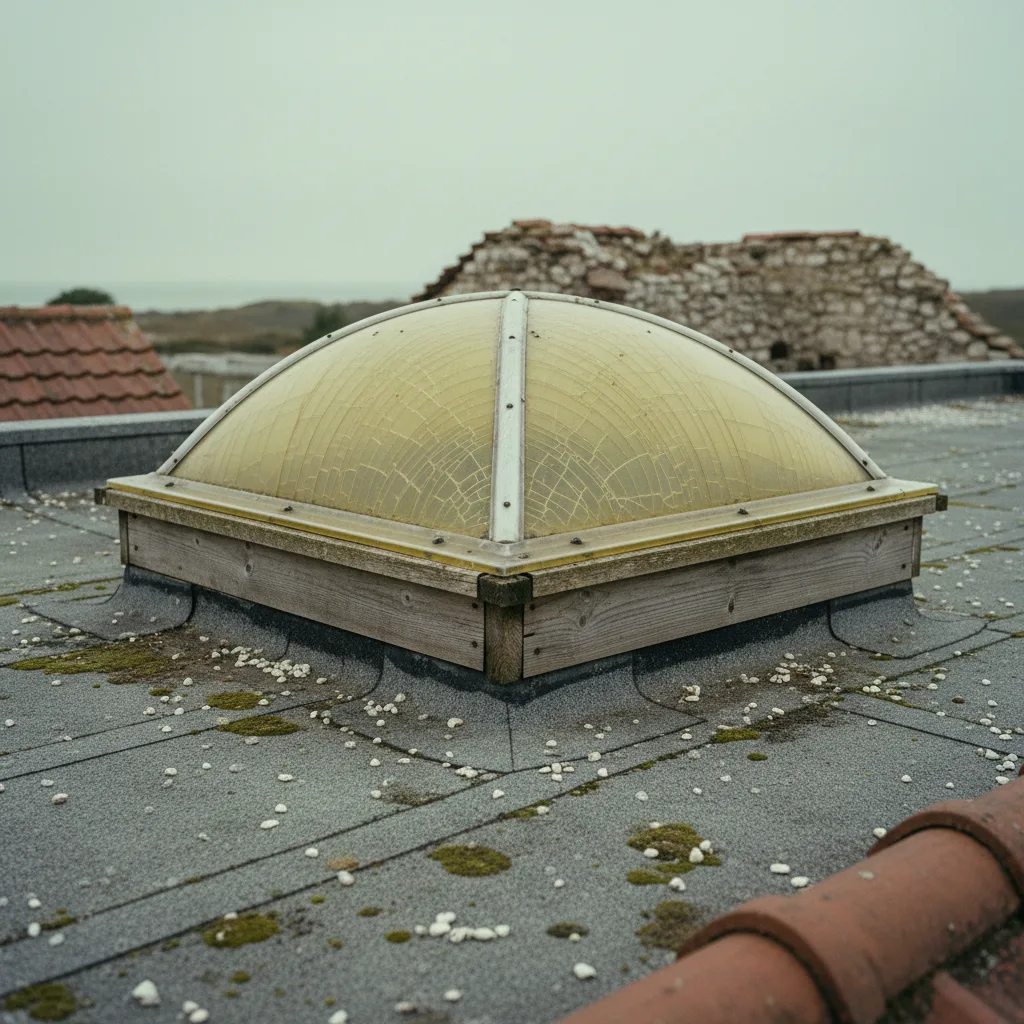
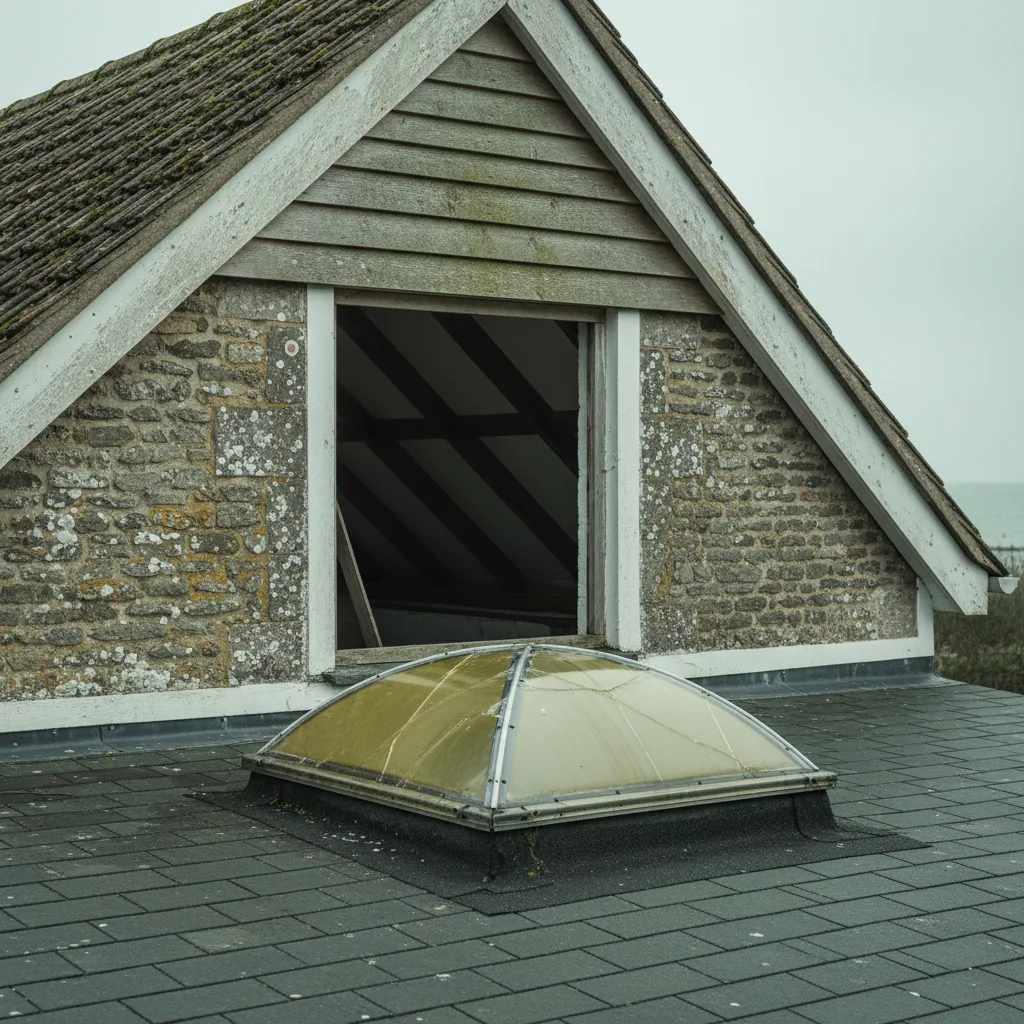
A great many flat roofs in this area carry a polycarbonate dome from the seventies or eighties. They diffuse rather than transmit, so there is no view through them, they yellow and craze with age, they are noisy in rain, and thermally they are poor.
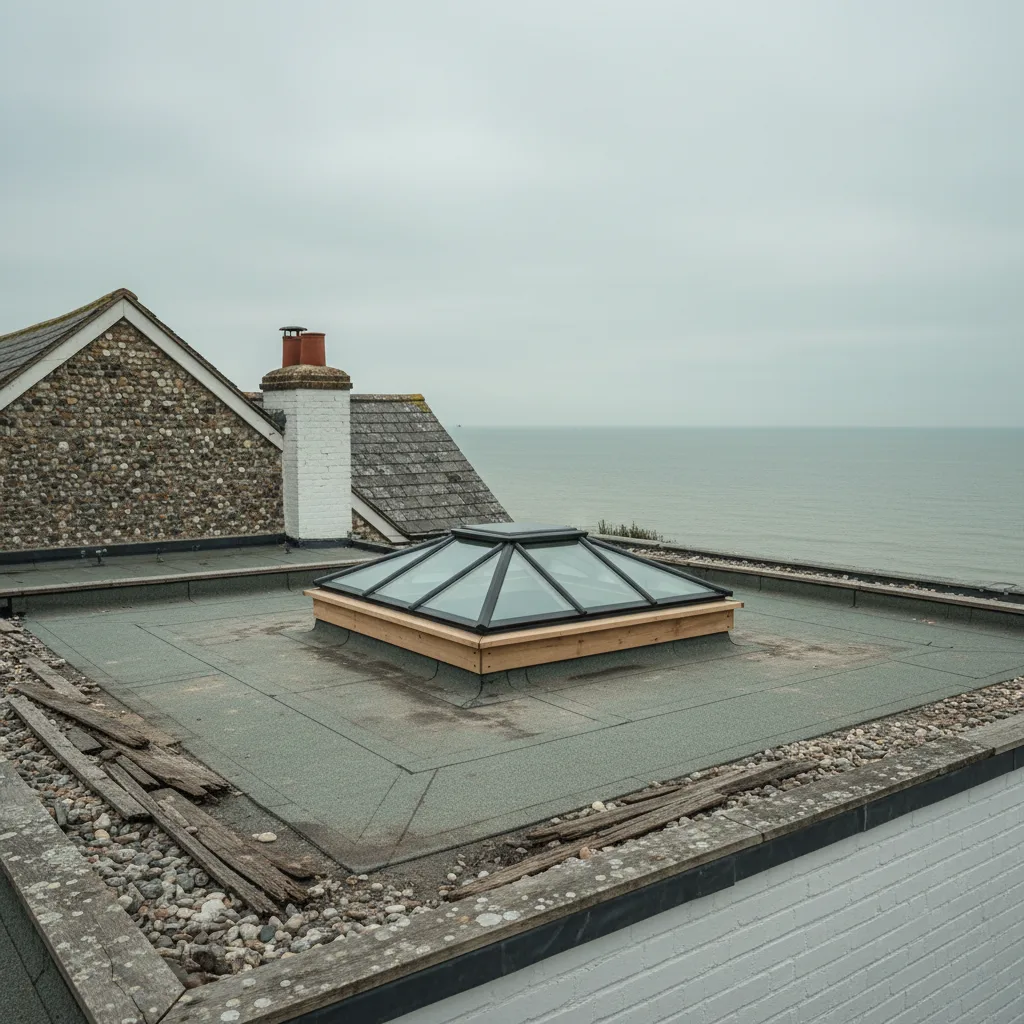
A flush glazed unit will normally go onto the same kerb, provided the kerb is sound and square, and the improvement is dramatic: a clear view of the sky, a fraction of the heat loss, and a roof that looks deliberate rather than patched.
The kerb is the question. A kerb built for a dome in 1978 is often too low, frequently out of square, and sometimes not insulated at all. Where that is the case the honest answer is to rebuild the kerb as part of the job rather than fit a good unit to a bad upstand.
Matching an obsolete size
Roof window sizes have been reasonably stable for decades, and a size code from the eighties can usually still be matched. Flat roof rooflights are less standardised, and an older unit is frequently a size nobody makes.
The options are the nearest standard size with the opening adjusted, a made to measure unit at more cost and a longer lead time, or reframing the opening to a standard size, which is often right when the timber needs attention anyway. We set out which applies and why, rather than presenting one as the only possibility.
If you are replacing a roof window, a photograph of the data plate on the sash usually gets you a price without anyone visiting.
Thermal improvement you can actually expect
An old double glazed unit with an aluminium spacer and no coating is likely above 3.0 W/m2K. A single skin dome is worse than that. A current unit with a low emissivity coating, argon and a warm edge spacer lands around 1.2 to 1.4 as a whole unit.
That is a genuine difference you will feel under the rooflight in winter, and it is one of the few replacements in a house where the comfort improvement is immediate and obvious rather than theoretical.
Building Regulations on a replacement
Replacing a rooflight into the same opening is not normally notifiable. The unit still has to meet the limiting thermal standard, which any current product does comfortably.
Enlarging the opening, or forming a new one, is notifiable. Where that applies we notify and the completion certificate comes to you.
In a conservation area or inside the South Downs National Park, replacing like for like is usually straightforward, and changing the appearance is not. Swapping a slim conservation unit for a standard one that stands proud will attract attention, and we check before ordering rather than after fitting.
Working around you
Most replacements are a day. The roof is never left open overnight: if the job cannot be finished, it is made watertight before we leave.
Inside, the area below is sheeted and the reveal is made good, though redecoration is yours rather than ours and we will say so up front rather than leaving it ambiguous on the quotation.
Resealing, and why it rarely works
The instinct when a rooflight leaks is to seal around it, and there is almost always somebody willing to do that cheaply.
It works when the leak is genuinely at a joint that sealant is designed to close, which is uncommon. It fails when the water is getting in behind the covering, under a flashing or past an underlay collar, because sealant applied on top of a failed detail traps water rather than excluding it. The leak stops for a season and returns worse, with the timber underneath wetter than it was.
We would rather replace a detail than seal over one, and where somebody has already sealed over it we take that off and look at what is underneath before quoting.
Asbestos in older surrounds
On some pre-1990 flat roofs, particularly on garages, outbuildings and a few 1960s and 1970s extensions across the estates, the rooflight surround or the roof sheet itself may contain asbestos cement.
It is not dangerous left alone and it is not something to break up. Where we suspect it we stop, say so, and it is sampled and dealt with by a licensed contractor before any rooflight work happens. It is rare, it is not a reason for alarm, and it is absolutely a reason not to let anyone cut into it with an angle grinder.

Timing a replacement
A misted unit is an inconvenience rather than an emergency, and a replacement can wait for reasonable weather.
A leaking one should not wait, because water in a roof build up does its damage slowly and continuously, and the difference between a leak dealt with in March and the same leak dealt with in September is frequently the difference between a new unit and a new unit plus timber repairs.
On the coast the sensible pattern is to plan replacement when the frame starts chalking rather than when the seal fails, because at that point you are choosing the date instead of the weather choosing it for you.
How we price it
Send a photograph of the unit from inside, one from outside if you can get one safely, and the data plate if it is a roof window. That is usually enough for an indicative range the same day, free.
Then a survey, and a fixed written price itemised so the unit, the labour, any scaffold and any Building Control fee are separately visible. Where decayed timber is a real possibility it is named at that point with a figure attached, so the worst case is known before you commit.
In this section
Asbestos in older rooflight or skylight surrounds, and what to do about it
Read moreCan a dome rooflight or skylight be replaced with glass?
Read moreCan a leaking rooflight or skylight be resealed?
Read moreCan a misted rooflight or skylight be repaired?
Read moreCan a rooflight or skylight be replaced in the same opening?
Read moreCan just the glass be replaced?
Read moreCan you replace a rooflight or skylight in winter?
Read moreCan you replace a rooflight or skylight without scaffolding?
Read moreChalked powder coat, and what it tells you about the rest of the unit
Read moreDecayed timber found on opening up, flagged rather than sprung
Read moreDo I have to replace like for like?
Read moreDoes replacing a rooflight or skylight need building regulations?
Read moreDoes replacing a rooflight or skylight need planning permission?
Read moreHow do I know if my rooflight or skylight has failed?
Read moreHow long do rooflights and skylights last?
Read moreHow long does a rooflight replacement take?
Read moreHow much does it cost to replace a rooflight?
Read moreIs it condensation or a leak?
Read moreMatching an obsolete size without disturbing the covering
Read morePane replacement against whole unit replacement
Read morePerished gaskets on a thirty year old unit
Read moreRain leaks follow rain, condensation follows cold
Read moreReading the symptom before ordering anything
Read moreReplacing a dome with a flush glazed unit on the same kerb
Read moreReplacing a rooflight or skylight on a Regency parapet roof in Brighton
Read moreSalt damage to a coastal frame, and when the frame is finished
Read moreThermal performance you gain from a like for like replacement
Read moreWhat happens if the timber underneath has rotted?
Read moreWhy has my rooflight frame gone chalky?
Read moreWhy is my rooflight or skylight misted up?
Read moreWhy is water coming in around my rooflight?
Read moreWill a new rooflight or skylight be warmer?
Read moreThinking about this job? We survey across Worthing, West Sussex and the South Downs and give you a fixed price before any work starts, with a 10-year workmanship guarantee.