Chalked powder coat, and what it tells you about the rest of the unit
A chalked frame is the most visible thing about an ageing rooflight and the least important in itself. Its value is as evidence: it is a record of how much ultraviolet and salt that unit has taken, and everything else on the unit has taken the same.
What chalking is chemically, and what coating specification resists it, are on the coating life page. This one is about reading it.
The coating as a dosimeter
The useful way to think about a chalked frame is as an exposure meter that has been running since installation.
Ultraviolet degrades the coating at a rate set by how much arrives. Salt accelerates it. Heat accelerates it. So the degree of chalking is an integrated record of the ultraviolet, salt and temperature that surface has seen.
Every other component on that unit has been sitting in the same conditions for the same period. Which means the coating is telling you about the gaskets, the seals, the fixings and the mechanism, and it is the only one of those you can read from the ground.
What chalking predicts
| Component | Same exposure means | Check |
|---|---|---|
| Gaskets | Ultraviolet has hardened them too | Press one. Does it give, or is it rigid? |
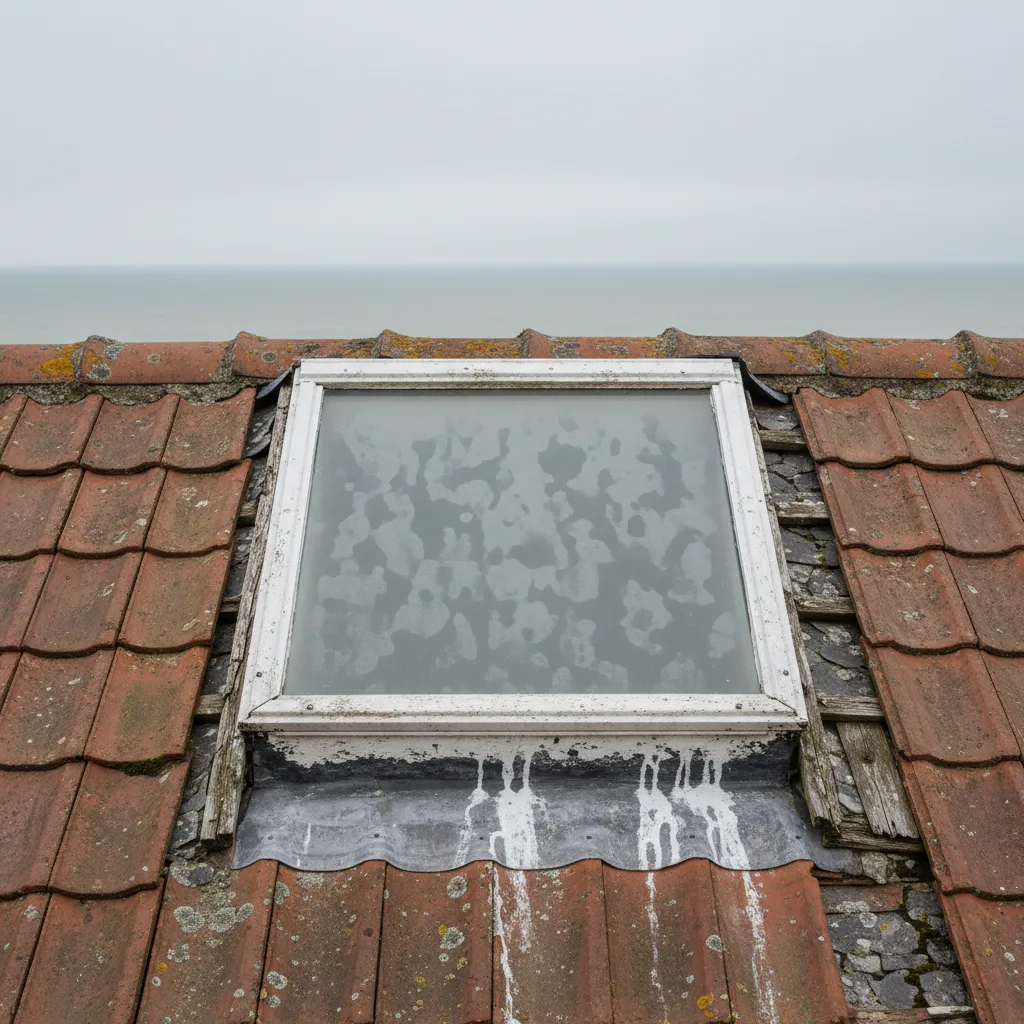
| Sealed unit edge seal | Same years of thermal cycling | Any misting between the panes? |
| Fixings | Same salt exposure at every breach | Staining running from any fixing head? |
| Mechanism | Same salt in every clearance | Operate it fully. Is it stiff? |
| Flashing or trim | Horizontal, so worse than the frame | Look for lifting or corrosion at the head |
| Timber below | Not exposure. Water, if any got past | Different question, needs opening up |
Reading the pattern, not just the presence
Where the chalking is tells you as much as how much there is.
Even chalking across the whole frame is straightforward age and exposure. It says the unit is old and it says nothing surprising.
Chalking concentrated on one elevation of the frame, or worse on the south facing side, is normal too: that face takes more ultraviolet. Worse on the horizontal surfaces than the vertical ones is also normal, because they take more and hold water.
What is worth attention is chalking that is dramatically worse in one small area, or breaks in the coating rather than fading. That is not exposure, it is damage, and damage is where corrosion starts.
Fading against chalking
Two different things that get conflated, and the distinction is useful.
Fading is loss of colour: the pigment itself degrading under ultraviolet. The surface may still be intact and glossy.
Chalking is loss of binder: the polymer breaking down and releasing pigment as a loose powder. The finger test separates them, and chalking is the more advanced condition because the film itself is going rather than just its colour.
A frame that has faded but not chalked has a coating still doing its protective job. A frame that chalks off on a finger has a film that is thinning.
What it does not tell you
Two important limits, because chalking gets over-interpreted in both directions.
It says nothing about the structural condition of the aluminium underneath. A heavily chalked frame is usually structurally sound, because the metal corrodes at breaches rather than under an intact if degraded film.
And it says nothing about the installation. Whether there is an underlay collar, whether the insulation reaches the frame, whether the vapour control layer was sealed: none of that is affected by ultraviolet and none of it is visible from a coating.
The age it implies
Chalking is a rough clock and it runs at very different speeds in different positions.
Inland, on a standard architectural coating, visible chalking suggests a unit of some age, and the frame will still outlast the sealed unit. On the seafront the same appearance can arrive in a handful of years, particularly on a dark colour on a horizontal surface.
Which means chalking dates a unit only when you know the position. On a Goring seafront property it might mean ten years; at Storrington it might mean twenty five.
Why dark frames chalk sooner
Worth knowing because almost every frame we specify is dark.
A dark colour absorbs more solar energy, so the frame runs hotter in sun, and heat accelerates the ultraviolet degradation of the film. A dark frame in the same position therefore chalks earlier than a pale one.
Against that, chalking shows up far more obviously on a dark colour, because the powdery residue is pale. So a dark frame both chalks sooner and looks worse when it does, which is why the coating specification matters most on exactly the frames we recommend for appearance and for conservation reasons.
The three things to check the same day
Where a chalked frame prompts a call, three checks take five minutes and are worth doing before anything else.
- Press a gasket. A serviceable gasket gives under a thumb and springs back. A hardened one is rigid and may be cracked at a corner.
- Operate the unit fully. Both directions, listening. Stiffness or a change in note is the mechanism reporting the same exposure.
- Look for staining below any fixing. A brown or white run from a fixing head is corrosion at a coating breach, and it is the finding that matters most.
Those three convert a cosmetic observation into an assessment.
Where chalking is misleading
Two situations produce chalking that does not mean what it usually means.
A frame that has been repainted at some point may have a chalking new coating over a sound original one, which reads as worse than it is. The tell is a coating that looks a slightly different colour in a shadow line or at an edge.
And a frame with a marine grade coating on a seafront property may show very little chalking at twenty years, which is the specification working. That is not evidence the rest of the unit is young, because the gaskets and the fixings had no such upgrade.
Which is a caution about the whole method: it reads across best where the components have comparable specifications.

What to do about the appearance
Where the assessment says the unit has life in it and the frame simply looks tired, repainting in place is available.
Properly done it means degreasing, removing the loose chalk completely, and applying a system suited to aluminium. Poorly done, over a chalked surface without preparation, the new paint sits on loose powder and fails quickly.
It is a cosmetic remedy rather than a return to the original specification, it means working at height, and where a unit is otherwise near the end of its life it is rarely the better spend.
Where it says replace
Chalking alone never says replace. The combination it appears in does.
A chalked frame plus hardened gaskets plus a stiff mechanism plus staining at the fixings is a unit where every component has aged together and each individual repair is a fraction of a replacement that solves all of them.
Add a misted sealed unit to that list and the arithmetic is clear, because the glass is the expensive part and it has gone.
Where it says service
Equally, chalking plus sound gaskets plus a free mechanism plus clean fixings is a unit that looks old and is not.
That is a frame to repaint or to live with, and the money is better spent on the installation details the unit almost certainly lacks: the collars, the insulation to the frame, the vapour seal.
We say so when we find it, because the visible thing is the coating and the valuable thing is not.
What it tells you about the next unit
The most useful thing about a chalked frame is what it says about what to specify to replace it.
The degree of chalking, and how long it took, is a direct measurement of the exposure at that position. Where a standard coating has chalked heavily in twelve years, that position needs a marine grade coating and A4 stainless throughout, and the measurement rather than the mileage from the sea is the evidence.
It is the one situation where a failed component tells you exactly how to specify its successor.
The neighbours as a control
On an estate or a terrace where several houses had the same work done at the same time, the street is a dataset.
Rooflights fitted across a development in the same year, in the same product, sitting at different orientations and different degrees of shelter, will have chalked to visibly different extents. Walking the road and looking is genuinely informative about what the position does.
It also tells you something useful about your own: a frame noticeably worse than the same units three doors down has either a different orientation, a different coating specification, or damage. All three are worth knowing.
Recording it
A photograph of the frame, dated, is worth taking whether or not anything is done now.
Chalking progresses, and the useful question in five years is not whether it is chalked but whether it has got worse and how fast. On a property with several units it also shows which is deteriorating quickest and therefore which to deal with first.
It costs a minute and it converts an impression into a trend.
Anodised and timber frames read differently
The method above assumes a powder coated aluminium frame, which most rooflights are. Two other finishes give different evidence.
An anodised frame does not chalk, because the finish is an oxide layer grown out of the metal rather than a polymer applied to it. It weathers by very slow surface change instead. Which means an anodised frame carries no exposure record at all, and the assessment has to be made from the gaskets and the fixings directly.
A timber frame records exposure differently again: the finish weathers and breaks down, and where it has gone the timber greys and eventually softens. That is a moisture record rather than an ultraviolet one, and it reads across to decay rather than to corrosion. The principle survives; the thing being read is not the same.
The rinse, which slows it
Salt accelerates the degradation and salt is removable, which means the rate is partly within an owner’s control.
A fresh water rinse over the frame twice a year removes the deposit and the moisture it holds, so the film spends less of its life wet. It will not undo chalking that has happened and it slows what happens next.
What it must not involve is abrasive cleaning, which removes coating directly, or aggressive chemicals, which attack it. Fresh water and a soft cloth.
How we treat it on a replacement
We treat a chalked frame as evidence rather than as a fault, and we check the gaskets, the mechanism and the fixings on the same visit because they have taken the same exposure. We say when a unit looks old and is not, and we use the rate of chalking to specify the coating and the fixings on whatever replaces it.
Where somebody has called about a chalked frame and everything else on the unit checks out, we will say the frame is cosmetic and quote nothing, because that is the honest answer and a customer who gets it once tends to call again when there is something real.
The coating is the only part of an ageing rooflight you can read from the ground. It is worth reading properly.
Thinking about this job? We survey across Worthing, West Sussex and the South Downs and give you a fixed price before any work starts, with a 10-year workmanship guarantee.