Roof Lantern Installation
- Fixed quote before we start
- Roof never left open overnight
- 10-year workmanship guarantee
- Fixed quote before we start
- 10 years workmanship guarantee
- 25 years fitting rooflights
- Skylights only, not a general roofer
Roof lantern installation in Worthing and West Sussex
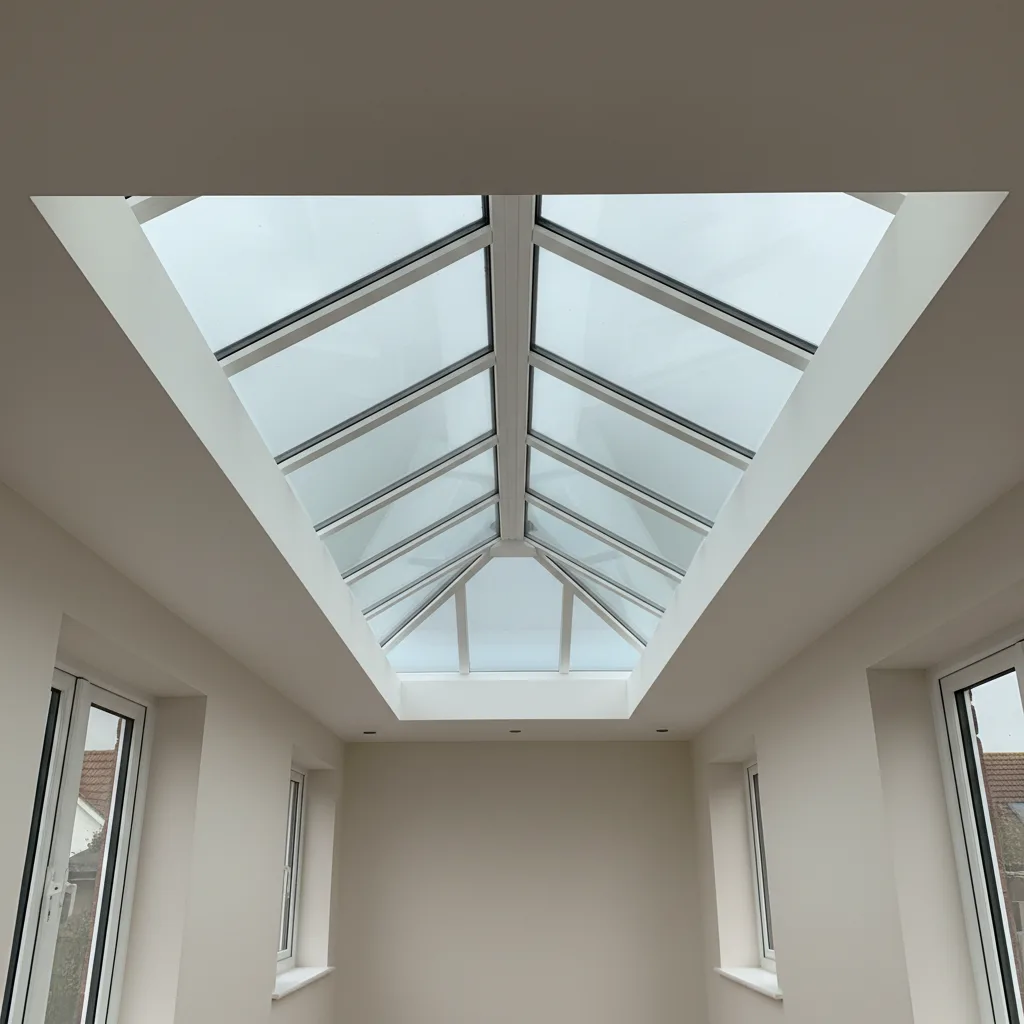
A roof lantern is a pitched glazed structure standing on a kerb above a flat roof. It is not a flat rooflight with a hat on. The pitch is doing work: it catches light from four directions rather than one, it sheds water and dirt by gravity rather than waiting for rain to move them, and it gives a room real height above the ceiling line where a flat unit gives none.
That makes it the right answer over a kitchen extension or a main living space, and the wrong answer over a utility room, a cloakroom or a corridor. A lantern over a room nobody sits in is money spent on the wrong room, and we will say so.
Where a lantern earns its place around here
The rear extension is the standard improvement across every post-war estate in this radius, from Durrington and Rustington to Southwater and Burgess Hill. Most of those extensions have a flat roof, and most of those flat roofs are large enough to take a lantern without crowding the plane.
The older stock behaves differently. A Victorian terrace in Heene or Hove usually has a narrow back addition with a small flat roof over it, and a lantern there has to be modest or it reads as a conservatory bolted to the roof. On the Downs villages the question is rarely proportion at all, it is whether the National Park Authority will accept a raised glazed structure on a visible roof, and frequently the answer is no.
Getting the proportion right
A lantern needs roof around it. It is a form that rises from a plane, and if it occupies most of that plane it stops reading as a lantern and starts reading as a glass roof with a border.
As a working guide, leave a clear margin of roof on every side, generous enough to be obviously deliberate rather than whatever was left over once the unit was ordered. Rectangular proportions generally sit better than square, because a square lantern on a rectangular room fights the room it is lighting.
Position matters more than size. Centred on the roof, a lantern lights the floor. Centred on what the room is actually for, over an island or a table, it lights the thing you use. Those are rarely the same point, and the difference is decided at survey, not on site.
Where the roof is wide, two smaller lanterns often beat one large one: less structure, a more even spread of light, and no single span demanding a steel.
| Decision | The working guide | Why it matters |
|---|---|---|
| Margin of roof around the kerb | A clear, obviously deliberate margin on every side | Too little and it reads as a mistake rather than a choice |
| Plan shape | Rectangular generally sits better than square | A square lantern on a rectangular room fights the room |
| Pitch | Enough to shed water and dirt without dominating the roofline | Too shallow and it holds dirt; too steep and it is visible from the street |
| Position over the room | Centred on what the room is for, not on the roof | Over an island or a table it lights the thing you use. Centred on the roof it lights the floor |
| Number of units | Two smaller ones often beat one large one | Smaller units need less structure and give a more even spread |
| Glass | Solar control on south and west | Overhead glass takes more solar energy than any other glass in the building |
A lantern needs roof around it. It is a form that rises from a plane, and if it occupies most of that plane it stops reading as a lantern and starts reading as a glass roof with a border.

The kerb decides the job
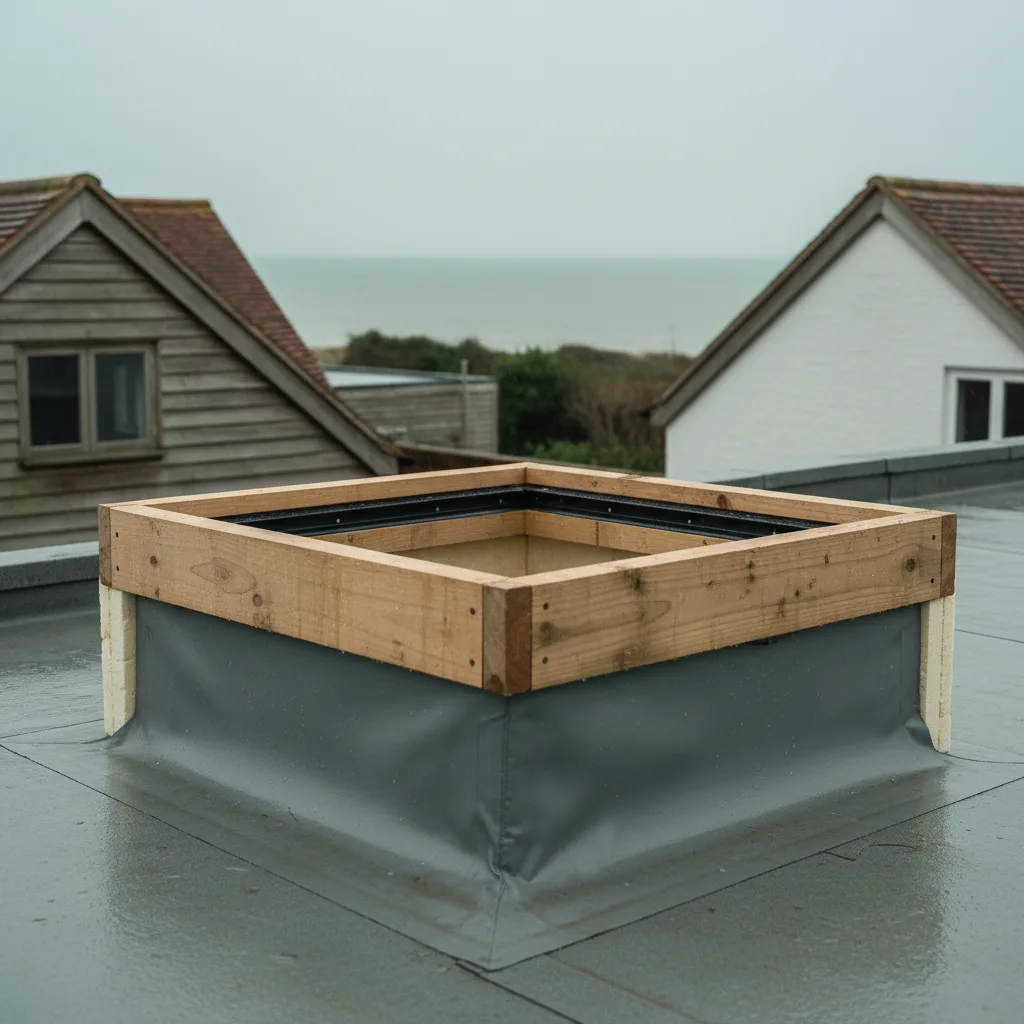
Every lantern sits on a timber upstand, and the upstand is where lantern jobs succeed or fail.
It has to be square within a few millimetres across the diagonals, because a made to size lantern will not sit down on a kerb that is out of square and it cannot be packed straight afterwards. It has to be level along its top even though the roof beneath it falls, or the frame is twisted and the seals are loaded unevenly from the day it goes on. It wants to stand about 150mm above the finished surface at the lowest point of the fall, so water arriving at the kerb has somewhere to go before it reaches the termination. It has to be insulated on its outer face, continuous with the roof insulation, or there is a cold bridge at the frame and the inside of it runs with condensation every winter.
And the vapour control layer has to be carried up the kerb and sealed to the frame. Where it is not, warm moist air from the room gets into the build up and condenses inside the insulation, which shows on the ceiling as a damp patch and gets reported as a leak.
On most jobs the kerb is built by whoever builds the flat roof, and that is frequently not the company supplying the lantern. That split is the single most common reason a lantern job goes wrong. We measure the kerb before the unit is ordered, whoever built it.
Aluminium, timber, and what the coast does to both
Most lanterns sold today are powder coated aluminium, because aluminium carries the load in a slimmer section than timber and gives thinner sightlines for the same span. Timber, or timber with an aluminium capping, is still the easier product to get accepted in a conservation setting and reads better on a period building.
Within about a mile of the water the material matters far less than the finish. A standard architectural powder coat is warranted for inland exposure. On a seafront at Goring, Ferring, Middleton-on-Sea or Rottingdean it chalks within three or four years: the resin at the surface breaks down under ultraviolet and salt, the pigment is left loose, and the frame goes matt and pale. It has not faded. The surface has degraded, and there is no repair short of recoating.
A marine grade coating is a thicker system with a different pre-treatment, and it does not do that. It costs a little more at order. Specify it once and the question never comes up again.
Fixings want to be stainless rather than plated for the same reason, and that includes the fixings holding the flashing and the kerb straps, not only the visible ones. Plated fixings corrode from the shank outwards, inside the timber, where nobody can see them.
Glass, and the decision people regret
A lantern is a large area of overhead glass, and overhead glass takes more solar energy than any other glass in a building because in summer the sun is high and strikes it nearly square on.
A great many rear extensions on this coast face south, towards the sea. A south or west facing lantern in clear double glazing is a greenhouse from about eleven in the morning, and the only remedy afterwards is replacing the glass, which means dismantling the unit.
Solar control glass cuts the solar energy roughly in half while keeping the light. It is the specification most often dropped to save money at order and by a wide margin the one most often regretted. On a north facing roof the opposite holds: there is no gain to control, north light is the best light in the building, and solar control there just makes a good room darker.
Where rain noise carries, an acoustic laminate in the outer pane is worth asking about. A lantern has more glass area and more pitch than a flat unit, so it is louder in heavy rain, and on an exposed site that is worth planning for rather than discovering.

Ventilation, and whether a lantern should open
Most lanterns are fixed, and most of the time that is right: the room is ventilated by its doors and windows, and an opening pane in a pitched glazed structure is a seal that has to work harder than a fixed one for a benefit nobody uses.
There are two cases where it earns its place. A kitchen producing steam and cooking smells wants purge ventilation, and an opening vent at the highest point of the room removes them faster than any extractor sited on a wall. And a room that overheats despite solar control glass benefits from letting hot air out at the top rather than trying to cool it at the bottom.
If it opens, it opens electrically. Nothing at lantern height is within reach of a pole, and a chain actuator with a rain sensor closes itself when the weather turns. The cable route has to exist before the ceiling closes, which makes it a decision at survey rather than an afterthought.

Living with one
A lantern sheds dirt better than a flat unit because it has pitch, but it does not clean itself. On an exposed coastal site salt film builds on the outer glass and dulls the light noticeably within a year, and a rinse with clean water two or three times a year keeps it clear. A self cleaning outer pane helps where the glass cannot be reached safely, though it needs a reasonable pitch to work and does very little on anything shallower than about ten degrees.
If it opens, the gaskets want the same rinse. Salt crystals are abrasive, they collect in the gasket channel, and every closure grinds them into the seal. Five minutes a couple of times a year roughly doubles the working life of the seal, and almost nobody is ever told to do it.

Structure, and when a steel is unavoidable
A lantern imposes its load on the kerb, and the kerb imposes it on whatever the flat roof is built from. Over a modest span with joists in reasonable condition that is straightforward. Over a wide opening, or where a previous extension has already removed a supporting wall, the roof may need a designed steel to carry the new opening.
Where that is likely we say so at survey and involve a structural engineer before quoting, because a steel is frequently more than the lantern and it is not a line anyone should discover late. It is also a Building Regulations matter in its own right.
Planning, Building Control and the National Park
On an ordinary house, a lantern on a rear flat roof is usually permitted development, because the rules that matter concern projection beyond the roof plane and height relative to the ridge, and a rear extension roof is normally well below both.
Inside the South Downs National Park the position is different. The Authority is the planning authority rather than your district council, the land is Article 2(3), and a raised glazed structure on a roof visible from a lane or a footpath is scrutinised in a way it is not in a suburb. We check before quoting.
Forming a new opening is notifiable under Building Regulations. We handle the notification and the completion certificate comes to you, which is the document a buyer’s solicitor will ask for.

How we price a lantern
An indicative range by email from a description and a photograph, free and usually the same day. Then a survey, also free, which looks at the roof build up, the kerb if one exists, the fall, the structure, the access and what sits in the ceiling below.
Then a fixed written price, itemised so the unit, the labour, the scaffold and the Building Control fee are all visible separately. It does not move afterwards.
What we will not do is price a lantern over the phone. The kerb decides the job, and a price given without seeing it is a guess with a number attached.
In this section
Are roof lanterns worth it?
Read moreBuilding a kerb that will take a lantern on a Sussex flat roof
Read moreCan a roof lantern be opened?
Read moreCan a roof lantern go on a pitched roof?
Read moreCan two lanterns go over one extension?
Read moreCan you fit a roof lantern in winter?
Read moreCan you put a roof lantern on a garage?
Read moreCondensation on a lantern, and what actually causes it
Read moreDo roof lanterns come with blinds?
Read moreDo roof lanterns leak?
Read moreDo roof lanterns need building regulations approval?
Read moreDo roof lanterns need cleaning?
Read moreDo roof lanterns need planning permission?
Read moreGlass specification for a lantern over a south facing kitchen
Read moreHow big can a roof lantern be?
Read moreHow long does a roof lantern take to fit?
Read moreHow much does a roof lantern cost?
Read moreHow much heat do you lose through a roof lantern?
Read moreLantern proportions on a narrow Victorian rear extension
Read moreMarine grade coatings against standard powder coat on a coastal lantern
Read moreRidge orientation, and why it changes the light in the room
Read moreRoof lanterns and wind loading on the Downs edge
Read moreRoof lanterns in a conservation area at Steyning or Arundel
Read moreStainless fixings and why plated ones fail within sight of the sea
Read moreStructural openings a lantern needs, and when a steel is unavoidable
Read moreThermal bridging where a lantern meets the kerb
Read moreWhat colour should a roof lantern frame be?
Read moreWhat decides the size of a roof lantern
Read moreWhat is a roof lantern?
Read moreWhat is the difference between a roof lantern and a skylight?
Read moreWhat pitch should a roof lantern be?
Read moreWill a roof lantern make the room too hot?
Read moreThinking about this job? We survey across Worthing, West Sussex and the South Downs and give you a fixed price before any work starts, with a 10-year workmanship guarantee.