Stainless fixings and why plated ones fail within sight of the sea
A fixing is the cheapest component on a rooflight and the one that decides whether the installation is still sound in twenty years. On this coast the specification is stainless, and the reason is worth setting out properly rather than asserting.
What salt air actually does
Air arriving off the Channel carries sea salt as a fine aerosol. It settles on every surface it reaches, and unlike dust it does not blow away, because it is hygroscopic: it draws moisture out of the air and holds it against the surface as a damp salty film.
Two consequences follow, and both matter.
- Metal surfaces stay wet for far longer than the weather alone would suggest, including on dry days.
- The film is an electrolyte, which means it will carry a current between two dissimilar metals in contact.
Corrosion needs moisture and an electrolyte. Salt air supplies both, continuously, for the life of the building.
How a plated fixing fails
A zinc plated screw is a steel screw with a thin sacrificial zinc coating. The zinc corrodes in preference to the steel, which protects the steel for as long as the zinc lasts.
Inland that is decades. In salt air it is a small number of years, because the salt film accelerates the loss of the zinc considerably. Once the zinc is gone the steel is exposed, and steel in a permanently damp salty environment rusts quickly.
What that looks like on a roof
First a brown stain running from the fixing head down the frame or the covering, which is the zinc gone and the steel starting. Then swelling at the head, because rust occupies more volume than the steel it came from. Then a head that shears when anyone tries to remove it, which is the point at which a simple job becomes a difficult one.
Why the timescale is misleading
Nothing goes wrong in the first few years, which is precisely what makes it a bad economy. The failure arrives after the installer has gone and long after anybody connects it to a decision made at ordering.
Galvanic corrosion, the second mechanism
The first mechanism is the coating wearing out. The second is more aggressive and it is specific to rooflights, because a rooflight frame is usually aluminium.
Put two different metals in electrical contact with an electrolyte between them and you have made a battery. Current flows, and the less noble of the two metals corrodes preferentially. The further apart the two metals sit on the galvanic series, the faster it happens.
Aluminium and steel are far enough apart for this to matter. Aluminium and stainless steel are closer, and the reaction is correspondingly slower.
Which metal loses
Against a steel fixing, the aluminium frame is the one that corrodes. That is the part that is expensive to replace, and the damage shows as white powdery pitting spreading out from the fixing rather than as rust.
How it is controlled
By choosing metals that sit close together on the series, by isolating them with a washer or a sleeve where they must differ, and by keeping the joint out of standing water so there is less electrolyte to work with.
A2 and A4, and why the distinction matters here
Stainless steel is not one material. The two grades that turn up on a domestic roof are A2 and A4.
| Grade | Also called | Resists | Where we use it |
|---|---|---|---|
| Zinc plated steel | BZP | Ordinary damp | Internal work only |
| A2 stainless | 304 | Weather, general corrosion | Inland sites away from the coast |
| A4 stainless | 316, marine grade | Chlorides, salt air | The coastal strip, and anywhere exposed to the Channel |
The difference between A2 and A4 is molybdenum, which is what gives A4 its resistance to chloride attack specifically. Salt is a chloride. That is the entire reason A4 is the marine grade and A2 is not.
A2 in a salt environment does not fail like a plated screw. It pits, in small deep points rather than general rusting, and pitting is harder to see and more damaging structurally than surface rust.
How far inland does this apply
This is the question we are asked most, and the honest answer is that it is not a line on a map.
Salt aerosol carries inland on the prevailing wind, and on this coast the prevailing wind is a south westerly straight off the water. It reaches further on exposed open ground and far less far where there is a town, a belt of trees or rising ground in the way.
- On the seafront at Worthing, Goring, Littlehampton, Bognor or Rottingdean, A4 is not a discussion.
- A mile or two back, through Broadwater, Durrington, Rustington or Portslade, A4 is what we fit as standard and we would not do otherwise.
- Further inland at Storrington, Billingshurst or Cowfold, A2 is a reasonable specification.
- On the open scarp above the coastal plain, exposure can put a site back into the coastal category despite the distance, because nothing has slowed the wind.
We specify from the site rather than from the mileage, and where it is marginal we specify up. The difference in cost across a whole lantern is small.
It is not only the screws
A fixing specification that stops at the screws misses several components that fail the same way.
- Washers. A stainless screw through a plated washer has a plated component in the joint, which is where the corrosion starts.
- Brackets and cleats. Anything holding the frame down is in the same environment as the screws.
- Hinges and stays on an opening unit. These carry load and move, and a corroded hinge seizes rather than simply looking poor.
- Actuator mountings on an electric unit. Frequently the last thing anyone specifies and squarely in the weather.
- Trim fixings. Small, numerous, and the ones that stain a whole elevation when they go.
Isolation where metals must differ
Sometimes two dissimilar metals have to meet. Where they do, the joint is isolated rather than left in contact.
A nylon or fibre washer between the fixing head and the frame breaks the electrical path. A sleeve through the hole does the same for the shank. Neither is expensive and both are trivial to fit at installation.
The one place it cannot be done is where the fixing has to bite into the metal itself, which is why choosing compatible metals in the first place is the better answer.

Why the roof is worse than the walls
It is reasonable to ask why fixings on a roof need a higher specification than the ones holding the front door furniture on, when both are on the same house in the same air.
A roof takes the salt aerosol before anything else does, because it is the first surface the wind meets and nothing shelters it. It is also the surface that stays wet longest, because dew forms on it overnight even when it has not rained, and it dries last in the morning. And a rooflight fixing sits in a detail that holds a little water by design, at the junction between a frame and a covering.
Walls get rain washing down them, which removes salt. A horizontal or near horizontal surface collects it. That is the whole of the difference, and it is why the roof gets the marine specification and the front door does not.
Rinsing, and the only maintenance that matters
Salt accumulation is cumulative and it is reversible, which is an unusually cheerful fact in building maintenance.
Fresh water removes it. On a coastal property, running a hose over the frame and the fixings once or twice a year, when it is convenient and safe to do from the ground or from a window, measurably extends the life of every metal component up there. Rain does some of this on the exposed faces and almost none of it in the sheltered detail under a trim, which is where it matters most.
Nobody does this. It is worth saying anyway, because it costs nothing and it is the single most effective thing an owner can do for a coastal installation between our visits.
What we find on older coastal installations
When we take off a rooflight fitted twenty or thirty years ago within a mile of the sea, the pattern is consistent.
The glass is frequently fine, or has failed at the edge seal for reasons of age rather than corrosion. The frame is chalked but structurally sound. The fixings are the part that has gone, and on the worst of them the heads are unrecoverable and have to be drilled out, which turns a straightforward replacement into an afternoon of careful work.
That pattern is why we quote coastal replacements with the fixing condition unknown until the unit is off, and say so up front rather than after.
What a shear tells you
The moment that most reliably reveals the original specification is the moment somebody tries to take the unit off.
A sound stainless fixing in a sound frame backs out under a driver with a little persuasion. A plated fixing that has been in coastal air for fifteen years frequently does one of three things: the head rounds out because the drive recess has corroded shallow, the head shears off the shank under torque because the neck has lost section, or the whole fixing turns endlessly because the thread has corroded away in the timber below.
Each of those turns a half day replacement into a full one. The remedy is drilling out, which risks the frame around it, and on a lantern with fifty fixings the arithmetic is not kind. This is why we survey a coastal replacement without committing to a fixed duration until we have had a unit off, and why we say so at quotation rather than on the day.
Timber, and the second failure mode
A corroding fixing does not only lose its own section. It damages what it is fixed into.
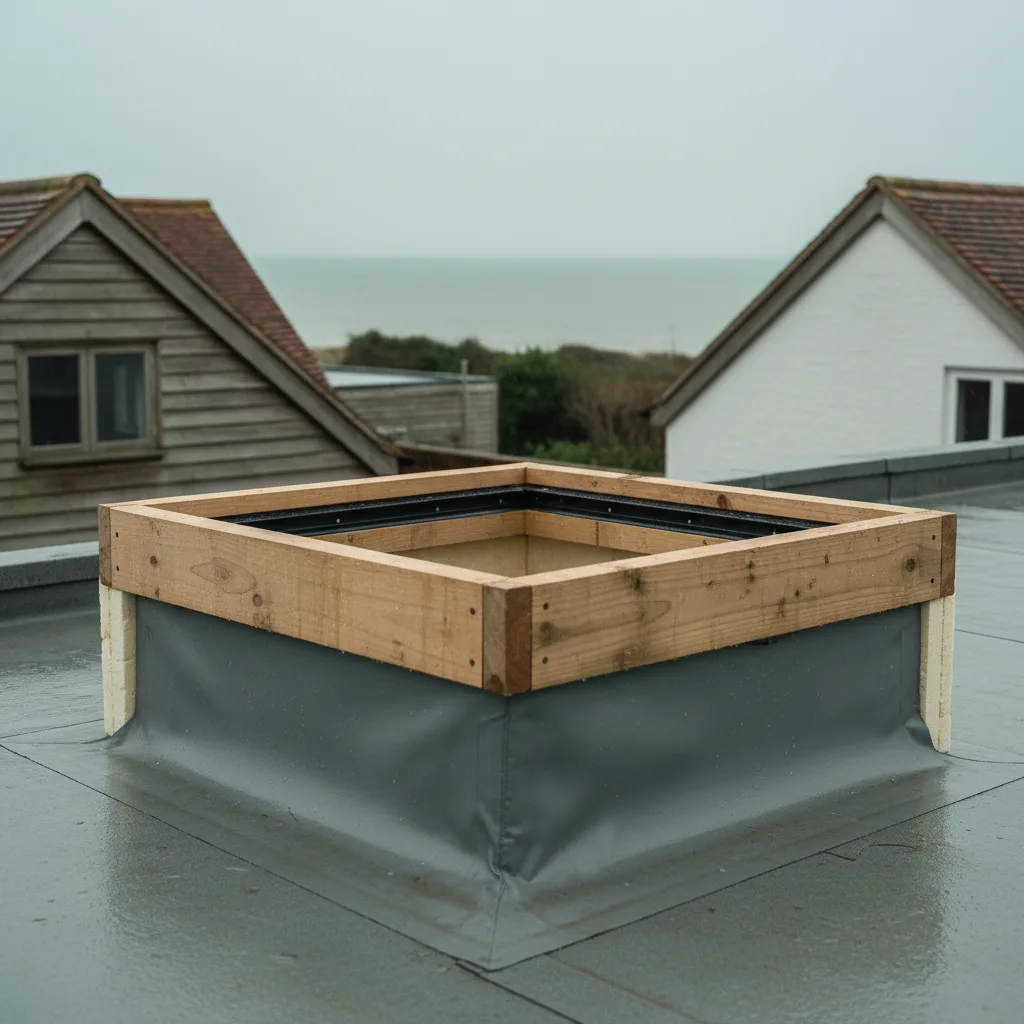
Rust expands, so a corroding steel screw in a timber kerb splits the fibres around it as it grows. The joint loosens, the loosened joint admits water, and the water accelerates both the corrosion and the decay of the timber. It is a loop that gets worse rather than settling, and it is the reason a coastal kerb sometimes has to be rebuilt when the covering above it is still sound.
Stainless does not do this, because it does not grow. The fixing stays the size it was and the timber around it stays intact, which matters as much on a thirty year view as the fixing itself.
The coating on the frame is a separate decision
Fixings and frame finish are two different specifications that both follow from the same exposure, and they are easy to conflate.
The fixings are about corrosion of the metal that holds the unit down. The frame coating is about the finish on the aluminium, which chalks and loses its colour in ultraviolet and salt long before the metal underneath is compromised. Marine grade coating and stainless fixings usually appear on the same order, and neither substitutes for the other.
What it costs to get right
Across a whole lantern or a rooflight installation, moving from plated to A4 stainless is a small proportion of the order. It is measured in the price of a box of screws rather than in the price of the unit.
Against that, the cost of getting it wrong is a frame pitted around every fixing, heads that shear on removal, and a replacement that takes twice as long because nothing comes apart cleanly.
There is no version of this arithmetic where the cheaper fixing wins.
What we specify on a lantern
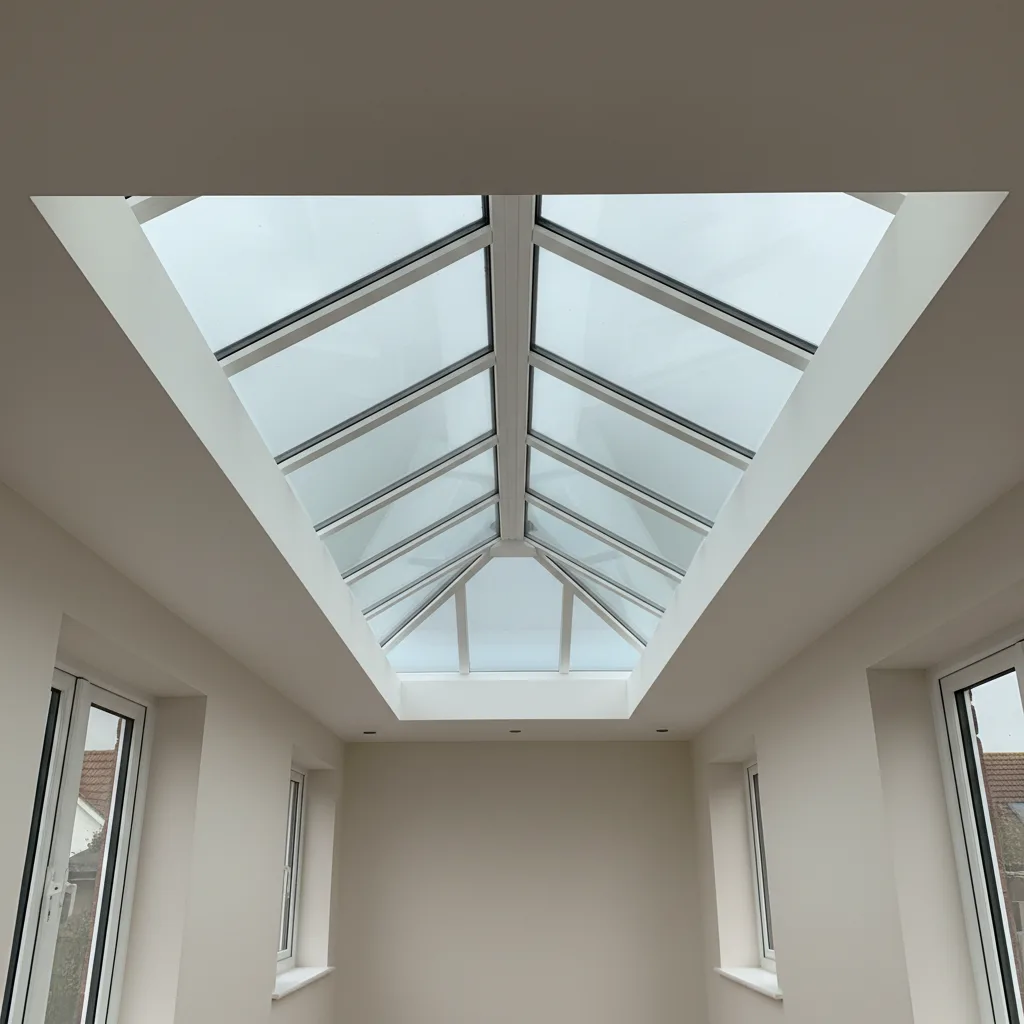
We specify A4 stainless as standard across the coastal strip and anywhere the site is exposed to the Channel, we isolate dissimilar metals where they have to meet, and we apply the same specification to washers, brackets, hinges and trim fixings rather than to the screws alone.
Salt does not care what the brochure says. It works on whatever is actually in the hole.
Thinking about this job? We survey across Worthing, West Sussex and the South Downs and give you a fixed price before any work starts, with a 10-year workmanship guarantee.