Marine grade coatings against standard powder coat on a coastal lantern
Two coatings that look identical on the day
A roof lantern finished in standard architectural powder coat and one finished in a marine grade system look the same when they arrive. They cost differently, they are warranted differently, and within sight of the sea they age completely differently.
Because the difference is invisible at the point of sale and obvious eight years later, it is the specification decision most often got wrong on a coastal roof, and the one that is least recoverable once the unit is fitted.
This page explains what the two systems actually are, what failure looks like, and where along a run from the beach to the Weald the line between them falls.
What powder coating is
Powder coating is not paint in the ordinary sense. Dry polyester powder is applied electrostatically to the aluminium and then baked, so the powder melts, flows and cures into a continuous film bonded to the metal.
The film is tough, consistent in thickness and free of the solvents in wet paint. On an inland building it will hold its colour and finish for decades, which is why it became the standard architectural finish for aluminium in the first place.
Its vulnerability is at the surface and at the interface with the metal, and salt attacks both.
What actually fails, in order
Chalking at the surface
Ultraviolet light degrades the polyester resin holding the pigment. On any coating anywhere this happens slowly; airborne salt accelerates it markedly. As the resin breaks down the pigment is left loose on the surface, and the frame goes matt and pale.
Run a finger down a chalked frame and it comes away dusty. Householders describe it as fading, which it is not: the colour has not changed, the surface holding it has disintegrated. There is no repair short of recoating, which on a fitted lantern is not a practical proposition.
Filiform corrosion under the film
The second and more serious mechanism happens beneath the coating rather than on it. Where moisture and chloride reach the aluminium at a cut edge, a fixing hole or a scratch, corrosion travels under the film in fine threads, lifting it from the metal as it goes.
It shows as thin worm-like lines under the finish, usually starting at an edge, and it does not stop once it has started. This is the failure that pre-treatment exists to prevent.

What marine grade means
The phrase covers three separate improvements, and it is worth knowing which one you are being sold.
Pre-treatment
The most important difference is what happens to the aluminium before any powder is applied. A marine specification uses a more thorough pre-treatment stage, which produces a surface the coating can key into and which resists corrosion creeping under the film.
This is the part the customer cannot see, cannot verify by looking, and is entirely reliant on the specification being written down.
Coating system
Typically a two coat rather than single coat system, giving a greater total film thickness and better resistance to the ultraviolet and salt combination that causes chalking.
Warranty terms
Coating warranties are written by environment. The same product will carry a long warranty inland and a shorter one, or none at all, within a stated distance of the coast, and some exclude marine environments entirely unless the marine specification was ordered.
That last point is the practical one. A standard coating on a seafront lantern may not merely fail earlier; it may fail outside any warranty at all.
| Aspect | Standard powder coat | Marine grade system |
|---|---|---|
| Pre-treatment | Conventional | Enhanced, specified for chloride exposure |
| Coating build | Usually single coat | Usually two coat, greater film thickness |
| Typical failure | Chalking, then filiform corrosion from edges | Slow, uniform weathering |
| Warranty near the coast | Reduced or excluded | Written for the environment |
| Repairable in place | No | No, but far less likely to be needed |
| Sensible use | Inland, sheltered | Within reach of salt-laden air |
The difference is decided at the factory, before the frame reaches site, which is why it has to be written on the order rather than discussed on the day of fitting.
Why a lantern is the worst case
Of everything we install, a lantern is the product that shows an under-specified coating first.
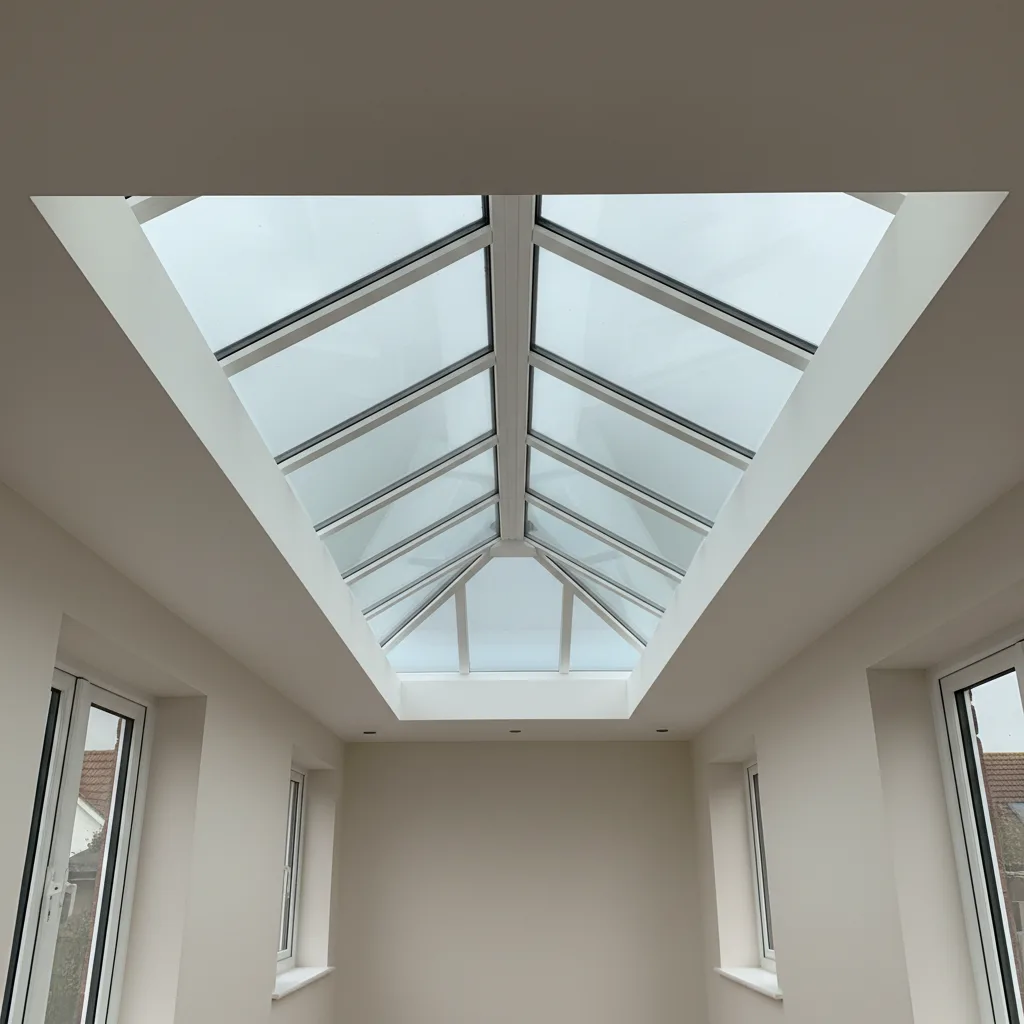
It has more frame than any other unit for its glazed area, because it is made of rafters, a ridge, eaves and corner posts rather than a single perimeter. It has more edges, more junctions and more fixings, and edges are where filiform corrosion starts. It stands proud of the roof rather than sitting flush, so it is washed by wind-driven salt from every direction rather than only from above.
A flush rooflight in a standard finish on a coastal roof will disappoint you eventually. A lantern in a standard finish on the same roof will disappoint you sooner and more visibly, because there is more of it to look at.
Where the line falls between the beach and the Weald
There is no official distance and anyone quoting one precisely is guessing. What can be said usefully is how exposure varies across the ground we cover.
- Beachfront and clifftop, where the shingle or the drop is at the end of the road. Marine specification without exception, and stainless fixings and ironmongery with it.
- Seafront towns and harbour edges. Marine specification as standard. Salt is in the air on every roof, and still air over water is worse than moving air because the salt is not blown off again.
- A mile or so inland, or behind a substantial built-up frontage. Judged by aspect. A house with an open run south towards the water is treated as coastal; one sheltered behind other buildings frequently is not.
- The coastal plain, several miles back. Level open ground carries salt further than hilly ground, so an exposed plot with a clear southern aspect is worth specifying marine grade even at a distance that sounds safe.
- The Weald and the Downs valleys. Standard coatings do their job, and paying a marine premium here is spending money on nothing.
The test is the aspect of the specific elevation rather than the postcode. Two houses on the same road can sit either side of that judgement, and looking is the only way to make it.
What else has to match the coating
Specifying a marine coating and then fixing the unit with plated steel is a wasted upgrade.
Fixings corrode from the shank outwards, inside the timber, where nothing is visible from either side of the roof. The unit looks perfect for years, then a fixing lets go, the frame moves a fraction and a seal breaks. Stainless throughout, including the fixings holding the flashing kit rather than only those holding the frame.
On an opening lantern the hinges, stays and locking gear matter as much as the frame, because moving parts collect salt in every crevice and are the first components to bind. Stainless gear is not a luxury on a coastal roof.
The maintenance nobody mentions
Rinse the frame and gaskets with clean water two or three times a year on a coastal roof.
Salt crystals collect in the gasket channel and along the drainage path. They are abrasive, and every closure of an opening unit grinds them into the seal. Fresh water removes them, takes five minutes, needs no equipment beyond a hose, and roughly doubles the working life of a gasket in a marine environment.
It also removes the salt film from the coating itself, which slows the chalking process on any finish, marine or otherwise.
The short version
The difference between the two coatings is decided before the frame leaves the factory, cannot be assessed by looking at the finished unit, and cannot be corrected once it is fitted. On any roof within reach of salt-laden air, it goes on the order in writing or it does not happen.

How to check what you have been quoted
Coating specification is one of the few things on a quotation a homeowner can verify without technical knowledge, provided they know what to look for.
- Does the quotation name the coating system, or does it only give a colour and a finish? A colour reference on its own says nothing about the specification.
- Does it state the pre-treatment or the marine specification explicitly, in writing, rather than as a verbal assurance?
- What warranty is offered on the coating specifically, and does it exclude coastal environments?
- Are the fixings and ironmongery specified as stainless, or only the frame finish?
If those four are answered clearly, the specification is probably sound. If the answer to any of them is a reassurance rather than a line in the document, that is worth pressing on before an order rather than afterwards.
What if a standard coating is already fitted
Where a lantern is already in place with the wrong finish, the honest position is that recoating in situ is not a solution. Powder coating is a factory process requiring a clean, pre-treated surface and an oven, and nothing applied by brush on a roof reproduces it.
What can be done is to slow it down. Rinsing the frame with clean fresh water several times a year removes the salt film that accelerates the breakdown, and it makes a measurable difference on a unit that is chalking but not yet corroding.
Where filiform corrosion has started, lifting the coating from the metal at the edges, the unit is on a path that ends in replacement, and the useful question becomes when rather than whether. Knowing that early is worth something, because it turns an emergency into a planned job.
Anodising, and where it fits
Anodising is the other durable finish for aluminium, and it comes up occasionally on coastal projects.
Rather than adding a layer on top of the metal, anodising thickens the aluminium oxide layer that is already there, electrochemically. The result is extremely hard, integral to the metal rather than sitting on it, and cannot chip or peel in the way a coating can.
It has two limitations for this application. The colour range is narrower than powder coating, so it will not match a specific paint reference. And it is not offered on every lantern system, so it may constrain the choice of product before it constrains anything else.
Where it is available and the colour suits, it is a very good answer on a marine site. Where it is not, a properly specified marine grade powder coat with the correct pre-treatment does the job well.
The short version
Within reach of salt-laden air, the coating specification is the decision that determines how the unit looks in ten years, and it is invisible on the day it is fitted.
Ask for the marine specification in writing, ask what warranty applies at your address, and check that the fixings and ironmongery are stainless as well as the frame. Those three questions cost nothing and they are the difference between a lantern that weathers slowly and one that is pale and powdery before it is a decade old.
Inland, none of it applies and none of it should be paid for. The test is the aspect of the elevation rather than the postcode, and it takes one visit to settle.
Thinking about this job? We survey across Worthing, West Sussex and the South Downs and give you a fixed price before any work starts, with a 10-year workmanship guarantee.
Tell us about the roof. We will tell you the price.
A survey costs you nothing and there is no obligation attached to it. We look at the roof build-up, the exposure and the opening, and give you one fixed figure, not an estimate that moves once work starts.
If your rooflight is leaking now, say so and we will prioritise the survey.
- Fixed price, confirmed in writing
- 10-year workmanship guarantee
- Installed to current Building Regulations
- Your roof is never left open overnight