A roof lantern stands proud of the roof, which is exactly what makes it worth having and exactly what makes wind a design case rather than an afterthought. At the foot of the Downs, on a rising site, or within sight of the Channel, the loads are higher than the flat coastal plain a few miles south.
This page is about what exposure does to the specification, and what we change because of it.
Why a lantern is a wind case at all
Wind on a building does two things to a pitched unit sitting above the roof line.
Pressure on the windward slope
The slope facing the wind takes a positive pressure, pushing in on the glass and the frame. This is the intuitive load and it is rarely the critical one.
Uplift on the leeward slope and at the ridge
Air accelerating over the ridge produces suction, and suction is what lifts things off roofs. On a lantern the critical load is generally uplift at the ridge and along the leeward slope, and it acts on the fixings holding the frame down to the kerb rather than on the glass.
That is why the specification changes at the fixings and the kerb connection rather than at the glass thickness.
What makes the Downs edge different
Three separate factors stack up along the northern edge of our radius, and they compound rather than add.
| Factor | Effect | Where it applies here |
|---|---|---|
| Topography | Wind accelerates up a slope and over a crest | Findon, High Salvington, Poynings, Fulking, Pyecombe, Steyning |
| Exposure and terrain | Open downland gives no shelter upwind | Anywhere the site faces open fields to the south west |
| Altitude | Basic wind speed rises with height above sea level | The scarp villages and the higher parts of Salvington and Findon Valley |
| Building height and position | A unit near a ridge or a corner sees higher local suction | Any lantern set close to the edge of its roof |
A house at High Salvington sits several hundred feet above one in central Worthing, four miles away, on open ground with the prevailing south westerly arriving straight off the sea and up the slope. The two are not the same design case, and treating them as the same is how fixings end up under specified.
The prevailing wind here comes off the water
The dominant wind on this coast is from the south west, arriving over open sea with nothing to slow it, crossing a narrow coastal plain, and then rising up the face of the Downs.
Two consequences follow. The first is that a lantern with a slope facing south west takes the highest pressure on that face and the highest suction on the opposite one. The second is that the same wind carries salt, which is why exposure and coastal specification are the same conversation on this stretch of coast even a few miles inland.
What we change for an exposed position
The lantern is the same product. What changes is how it is held down and what it is made of.
- Fixing centres are closed up, particularly at the ridge and at the corners of the kerb where local suction is highest.
- Fixings are stainless rather than plated, because a fixing under a high cyclic load in a salt laden atmosphere is the last place to economise.
- The kerb connection is made continuous rather than intermittent, so the uplift is spread into the structure instead of concentrated at a few points.
- The coating specification moves to marine grade, which is covered on its own page.
- Glass build-up is checked against the pressure on the largest pane, which occasionally moves a unit up a step.
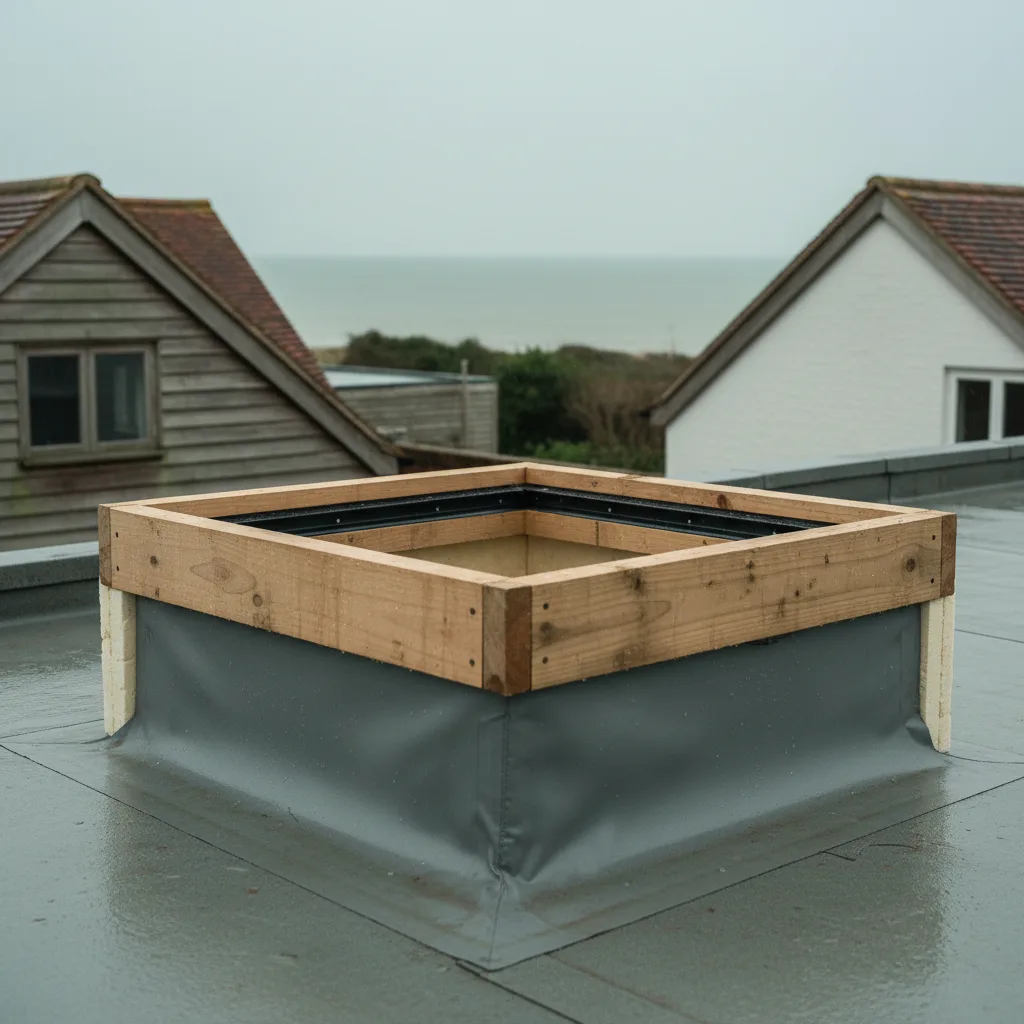
The kerb has to be able to hold it down
Fixings are only as good as what they go into. On an exposed site the uplift path runs from the lantern frame, through the fixings, into the kerb, and from the kerb into the trimmed opening and the joists.
A kerb built as a light timber box on top of a deck, fixed down at a few points, is a weak link in that chain no matter how well the lantern itself is specified. On an exposed job we check that the kerb is mechanically fixed into the structure rather than simply bedded onto it, and where it is not, correcting it is part of the work.
Where the lantern sits on the roof
Wind load is not uniform across a roof. Suction is highest at the edges, higher again at the corners, and lowest in the middle of a large plane.
That has a practical consequence which is easy to act on. A lantern set well in from the eaves on a rear extension sits in the calmest part of the roof. One set close to a verge, a corner, or a step in the building sits in the zone where local suction peaks, and it needs the closer fixing centres even on a site that is otherwise sheltered.
On a narrow extension there is frequently no choice, because the margins put the unit where it has to go. Where there is a choice, moving a lantern in from the edge is free and it reduces the load it has to be held down against.
Noise, and what exposure sounds like
An exposed lantern is audible in a way a sheltered one is not, and it is worth knowing which noises mean something.
- Rain on glass. Normal, and louder on an overhead unit than on a window. A laminated inner pane reduces it. A thicker outer pane reduces it further.
- Wind at the ridge. A low note in a strong south westerly is ordinary air moving over a ridge and is not a fault.
- A rattle or a tick under load. This one is worth reporting. It usually means a fixing or a cap has worked loose, and it is a five minute job caught early.
- Creaking as the sun comes onto it. Thermal movement in the frame. Normal on a large unit, and quieter where the frame was not installed under stress.

Guarding against the wrong conclusion
Exposure gets blamed for a lot of things that are not wind.
Water appearing at the frame in cold clear weather is condensation from a cold bridge at the kerb, not driven rain. Water appearing only in heavy rain from a particular direction is usually a flashing or a termination detail rather than a load problem. A unit that has gone misty has a failed edge seal, which is age and thermal cycling rather than wind.
Diagnosing before ordering saves replacing the right component for the wrong reason. The replacement pages cover the symptoms and what each one actually points to.
Debris, and the other thing wind brings
Wind on the scarp carries more than air. Gravel from a nearby flat roof, small branches from mature planting, and in a hard winter hail arriving at an angle all reach a lantern that stands above the roof line.
The inner pane is laminated as standard on any overhead glazing, which is the answer to impact from below. For impact from above, a toughened outer pane takes it, and on a genuinely exposed downland site a thicker outer pane is a reasonable and inexpensive change to make at the ordering stage.
Where the National Park sits in this
Twelve of the towns we cover sit inside the South Downs National Park, where the South Downs National Park Authority is the planning authority rather than the district council. That is a planning matter and not a structural one, but it lands on the same jobs.
The practical point is that the most exposed sites in our radius are frequently also the ones with the narrowest permitted development, so a lantern at Poynings or Fulking has both a structural conversation and a planning conversation attached to it. Both are worth having before anything is ordered, and the National Park pages set out the second one.
Working on an exposed roof
Exposure changes the installation as well as the specification.
- We do not open a roof in a forecast that will not let us close it. On the scarp that means watching the wind as closely as the rain.
- Glass is not lifted or handled in strong wind. A pane acts as a sail and it is a genuine hazard to the people carrying it.
- The roof is never left open overnight, which matters more where weather arrives quickly off the sea.
- Temporary covering on an exposed roof is fixed rather than weighted.
On a still day the work is the same anywhere. Exposed sites need the days chosen.
How the load reaches the ground
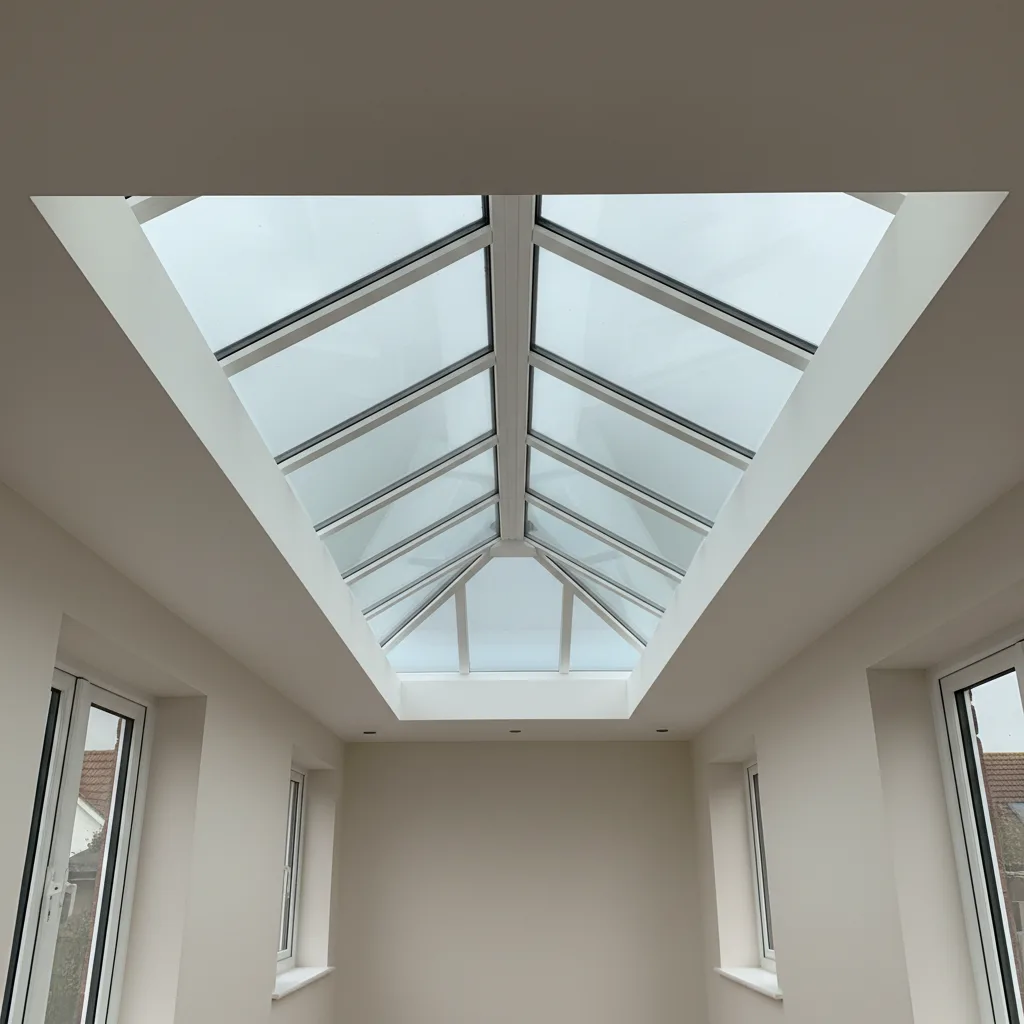
It helps to follow the uplift the whole way through the building, because every link in that chain is a place a job can be under specified.
Glass to frame
The glass is held in the rebate by the beads or caps and the gaskets. On a properly assembled unit this link is rarely the weak one, provided the caps are fully seated and the fixings in them are all present.
Frame to kerb
The frame is bolted or screwed down to the top of the kerb. This is where uplift concentrates, and it is where the fixing centres and the fixing material matter most. Closed up centres at the ridge ends and the corners cost minutes and are not recoverable later.
Kerb to structure
The kerb is fixed into the trimmed opening. A kerb bedded in adhesive and relying on the covering to hold it is not a load path. It has to be mechanically fixed.
Structure to walls
The trimmers carry into the joists and the joists into the wall plates. On a standard domestic extension this is ordinary construction and needs no special attention, unless the opening was formed without trimmers, which we do occasionally find on older work.
Maintenance on an exposed unit
An exposed lantern needs looking at, and there is very little to it.
- Once a year, look at the caps and the visible fixings from a safe position for anything standing proud.
- Clear the roof around the kerb of leaves and grit, particularly at the outlet, so water is never backing up against the kerb in a storm.
- On a coastal site, rinse the frame with fresh water when convenient. Salt is cumulative and rinsing is the whole of the maintenance.
- After an exceptional storm, look for anything that has arrived on the roof and not left it.
None of this needs a specialist. What it needs is somebody looking once a year rather than nobody looking for fifteen.
Inland is not automatically sheltered
It is easy to assume that moving north away from the sea reduces the load. On this coast that is only half true, because the ground rises as you go north.
A bungalow at Ferring, on flat ground a few hundred metres from the beach, takes a strong but unaccelerated wind. A house on the slope above Findon Valley, six miles inland, takes a wind that has been lifted and accelerated by the topography. Both need thinking about, and neither is served by a rule of thumb based on distance from the water.
Where we start on a lantern
We look at the position on the roof, the exposure of the site and the topography around it at survey, and we set the fixing specification and the coating from what we find rather than from a default. Where the loads warrant a structural opinion we say so before anything is ordered.
A lantern is held down by its fixings, and the fixings are decided by the site.
Thinking about this job? We survey across Worthing, West Sussex and the South Downs and give you a fixed price before any work starts, with a 10-year workmanship guarantee.