Why is water coming in around my rooflight?
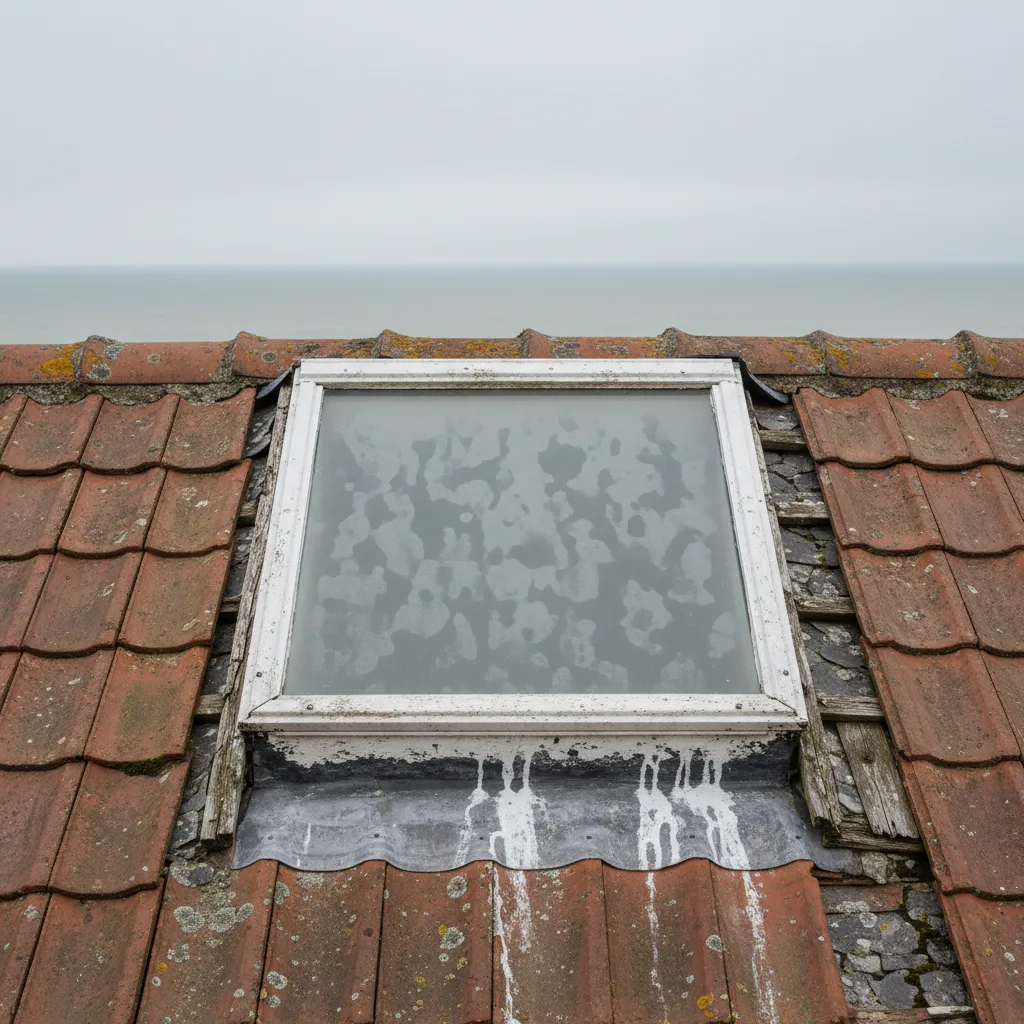
Almost always at the perimeter rather than through the rooflight itself. Water gets in at the junction between the unit and the roof, at the kerb, at the flashing, or through a covering fault nearby, and then travels before it appears. The wet patch on the ceiling is rarely directly beneath the point where it entered.
Why it travels
Because it follows the structure.
Water entering at the head of an opening runs along the top of a ceiling, down a joist or along a batten before it finds a place to drop.
A metre between the entry and the stain is ordinary.
Why that matters for diagnosis
Because looking directly above the stain wastes time.
The area to examine is the whole perimeter and the covering above it, working from the highest point down rather than from the wet patch up.
Is it a leak at all
The first question, and often the answer.
Condensation produces exactly the same marks in exactly the same places, and a great many reported leaks are not leaks.
How to tell is on is it condensation or a leak.
The timing test
What separates them fastest.
Water that appears in cold weather regardless of rain is condensation. Water that appears during or shortly after rain, particularly wind driven rain, is a leak.
The wind direction test
Useful on a coastal roof.
A leak that only shows in a south westerly is being driven at one face of the detail, which tells you which side of the perimeter to look at.
On a flat roof: the kerb
The first place to look, every time.
The covering has to be dressed up the upstand and terminated under the frame, and where that lap is short, split or the wrong way round, water goes in.
What it should be is on how high should a rooflight kerb be.

A kerb that is too low
A common original fault.
An upstand built shorter than it should be lets driving rain and standing water reach the frame line, and no amount of sealant will settle that permanently.
Ponding around the kerb
A roof problem showing at the rooflight.
Water standing against an upstand because the fall is insufficient will find any weakness given time, and the rooflight gets blamed for the roof.
The falls are on what is the minimum fall for a flat roof with a rooflight.
Blocked outlets
Worth checking before anything else. A blocked rainwater outlet turns a flat roof into a shallow pond, and the kerb is the tallest thing standing in it.
Clearing it sometimes ends the investigation.
On a pitched roof: the head flashing
Where a roof window most often lets water past.
The flashing above the window has to sit under the covering above it, and where a tile has slipped or the flashing has been dressed over rather than under, water runs in behind.
What a kit does is on what is a flashing kit.
The underlay collar
The hidden detail that decides a pitched installation.
The membrane around the opening has to be lapped so water reaching it is carried out over the flashing rather than in behind it, and the direction of that lap is everything.
Debris above the window
The maintenance failure that causes leaks.
Moss and leaf litter collecting on the covering above a rooflight dam water at the head flashing, which is exactly where a leak starts.
A slipped or cracked tile
Frequently the actual cause.
Water entering through a covering fault above the window runs down the underlay and appears at the first interruption, which is the rooflight.
The rooflight is where it shows rather than where it entered.
The gasket on an opening unit
Where a moving joint is the culprit.
A dirty seal or an actuator not pulling the sash fully home leaves the gasket uncompressed somewhere, and wind driven rain finds it.
That is on do opening rooflights leak more than fixed ones.
Blocked weeps on a lantern
The commonest lantern fault.
Drainage channels in the glazing bars discharge at the eaves, and once those holes silt up the channels back up over the frame.
That is on do roof lanterns leak.
How it is properly tested
With a hose, from the bottom up.
Water is applied to the lowest part of the detail first and worked upward with time between each stage, because wetting everything at once tells you nothing.
What we would not do
Seal round the outside and hope.
A bead of sealant round a perimeter traps water in a system designed to release it, and the problem comes back worse and less comprehensible.
Why is on can a leaking rooflight be resealed.
What a long standing leak does
Gets into the timber.
Water reaching a kerb or a trimmer over seasons rots it, and that has to be dealt with before any new work goes on top of it.
What that involves is on what happens if the timber underneath has rotted.
Where an extension meets the original roof
A junction that produces leaks blamed on a nearby rooflight.
The abutment where a flat extension roof meets the wall of the house is one of the more demanding details on any roof, and water entering there runs along the deck to the first interruption it finds.
If the rooflight sits near that wall, it will be the thing that gets wet.
Fixings through the covering
An old fault worth looking for. Aerials, satellite brackets, handrails and old fixings driven through a flat roof are entry points that were sealed once and have moved since.
They are checked along with everything else above the rooflight.
How we diagnose it
We diagnose before we quote, and we test from the bottom up, because the commonest reason a leak comes back is that somebody fixed the place where it was showing.
The whole picture is on the replacing a failed or misted rooflight page.
Thinking about this job? We survey across Worthing, West Sussex and the South Downs and give you a fixed price before any work starts, with a 10-year workmanship guarantee.