What is the minimum fall for a flat roof with a rooflight?
Current guidance expects a finished fall of at least 1 in 80 on a flat roof, and designers generally work to 1 in 40 so that deflection, settlement and construction tolerance still leave 1 in 80 when the roof is finished. A rooflight makes that more important, because a kerb standing in ponded water is where a leak begins.
Why a flat roof is not flat
Because water has to reach an outlet, and it does not do that on a level surface.
A fall is built in by firring the joists, by a tapered insulation scheme, or by laying the deck to a slope. Any of the three works; the roof simply has to drain.
Why design at twice the minimum
Because the built roof is never as good as the drawing.
Joists deflect under load, timber shrinks, an extension settles, and construction tolerances accumulate. A roof designed exactly at 1 in 80 will finish below it in places.
Designing at 1 in 40 is what leaves a working fall once all of that has happened.
What ponding actually does
Several things, none of them quick. Standing water keeps a covering permanently wet, holds debris against it, freezes and thaws in winter, and grows algae that holds more water still.
Around a rooflight kerb it sits against the termination detail, which is exactly where the covering is most vulnerable.
Why a rooflight or skylight raises the stakes
Because it introduces an upstand into the middle of a drainage surface.
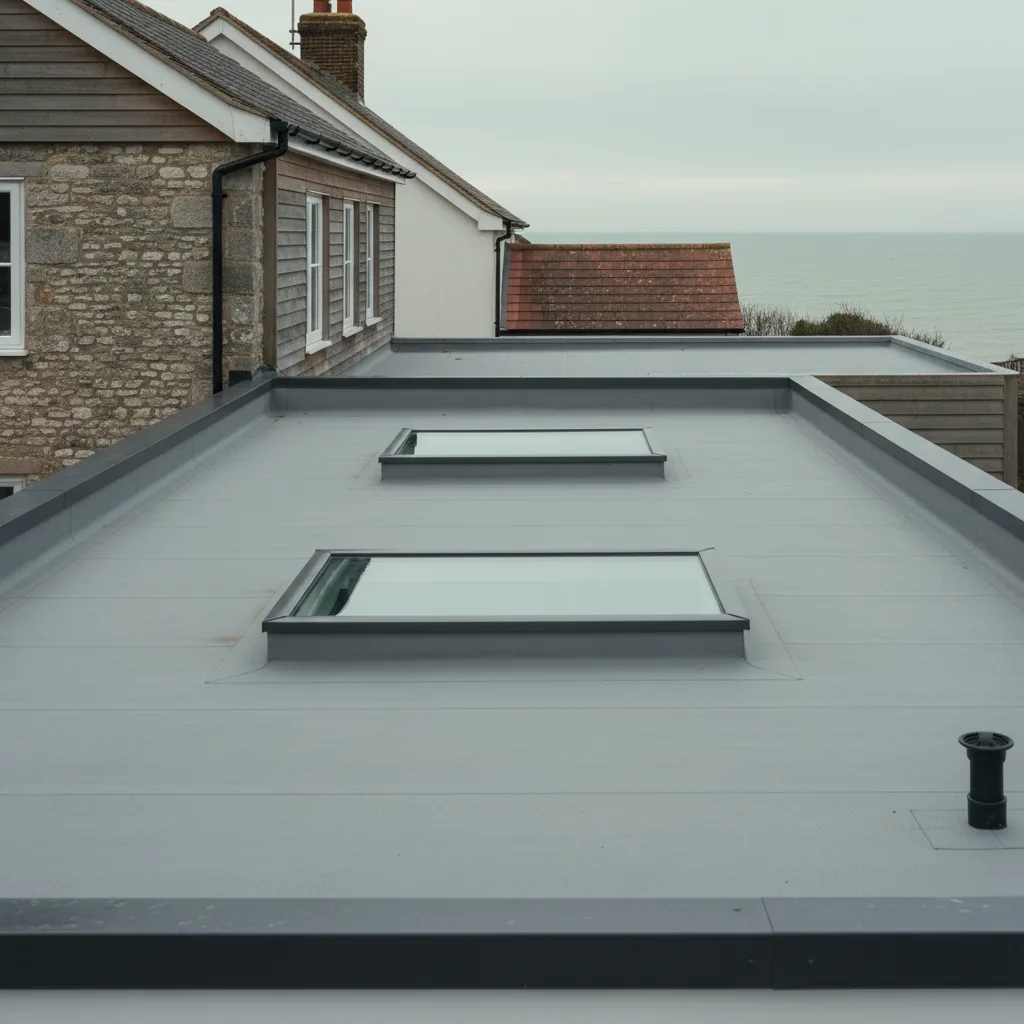
A kerb interrupts the flow of water across a deck, and where it sits across the fall it dams water on its upslope side rather than letting it past.
Which is why the position of a unit is decided from the falls rather than only from the room below.
Positioning a unit relative to the fall
The practical rule, and it is frequently ignored.
A kerb is better placed with its long axis running down the fall than across it, so water passes either side rather than being held against a long edge.
Where the room dictates otherwise, the upstand height matters more and the covering detail on the upslope side is the one to get right.
Where the outlets are
The other half of the same question.
A unit placed close to an outlet catches debris against itself and blocks it, and a blocked outlet on a shallow deck backs water up across the whole roof.
Outlet positions are traced before a rooflight position is agreed.
Tapered insulation
A useful answer where an existing deck is level.
A tapered scheme lays insulation cut to a falling profile above the deck, creating a fall without altering the structure below.
It is designed rather than improvised, it adds height, and it is the usual route on a warm roof refurbishment.
What to do about an existing flat deck
Establish the fall before specifying anything. A straight edge and a level across the deck in two directions gives the fall, and standing water after rain gives the answer more directly still.
Where the fall is inadequate we say so before fitting rather than after.
Whether a rooflight can go on a ponding roof
It can be fitted, and we would rather it were not.
Putting a good unit onto a deck that ponds is work that will come back, and the callback will be attributed to the rooflight rather than to the roof.
Correcting the fall, or renewing the covering, is the honest first step.
Zero fall roofs
They exist, and they are a designed system rather than an accident.
Some coverings are specified for zero fall applications with particular details and warranties. That is not the same as a roof that was meant to fall and does not.
Snow and drifting
A seasonal version of the same problem.
Snow accumulates against an upstand and melts slowly from the deck side, which produces standing water against a kerb long after the deck itself has cleared.
It is another argument for the upstand height rather than for the fall.

Debris in autumn
The maintenance item that turns an adequate fall into an inadequate one.
Leaf litter collecting against a kerb and around an outlet is how a roof that drained last year ponds this year.
A clear each autumn deals with it, and on a plot under trees it is worth putting on a list.
What the covering can tolerate
Varies, and it is worth asking rather than assuming.
Manufacturers of single ply, liquid and GRP systems state what they will warrant in terms of ponding, and some are considerably more tolerant than others.
Where a deck is marginal, the covering warranty is the practical constraint.
What we check at survey
Three things, before any product is discussed.
The fall in both directions, where the outlets are and whether they run, and whether there is evidence of standing water in the form of staining or algae.
Warm roof and cold roof
A distinction that decides where the fall is formed.
On a warm roof the insulation sits above the deck and the fall is frequently created within it using a tapered scheme. On a cold roof the insulation is between the joists and the fall is built into the structure by firring.
Which the roof is decides how a fall can be corrected, and it is established before anything is proposed.
Rainwater outlets and overflows
The other end of the drainage, and worth checking while the falls are being traced.
A flat roof needs somewhere for water to go and, on many roofs, an overflow to warn that the outlet has blocked before water backs up over an upstand.
A roof with a single outlet and no overflow is one blocked gutter away from testing the kerb height.
How we trace it
We trace the falls and the outlets before agreeing a position, and we position a kerb down the fall rather than across it wherever the room allows.
The kerb detail itself is on the kerb decides the job.
Thinking about this job? We survey across Worthing, West Sussex and the South Downs and give you a fixed price before any work starts, with a 10-year workmanship guarantee.