Does replacing a rooflight or skylight need building regulations?
Generally yes. Replacing a rooflight is controlled work because the new unit is a thermal element in the building envelope, and it has to meet a stated standard even where nothing structural changes. Replacing only the glass in an existing frame is usually treated as a repair rather than a replacement, which is a different position entirely.
What applies generally
The overall position on rooflights and building control is on do flat rooflights need building control.
What follows is what is different when there is already a rooflight in the roof.
Why a replacement is controlled
Because a new element has to meet current standards.
The regulations set a limiting performance for a replacement element, so a new rooflight cannot simply match what came out if what came out was poor.
The figure is on what is the limiting U value for a replacement rooflight.
Why the standard is lower than for new work
Because the rest of the building is not changing.
A replacement limit is set at a level achievable in an existing roof, rather than the tighter figure that applies to a new extension designed as a whole.
Where the structure is also changing
A larger question and a clearer answer.
Any change in the size of the opening interrupts more structure, and that is controlled work on the structural side as well as the thermal.
What that involves is on do I have to replace like for like.
Where the glass alone is replaced
Ordinarily a repair. Changing a failed sealed unit in an existing frame is generally treated as maintenance rather than as replacing the element, and it is not notified.
That route is on can just the glass be replaced.
Where it stops being a repair
When the frame goes too. Taking out the whole rooflight, frame and all, is replacing the element, and that engages the requirement regardless of whether the opening changes.
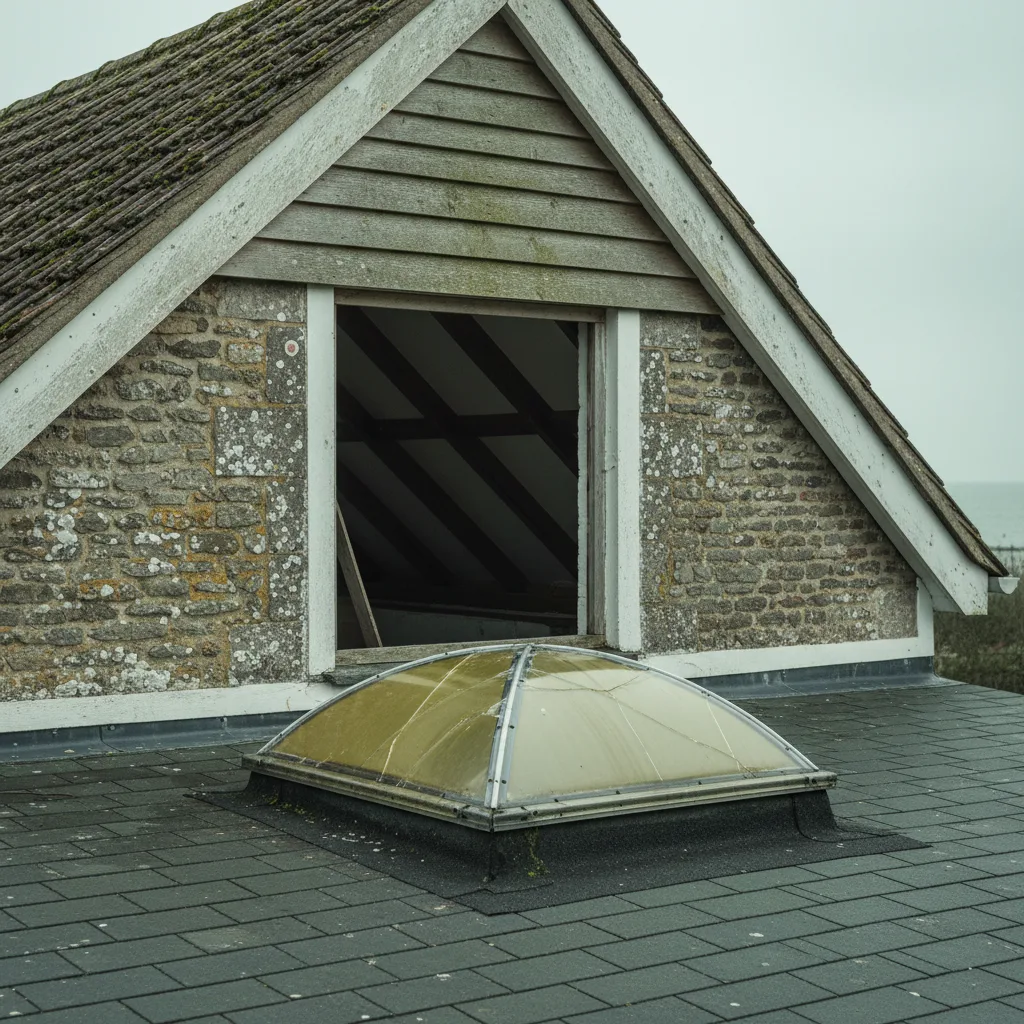
Safety glazing overhead
Applies to any new glass in a roof.
Glass above a room has to be specified so it does not fall as pieces if it breaks, which generally means a laminated inner pane.
It is a specification point that an inspector will ask about.
What the kerb has to do
Not fall foul of the same thinking.
A cold upstand is a thermal bridge and a condensation risk, and where a kerb is being rebuilt as part of the work it is insulated properly.
How it should be built is on what is a builders kerb.
Two routes to approval
A building notice or a competent person scheme.
Straightforward replacement work is commonly notified under a building notice, and some installers are members of schemes that let them self certify.
Competent person schemes
Where a self certificate is issued. Certain installer schemes allow replacement glazing work to be self certified and registered, which produces a certificate without a separate application.
Whether one applies is worth asking about directly.
Local authority or approved inspector
Either, and it is the homeowner’s choice.
Both discharge the same requirement, and which is used usually follows whoever is coordinating any wider work.
Who notifies
Whoever is contracted to do the work.
It is arranged before the covering comes off rather than after, because an inspection wants to see the opening at the right stage.
What an inspector looks at
The specification and any structure.
The performance figure for the new unit, the glazing specification, and where the opening has been altered, the trimming before it is covered.
The completion certificate
The document that matters years later.
A buyer’s solicitor asks for evidence that notifiable work was signed off, and undocumented work can hold up a sale or lead to an indemnity policy.
An indemnity policy instead
What happens where the paperwork is missing.
A conveyancer will often propose an indemnity policy for undocumented work, which covers enforcement risk rather than putting the work right.
It is a workaround rather than a substitute.
Where a rooflight is in a listed building
An entirely separate consent as well.
Listed building consent applies to works affecting the character of a listed building whatever the building regulations position is.
That is on do I need listed building consent for a rooflight.
Planning is separate again
And usually not engaged by a replacement.
Planning is about appearance and amenity, and a like for like replacement in the same opening rarely raises it.
The tests are on does replacing a rooflight need planning permission.
Where nothing is notified
Worth being clear about the risk.
Work that should have been notified and was not remains a problem attached to the house rather than to whoever did it, and it surfaces at sale.
Regularisation afterwards
Possible, and it is more work.
An authority can be asked to regularise unnotified work, which generally means opening up parts of it so the construction can be inspected.
What it adds to a job
A fee and a visit, and very little time.
On a straightforward replacement the notification is a small item, and it is far cheaper than the alternative at the point of selling.
What we confirm first on a replacement
We establish the route before the covering comes off and we say plainly when a job is a repair rather than a replacement, because the two carry different obligations and the difference is worth knowing.
The whole picture is on the replacing a failed or misted rooflight page.
Thinking about this job? We survey across Worthing, West Sussex and the South Downs and give you a fixed price before any work starts, with a 10-year workmanship guarantee.