Reading the symptom before ordering anything
Most rooflight replacements we are asked to quote for are the right job. A meaningful minority are a new unit fitted to solve something a new unit cannot solve, and the customer has paid for a window and kept the problem. This page is about the order of investigation that prevents that.
The principle
A rooflight is a product sitting in an installation sitting in a roof, inside a room. A symptom can originate in any of those four, and they are not equally likely.
The unit itself is the most expensive to change and, in our experience, is the cause in a minority of cases. Which means suspecting it first is both the most expensive habit and the least accurate one.
The order that works runs outward from the cheapest and most probable to the most expensive and least probable.
The order
- The room. Humidity, ventilation, how it is heated and used. Costs nothing to establish and explains a large share of complaints.
- The installation. The collars, the insulation, the seal to the vapour control layer. Invisible and frequently the answer.
- The roof around it. The covering, the flashing, the kerb, the drainage. Visible with access.
- The unit’s serviceable parts. Gaskets, catches, mechanisms, drainage paths. Replaceable.
- The unit itself. The frame and the sealed glass. The expensive answer, and the last one to reach for.
Nothing on that list is skipped because a later item seems obvious. The point of the order is that the obvious answer is frequently the fifth one and the actual answer is frequently the first.
Observations to make before calling anybody
Six things, all available from indoors, and between them they narrow almost any rooflight complaint.
| Observation | What it distinguishes |
|---|---|
| Which surface is affected | Inside the glass, outside it, between the panes, or the frame and reveal |
| What the weather was doing | Rain, wind, cold and clear, or mild |
| Whether it clears, and how fast | Transient against permanent |
| Where on the unit | All round, one corner, or the head |
| When it started | Gradual against sudden, and after what |
| Whether it is seasonal | Absent in summer points one way, present all year another |
The two questions that do most work
If only two of the six get answered, make them these.
What was the weather doing? Rain, wind and cold produce different faults, and the answer separates the largest categories immediately.
Which surface is the water on? Inside the glass, outside it, between the panes and on the frame are four different conditions with four different causes and four different costs.
Together they resolve most complaints to a category before anybody gets a ladder out.
Sudden or gradual
The onset is more informative than people realise, and it is worth thinking back rather than guessing.
A problem that appeared suddenly usually has an event behind it: a storm, work done on the roof, a neighbour’s scaffold, something arriving on the roof, or somebody walking on it. Those are worth identifying because they point at a specific place.
A problem that has crept up over years is a wear or a design condition: gaskets hardening, a seal failing, a coating chalking, a mechanism stiffening. Those point at the age of the unit rather than at an incident.
Has anything changed indoors
Frequently overlooked and frequently the answer. A room that has become a bathroom, a tumble dryer that now vents indoors, a cooker hood replaced with a recirculating one, an extract fan that has stopped working, a trickle vent that got closed one January. Each of those changes the humidity in a room substantially and each produces condensation that looks like a rooflight fault.
Ask what has changed in the room in the last couple of years before concluding anything about the roof.
What one rooflight tells you about another
A house with more than one rooflight has a built-in control, and it is free information.
If every rooflight in the house shows the symptom on the same night, the driver is the house: humidity, heating pattern, ventilation. If one does and the others do not, it is that room, that orientation, or that unit.
If one has misting between the panes and the others are clear, that is a failed seal on one unit and has nothing to do with the house at all.
Photographs that are actually useful
- The affected area, close and in focus, with something for scale.
- The whole unit from inside, so the reveal and the frame are visible.
- The data plate, which identifies what it is and what parts fit.
- The ceiling around the opening, in case the stain is not where you think.
- The unit from outside, if it can be seen safely from a window opposite.
- The same view a week later, because a change is evidence.
None of that needs a ladder, and it gets a conversation a long way forward before anybody visits.
The hose test, and what a negative result means
Running water down the roof above a rooflight reproduces rain under gravity, and it is the single most useful physical test there is.
A positive result, water appearing, localises a genuine leak in the covering or the flashing. A negative result on a unit that definitely lets water in is not inconclusive: it tells you the fault needs a condition the hose cannot create, which on a pitched roof is almost always wind pressure and points at the underlay collar.
The method matters. Start low and work up, one area at a time, with somebody watching inside, and allow time between areas. Soaking the whole roof at once proves only that it leaks somewhere.

What we open up, and why
Some things cannot be established from either side and need a small amount of opening up.
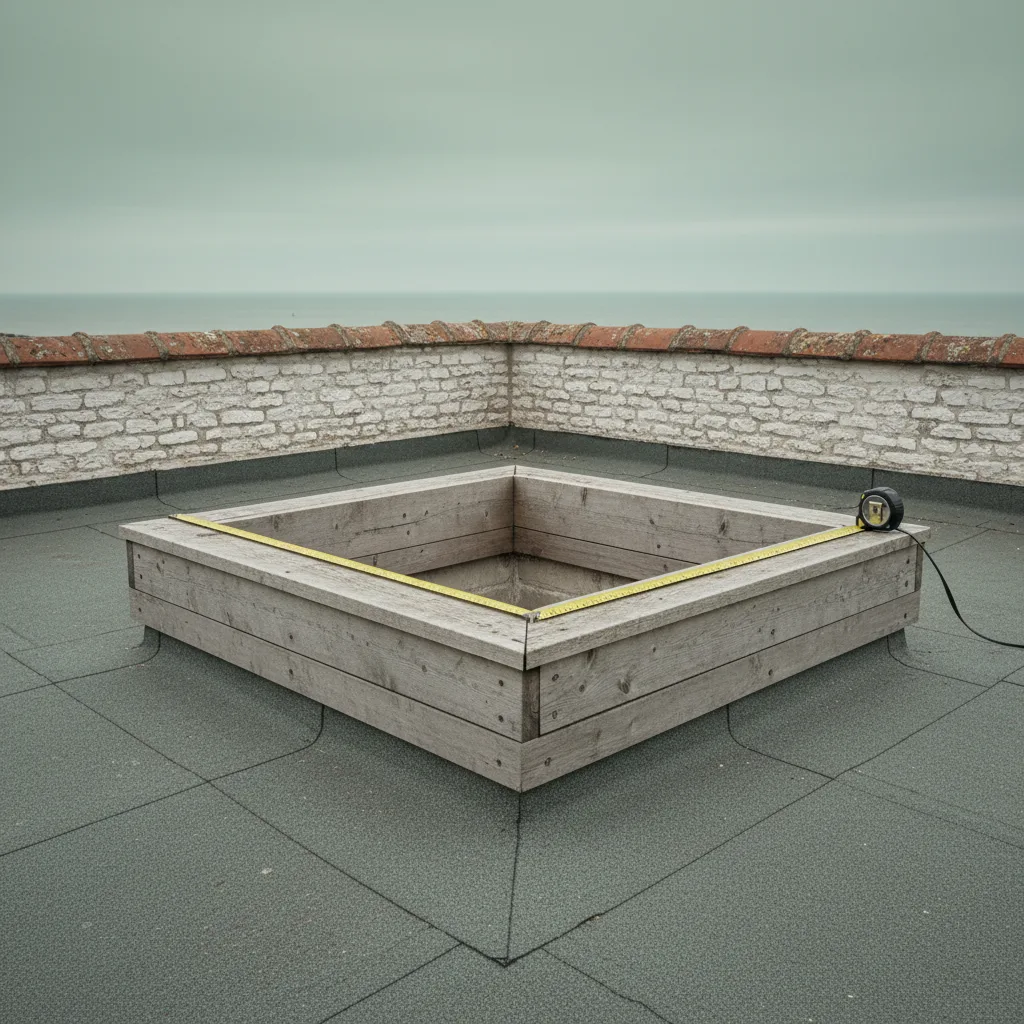
Whether there is an underlay collar. Whether insulation was carried up to the frame. Whether the vapour control layer was sealed. The condition of the trimmers. On a flat roof, whether the build-up is warm deck or cold deck.
That is a small area lifted at the perimeter and made good, rather than a strip out. It is the difference between a diagnosis and an opinion, and we would rather do it before quoting than discover it afterwards.
Symptoms that are not faults
Three things get reported regularly and are the product working correctly.
Dew on the outside of the glass on clear still nights, which is evidence the unit is well insulated. A little mist on the inside on a cold morning in a humid room, which clears through the morning. And rain noise on overhead glass, which is louder than on a window because the drops arrive perpendicular.
Knowing which of these are normal saves a call-out and, more usefully, stops somebody replacing a sound unit.
Symptoms that mean act now
And three that are worth attending to promptly rather than watching.
Anything that needs force to operate, because force turns a service item into a broken part. A mounting that has worked loose, because it works further loose. And staining or mould establishing on plaster, because by then it has been going on long enough to be doing damage.
Why we do not quote from photographs
We will look at photographs for a first conversation and we will not price from them.
A photograph cannot show whether the deck is sound, whether the roof ponds, what the fall or the pitch is, whether the kerb is square, what the build-up is, or what the access route is. Quoting with those unknown means a price that moves once work starts, which helps nobody.
What photographs are genuinely good for is establishing whether a visit is worth anybody’s time, and what to bring.
The trap of the previous repair
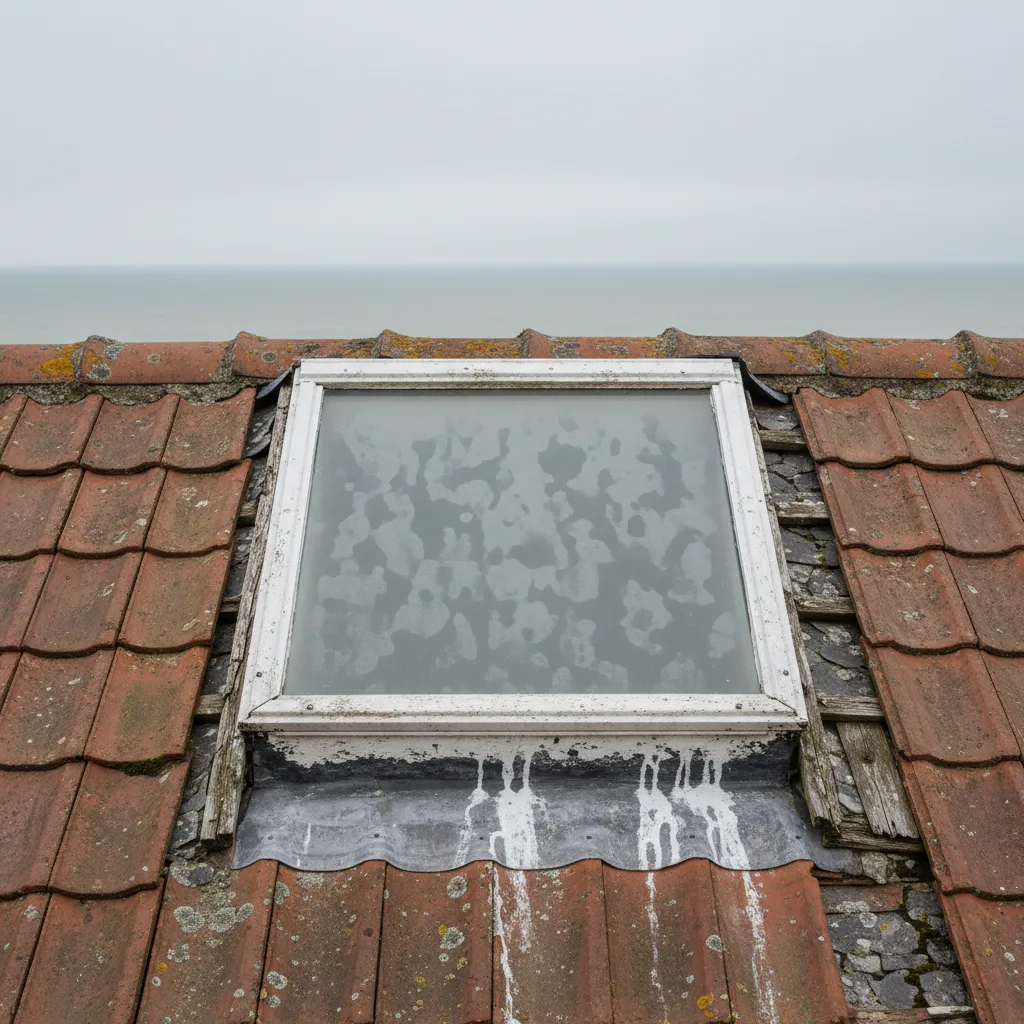
A rooflight that has already been worked on twice is a harder diagnosis than one nobody has touched, and it is the common case by the time we are called.
Previous repairs leave evidence and they also leave interference. Sealant applied over a junction hides what the junction was doing. A flashing replaced two years ago rules that out and also means the covering around it has been disturbed. A unit replaced once already means the trimming was accessible and either corrected or left.
So the useful question is what has been done before and whether it changed anything, rather than only what is wrong now. Where a previous repair made no difference, that is a strong indication the cause was never in that area at all, which narrows the field usefully.
Age, and what it makes likely
The age of a unit shifts the probabilities more than any other single fact, and it is the first thing we establish.
Under ten years, a symptom is unlikely to be wear and is much more likely to be the installation or the room. Ten to twenty, gaskets and mechanisms come into play. Beyond twenty, seal failure, hardened gaskets and chalked coatings are all normal, and the unit predates the practices that would have given it a collar and an insulated reveal.
Which means the same symptom on a five year old unit and a thirty year old one gets investigated differently, and reasonably so.
The diagnosis that saves the most money
In our experience the single most valuable finding is that a complaint about a rooflight is a complaint about the installation rather than the unit.
A missing underlay collar, insulation never carried to the frame, or a vapour control layer never sealed will each produce a symptom that looks exactly like a failed window. Each is fixed by opening up locally rather than by a new unit, and each will recur if a new unit is fitted into the same detail.
That is the case where getting the order of investigation right is worth the whole price of the job.
And the one that goes the other way
The reverse happens too, and it is worth being even handed.
A misted sealed unit is a failed unit. No amount of ventilation, heating, dehumidifying or investigation changes it, and no repair worth having exists. Where somebody has been chasing a leak for two years and the actual finding is a failed seal, the answer is the expensive one.
The point of the order of investigation is not to avoid replacing units. It is to replace them when that is the answer.
The question we start with on a replacement
We ask about the room before we ask about the roof, and about the weather before we ask about the water. We work outward from cheapest and most probable to most expensive and least probable, we open up locally where the answer is not visible from either side, and we say plainly when the fix is a ventilation change or a gasket rather than a window.
The unit is the last thing to suspect and the first thing everybody suspects. Working the order the other way round is most of the job.
Thinking about this job? We survey across Worthing, West Sussex and the South Downs and give you a fixed price before any work starts, with a 10-year workmanship guarantee.