Rooflight and Skylight Installation in Felpham
- Fixed quote before we start
- Roof never left open overnight
- 10-year workmanship guarantee

- Fixed quote before we start
- 10 years workmanship guarantee
- 25 years fitting rooflights
- Skylights only, not a general roofer
Felpham sits directly behind a sea wall, and that produces a condition distinct from ordinary coastal exposure. Most seaside properties deal with salt aerosol, a fine film carried on the wind. The first rows here deal with spray as well: actual water, thrown over a wall in volume, arriving as droplets rather than as a mist. The two do different things and they want different answers.
Aerosol and spray are not the same thing
The distinction that governs the specification on the front rows, and it is rarely drawn.
Salt aerosol is a fine suspension carried inland on the wind. It settles as a film, holds moisture against metal, and works slowly and continuously. It is what most of this coast deals with and it is a chemical problem.
Spray is water thrown over a wall by a wave. It arrives in quantity, with force, carrying whatever the sea has picked up, and it lands rather than settling. It is a chemical problem and a mechanical one at the same time.
| Salt aerosol | Overtopping spray | |
|---|---|---|
| Arrives as | A fine film | Water, in volume |
| Frequency | Continuous | Storm events |
| Attacks | Coatings, fixings | Coatings, seals, the detail |
| Force | None | Real, and directional |
| Carries | Salt | Salt, sand, shingle fragments |
| Remedy | Marine grade, stainless | The above, plus sealing detail |
What spray does to a rooflight
Three things, and only the first is what people expect.
It deposits far more salt in one event than a month of aerosol, and it deposits it on surfaces the wind alone would not reach, including the underside of a flashing edge and the upslope face of an upstand.
It arrives with force and direction, so it drives into laps and seals rather than settling on them. And it carries abrasive material, which over years dulls glass and wears at a coating in a way a still film does not.
How high it goes
The practical question on the front rows, and it is worth asking a household rather than estimating.
Overtopping is not uniform along a sea wall or between storms. Some positions take it regularly, some rarely, and the people who live there know exactly which.
We ask. A household that has watched water come over the wall for twenty years is a better source than any map, and their answer changes what we specify.
What that changes in the detail
Beyond the ordinary marine specification, which applies here as a baseline.
Sealing at the head of a unit matters more, because water is arriving from the seaward side with force rather than running down the slope. Laps are generous, flashings are held rather than dressed and trusted, and the upstand is not the minimum.
It is closer to how one would detail for driven rain than for a salt film, and on the front rows here it is both at once.
Rinsing after a storm
The maintenance point that is specific to spray rather than aerosol.
A single overtopping event puts more salt on a unit than months of ordinary exposure. Rinsing within a few days of one, rather than on a twice yearly schedule, is what actually protects the metalwork.
It is a small habit and on a low roof it is five minutes. Households on the front row generally already know when it has happened.
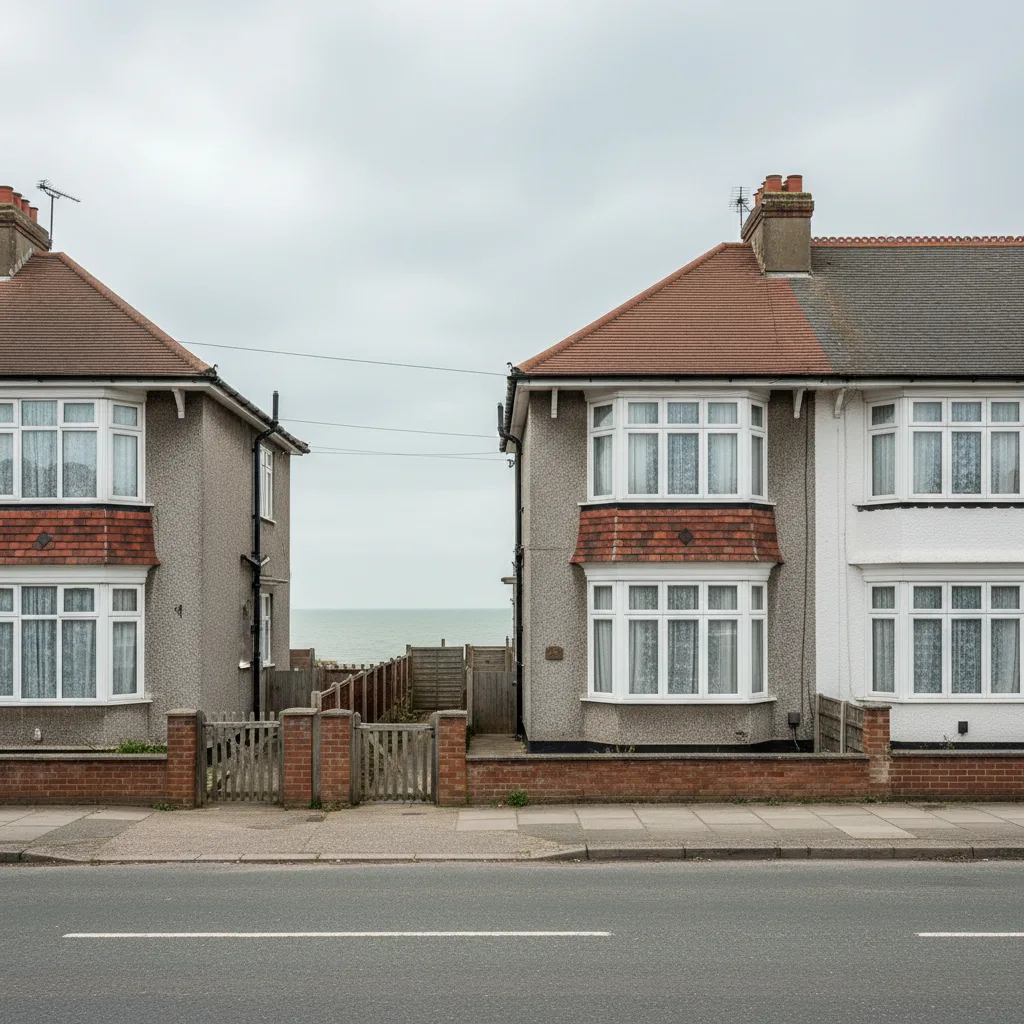
The sea wall, and what it does not stop
Worth saying, because people assume it shelters the roofs behind it.
A wall stops water at ground level and it does very little for a roof. Aerosol lifts over it and continues inland, and spray that clears the top arrives at first floor height rather than at the base of a building.
Which means a roof behind a sea wall is not in a sheltered position. It is in a position where the ground floor is protected and the roof is not.
Behind the front rows
The gradient inland, and it is steeper here than on an open beach.
Spray is a short range condition: it reaches the first row or two and then stops. Aerosol continues, attenuating with distance and with whatever built development stands in the way.
So the second street back is dealing with an ordinary coastal specification, and the fourth is dealing with very little. It is judged at the plot and we will specify standard where standard is right.
The old village
A quite different Felpham, and it is where the conservation work is.
A designated area over the old village core, with clay plain tile on cut roofs, flint elevations and a handful of buildings of real significance.
Slim flush units on anything visible, rear slopes treated more straightforwardly. How designation narrows permitted development is on article 2(3) land and permitted development.
Buildings of literary significance
Worth a note, because the village has one and it changes the assessment near it.
Where a building’s significance is historic and associational as well as architectural, the setting around it matters in a way it would not otherwise, and proposals nearby are considered against how that setting is experienced.
It is an unusual consideration and it is a real one. On properties in that part of the village, an application is worth pitching accordingly rather than as a routine roof alteration.
Flint, and where a scaffold ties
The walling in the old village, and it decides the scaffold rather than the roof.
What flint is, why it takes no fixing and where a tie can legitimately go is on the Poynings page, where it is the dominant condition.
On a listed building here a fixing into an elevation forms part of the consent rather than being incidental to it.
What the Felpham stock asks for
Three further conditions apply across the older stock and each is set out elsewhere.
Timber frames are on the Steyning page. Hand made clay tile is on Sussex clay peg tile. What helps a listed application is on the Arundel page.
Each is established at survey and none is peculiar to this village.
Conservation units in a spray zone
The combination that is hardest here, and it is worth naming because the two requirements pull opposite ways.
A conservation unit is slim, which means less metal and less coating between the weather and the fixing. The position wants the most robust specification available.
The answer is to specify the coating and the fixings up rather than the unit down. What that involves is on the Ferring page, where conservation and salt meet in the same way.

Salt inside a roof space
A consequence of spray that people do not expect, and it is worth checking on the front rows.
Where a roof has been ventilated and draughty for decades in this position, salt laden air has been moving through the roof space as well as over it. Fixings, nail heads and any metalwork inside it corrode along with those outside.
Which means the timber and the fixings a new unit is being attached to may be in worse condition than they look from a distance. It is checked with a torch rather than assumed, because a good unit on failing fixings is not a good installation.
Rooms that face the sea
A daylight point rather than a durability one, and it changes the specification.
A south facing slope on this frontage gets direct sun and a great deal of reflected light off the water, which together make a room brighter and warmer than the same aspect inland.
Solar control glass earns its place more readily here than a few miles back, and it is specified at order rather than dealt with by a blind afterwards.
The later housing
Most of Felpham by area, twentieth century development between the old village and the sea.
Cut roofs on the earlier stock, trussed on the later, and rear extensions with flat decks throughout. Ordinary work, in a position that is not.
Where the roof is trussed the widths are on trussed rafters and the widths that fit between them.
Gutters and downpipes on the front row
A related item worth looking at while a scaffold is up.
Overtopping puts sand and shingle grit into gutters in quantity, and on a property that takes it regularly the gutters silt faster than anybody expects. A blocked gutter overflows against a wall that is already taking salt.
It is not our work and it is worth mentioning, because the scaffold is there and clearing them at that point costs almost nothing.
Bungalows on the seaward side
Common here, and they make the work considerably easier in every respect except the environment.
Every room is reachable from the roof space, the roof is low enough to work from a tower, and the dome or unit is reachable for the rinsing that this position demands.
What a coastal bungalow specifically asks for is on flat roof rooflights on a coastal bungalow.
Ponding on a flat deck near the front
A condition worth checking on any seaward extension here.
Shallow falls are common on additions of this age, and where spray adds water in volume to a deck that already drains slowly, a kerb can stand in standing water for days after a storm.
Where the fall is inadequate we say so before fitting rather than after. A good unit on a ponding deck in this position is work that comes back sooner than it would inland.
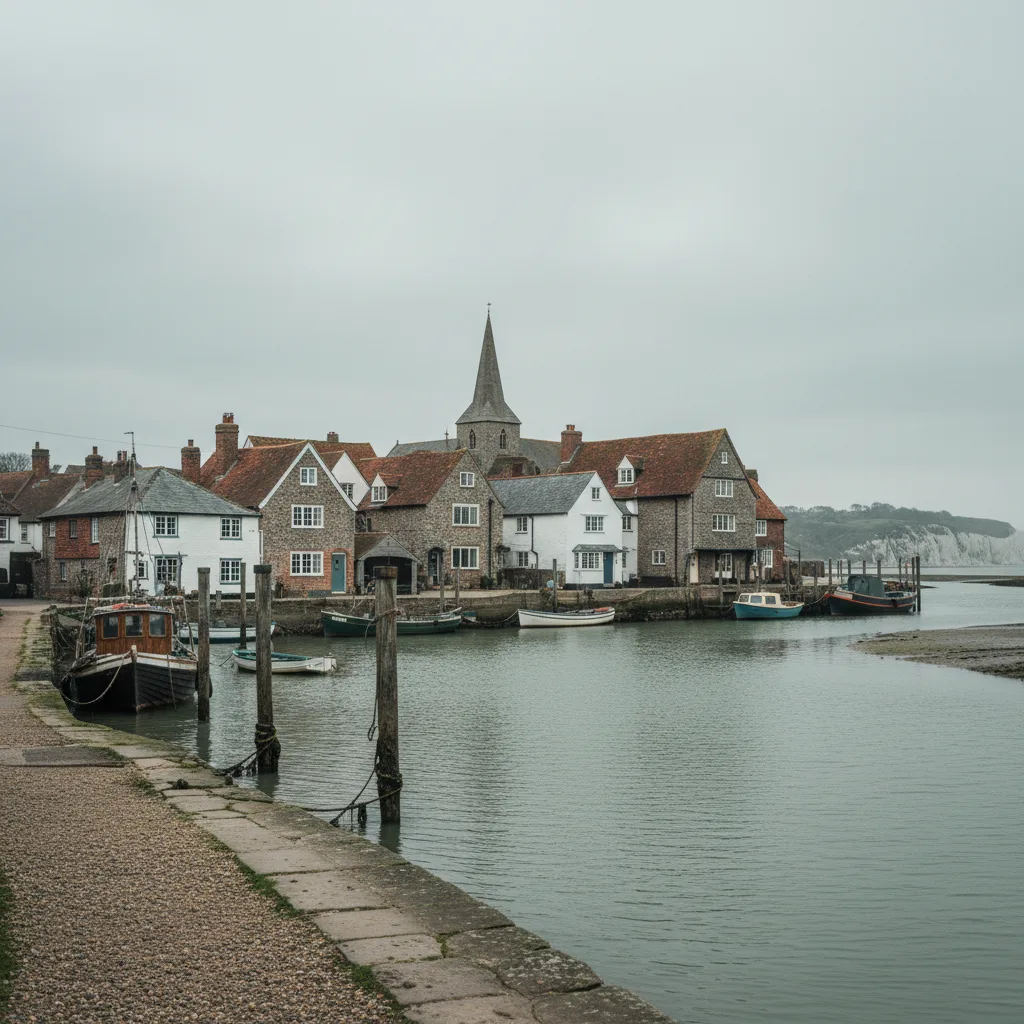
Getting to the roof in Felpham
Mixed, and it splits between the two halves of the village.
The old village has narrow lanes, frontages close to the road and limited turning, so a scaffold occupies rather than stands beside and needs a licence.
The later housing has drives, side gates and space, and on a bungalow a tower is generally enough. Both are settled at survey rather than averaged.
What the survey establishes
- Whether the property takes overtopping spray, asked of the household.
- How many rows back from the wall it sits, and what stands between.
- Whether it is inside the village designation or near a significant setting.
- Whether the elevation is flint, and where a tie can go.
- The fall on any seaward flat deck.
- Whether the roof is cut or trussed on the later stock.
Building Control
A replacement into an existing opening is not normally notifiable, though the unit still has to meet the limiting thermal standard. A new opening is, and goes to Arun District Council or an approved inspector.
The thresholds are on do flat rooflights need Building Control.
Permitted development
Across the later housing most work is permitted development, subject to the projection limit above the plane of the roof and nothing forward of the principal elevation.
In the old village those rights are narrowed and a visible slope needs an application. Which applies to a specific address is established before a unit is specified.
How we quote
A free indicative range by email from photographs, then a survey, then a fixed itemised written price that does not move afterwards. Anything we misjudge at survey is ours to absorb.
What is measured at each step is on the how we price and quote page.
Guarantee
Ten years on our workmanship, on every job, limits written down. The manufacturer stands behind the unit; we stand behind the kerb, the flashing and the making good.
The terms, and the accreditations we do not claim, are on the our guarantee page.
Skylight services in this area
Conservation Rooflight Installation
Read moreElectric and Opening Rooflight Installation
Read moreEnergy Efficient Rooflights
Read moreFlat Roof Rooflight Installation
Read moreReplacing a Failed or Misted Rooflight
Read moreRoof Lantern Installation
Read moreRoof Window Installation
Read moreSun Tunnel Installation
Read moreVELUX Window Installation
Read moreWalk-On Rooflight Installation
Read moreThinking about this job? We survey across Worthing, West Sussex and the South Downs and give you a fixed price before any work starts, with a 10-year workmanship guarantee.