Rooflight and Skylight Installation in Goring-by-Sea
- Fixed quote before we start
- Roof never left open overnight
- 10-year workmanship guarantee

- Fixed quote before we start
- 10 years workmanship guarantee
- 25 years fitting rooflights
- Skylights only, not a general roofer
Goring runs from a genuine old village core down to a beach, and the half mile between the two changes what a rooflight has to be. Inland of the railway a standard specification is fine. South of Goring Road it is not, and the units we are called to replace here are almost always the ones that were.
What we install in Goring-by-Sea
Replacements to a marine specification, more than anything else, and the reason is the previous unit.
A rooflight fitted here fifteen years ago with a standard architectural coating and ordinary fixings has by now taken fifteen years of salt film. The coating has chalked, the fixings have bled rust down the tile, and the ironmongery on anything that opens has seized.
The unit is frequently still watertight. It is the metalwork that has gone, and that is a specification failure rather than a manufacturing one.
What the salt actually does
Worth being specific, because the mechanism decides the remedy.
Salt aerosol carries inland on a southerly and settles as a film on everything facing the weather. It does not wash off in rain the way dust does; it stays, it holds moisture against the surface, and it keeps a metal component damp for far longer than the weather alone would.
Which means corrosion here is not a matter of the odd storm. It is continuous, it works on fixings and coatings rather than on glass, and it is why the specification is about metal.
The marine specification, item by item
| Component | Inland | South of Goring Road |
|---|---|---|
| Frame coating | Standard architectural | Marine grade |
| Visible fixings | Ordinary | Stainless |
| Flashing | Aluminium as supplied | Checked for compatibility |
| Opening ironmongery | Standard | Marine rated, and it matters most |
| Trickle and vent parts | Standard | Marine rated |
| Rinsing regime | Not needed | Twice a year makes a real difference |
Where the line actually falls
Not at a fixed distance, and it is worth saying so.
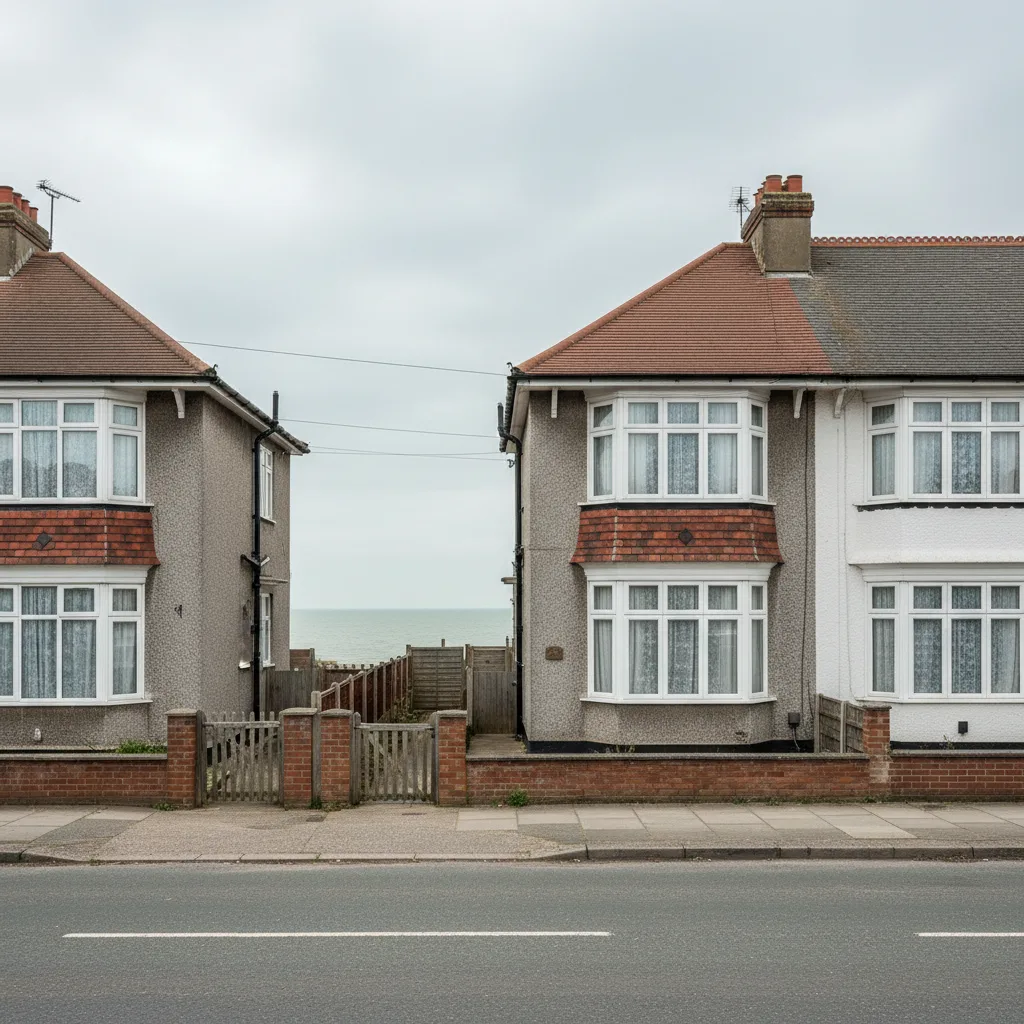
Exposure here is decided by what stands between the house and the sea rather than by how far the sea is. A first row bungalow on Marine Crescent is in a different environment from a house the same distance back but behind a terrace and a line of mature holm oak.
Which is why the survey looks at the approach from the south rather than measuring on a map. We will specify inland where inland is right, because marine grade costs more and adding it where it does nothing is not honest.
Ilex Way and the shelter it gives
A genuinely local factor and it makes a measurable difference.
The avenue of holm oaks along Ilex Way, and the mature planting through the old village, break the salt laden air before it reaches the houses behind them. Properties in that band are noticeably less exposed than their distance from the beach suggests.
They are also, for the same reason, shaded. A rear slope under a mature ilex delivers considerably less daylight than the same slope in the open, and that is worth saying before a unit is ordered rather than after it is fitted.
The old village and the conservation area
The designation covers Goring village and the streets around it, which is a different place from the seafront estates.
Here the roofs are clay plain tile on cut structures, the buildings face a village street rather than a beach, and the question is appearance rather than salt. Slim conservation units on anything visible, standard positions on rear slopes out of view.
How the designation narrows what is permitted is on article 2(3) land and permitted development.
The later estates
Most of Goring by area, and it is post-war housing on concrete interlocking tile.
Trussed rafters over much of it, deep profile tile, and rear extensions with flat decks. The flashing question here is the profile of the tile rather than the age of the roof, and the kit has to follow the roll rather than sit across it.
Which kit suits which covering is on flashing kits and roof coverings across Sussex.
Bungalows, of which there are a great many
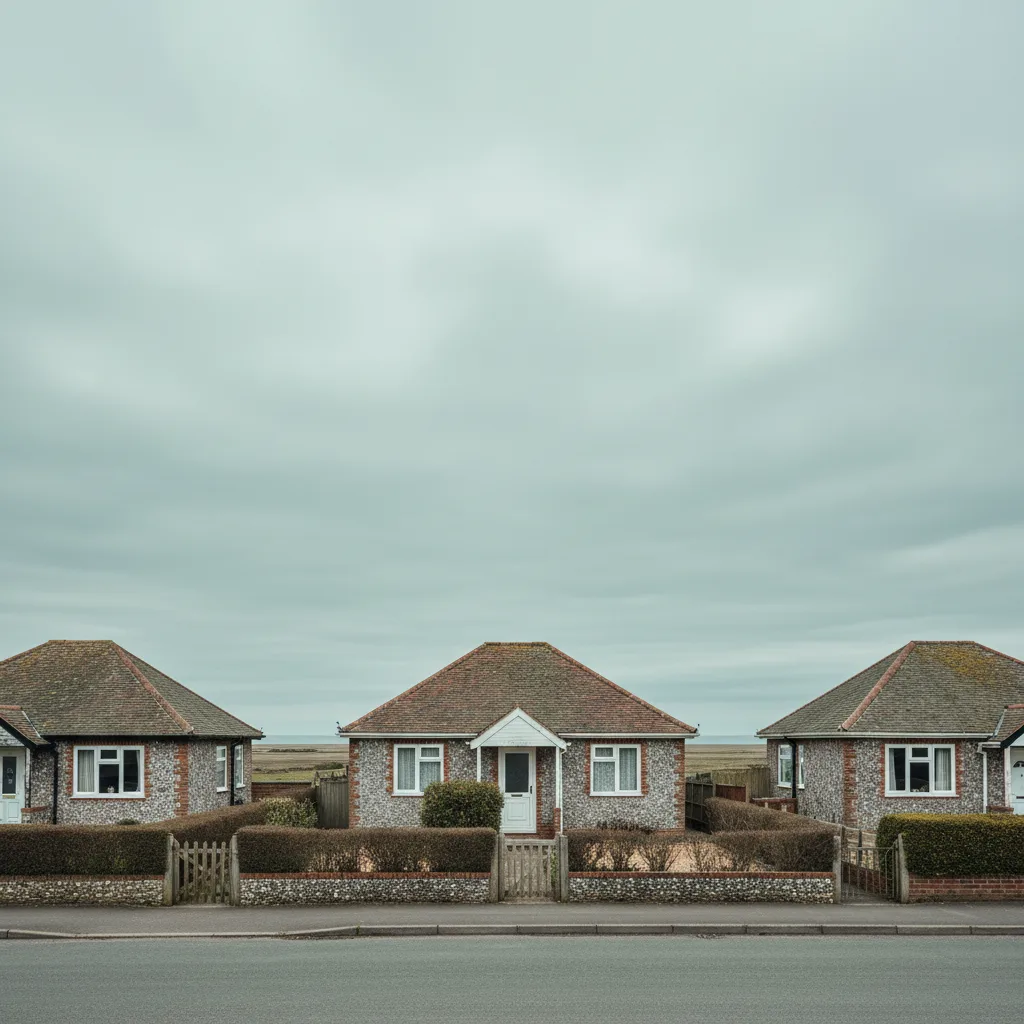
The dominant house type on the seaward side, and it changes what is possible in a good way.
Every ceiling in a bungalow has roof space above it, so every room can be reached. Rooflights, roof windows and sun tunnels are all available, and the runs are short.
What the coastal bungalow asks for specifically, from the shallow falls on its flat roofed addition to the salt on its fixings, is on flat roof rooflights on a coastal bungalow.
Wind, which comes with the salt
Rarely mentioned and it is the other half of the exposure.
A seafront plot with nothing between it and the Channel takes wind loading that an inland roof does not, and it arrives with the rain behind it. The fixing specification is the manufacturer’s rather than an approximation, and the flashing is dressed properly rather than relied on with sealant.
A unit that is correctly fixed is untroubled by it. One that is not finds out in the first serious southwesterly.
Rain noise on a bungalow ceiling
A Goring specific point because so much of the stock is single storey.
In a bungalow the roof is directly over the room, so anything happening on it is heard. An old plastic dome amplifies rain to a degree that surprises people, and replacing it with a glazed unit is quieter rather than louder.
Where rain noise is a stated concern, glass thickness and an asymmetric make up both help, and it is worth specifying deliberately rather than hoping.
Sand and grit
The other thing the wind brings, and it affects maintenance rather than specification.
Wind blown sand on a glazed surface is abrasive, and wiping a dry unit drags it across the glass. Rinsing first and then wiping keeps a rooflight clear; polishing a dry one with a cloth every spring will dull it within a few years.
It is a small thing to tell a household once, and it is worth more over ten years than most of the specification decisions.
The railway line, and what it divides
A useful local landmark for exposure, because it runs roughly parallel to the coast through Goring.
North of the line the houses sit behind a substantial band of built development and planting, and standard coatings generally hold up. South of it, and particularly south of Goring Road, they do not.
It is a rule of thumb rather than a boundary, and it is a better starting point than distance from the beach. The survey still looks at the individual plot, because a corner site with an open aspect can be more exposed than its neighbours.
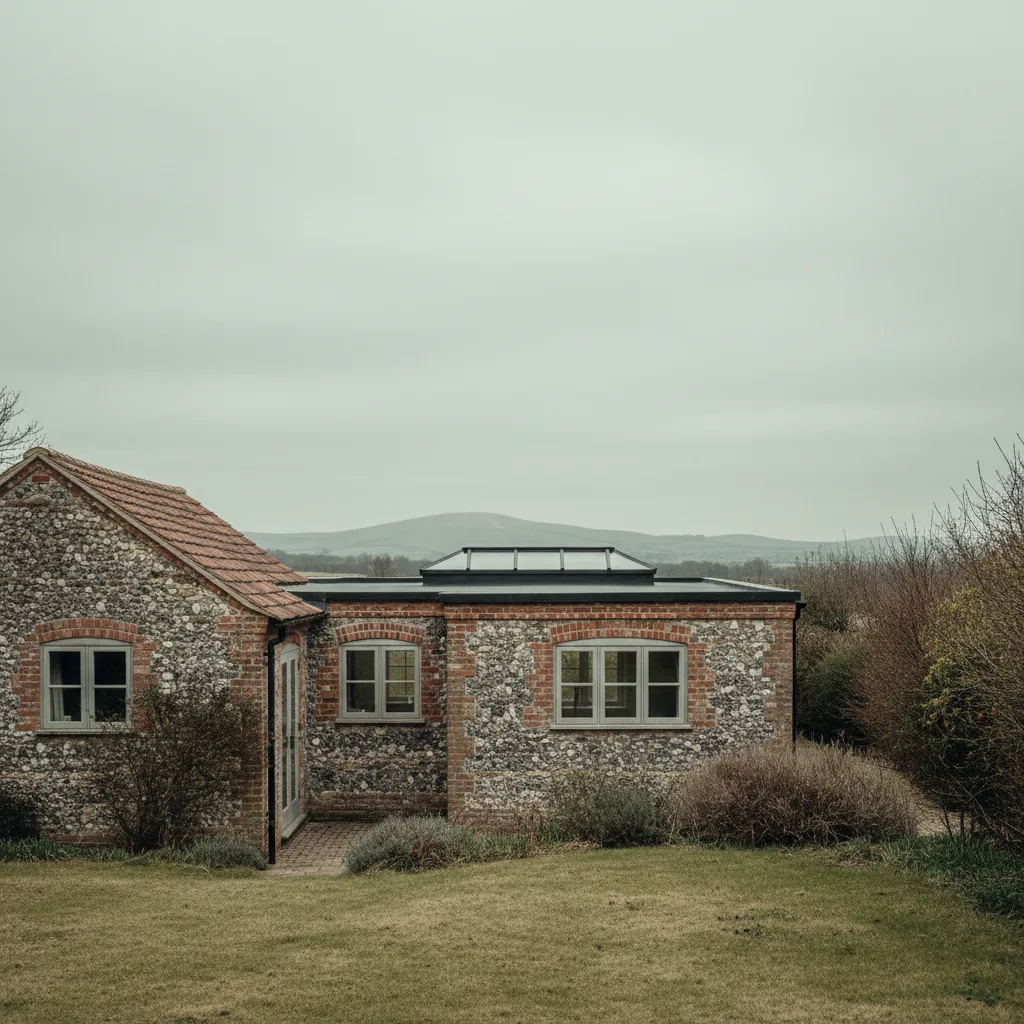
Flat roofed additions on the seaward side
Extremely common here, and the falls are the thing to check.
A single storey addition on a coastal plot was frequently built with a shallow fall, and thirty years of settlement has left some of them flatter still. Water sits, and a rooflight kerb standing in standing water is a different maintenance proposition from one on a deck that drains.
Where the fall is inadequate we say so, because putting a good unit onto a deck that ponds is work that will be back.
Rinsing, and why we mention it
The one piece of maintenance that genuinely extends the life of a unit here.
Fresh water over the frame and the fixings twice a year removes the salt film before it has done its work. On a bungalow it is reachable from a ladder and it takes a few minutes.
It does not replace a marine specification and it makes a marine specification last considerably longer. Both together are why some units on this coast are fine at twenty years and others are finished at eight.
Solar gain on a south facing slope
Goring faces the sea, which means a great many rear slopes and flat decks face south.
Solar control glass is close to standard on a south facing unit here, and it is worth specifying at order rather than adding a blind afterwards. On a north facing slope it does nothing and we will not include it.
West facing is its own case, where late afternoon rather than midday is the problem being solved, and the glass is chosen accordingly.
Access on the seafront roads
Generally easy and occasionally not.
Most of the estate housing has a drive and space beside it. The seafront roads themselves are narrower, with parking pressure through the summer, and a scaffold on the highway needs a licence and a date.
On a bungalow a tower is usually enough, which avoids the question entirely, and that is one of several reasons a bungalow job here is more straightforward than it looks.
Trickle vents and where the air comes from
A small requirement that catches replacements out here.
Where a room’s background ventilation came through the old unit, the replacement has to provide it too, and not every current rooflight carries a vent. On a bungalow with a single rooflight in a bathroom that is the only background ventilation the room has.
It is checked at survey, because discovering it at fitting means either the wrong unit or a room that no longer ventilates.
Replacing like for like, and when not to
The decision that comes up on almost every Goring replacement.
Where the existing opening is sound and correctly positioned, a current unit in the same opening is the short job and the right one. Where the original was badly placed, undersized, or fitted into an upstand that has never been right, replacing like for like repeats somebody else’s mistake for another twenty years.
We will say which of those we think it is, and the difference in price between them is usually smaller than people expect.
What the survey establishes
- What stands between the property and the sea from the south.
- Whether the address sits inside the village conservation area.
- The tile profile, which decides the flashing kit.
- Whether the roof is cut or trussed.
- Orientation, which decides the glass.
- The condition of any existing fixings, which tells us how hard this position actually is.
Building Control
A replacement into an existing opening is not normally notifiable, though the unit still has to meet the limiting thermal standard. A new opening is, and goes to Worthing Borough Council or an approved inspector.
The thresholds are on do flat rooflights need Building Control.
Permitted development
Across the estates most rooflight work is permitted development, subject to the projection limit above the plane of the roof and nothing forward of the principal elevation.
Inside the village conservation area those rights are narrower and a visible slope will need an application. Which side of that line an address falls on is established before a unit is specified, because it changes the product rather than only the paperwork.
How we quote
A free indicative range by email from photographs, then a survey, then a fixed itemised written price that does not move afterwards. Anything we misjudge at survey is ours to absorb.
What is measured at each step is on the how we price and quote page.
Guarantee
Ten years on our workmanship, on every job, limits written down. The manufacturer stands behind the unit; we stand behind the kerb, the flashing and the making good.
The terms, and the accreditations we do not claim, are on the our guarantee page.
Skylight services in this area
Conservation Rooflight Installation
Read moreElectric and Opening Rooflight Installation
Read moreEnergy Efficient Rooflights
Read moreFlat Roof Rooflight Installation
Read moreReplacing a Failed or Misted Rooflight
Read moreRoof Lantern Installation
Read moreRoof Window Installation
Read moreSun Tunnel Installation
Read moreVELUX Window Installation
Read moreWalk-On Rooflight Installation
Read moreThinking about this job? We survey across Worthing, West Sussex and the South Downs and give you a fixed price before any work starts, with a 10-year workmanship guarantee.