If the mist is between the two panes and will not wipe off either face, the sealed unit has failed. The seal around the edge of the unit has let moisture into the cavity, and once air can get in and out the glass will fog whenever conditions suit. It is a failed component rather than a symptom of anything the room is doing.
The test that settles it
Wipe both faces.
Mist that clears with a cloth is on a surface. Mist that remains when the inside is dry and the outside is dry is inside the unit, and nothing you do to the room will change it.
What a sealed unit is
Two panes and a controlled cavity. A spacer bar around the perimeter holds the panes apart, the cavity is filled with dry air or an inert gas, and a sealant around the edge holds the whole thing gas tight.
What the desiccant does
Keeps the cavity dry from the start.
The spacer bar contains a drying agent that absorbs the small amount of moisture sealed in during manufacture, which is why a new unit is clear.
Once it is saturated it can absorb no more.
How the seal fails
Slowly, by movement and by ultraviolet. The edge seal is worked by daily expansion and contraction and degraded over years by sunlight, and eventually it develops a path that lets air past.
Why a rooflight fails before a window
Because of what it faces. A pane in a roof takes direct sun for far longer than a vertical window, reaches higher temperatures, and cools further at night, so the edge seal is worked harder.
How long they last is on how long do rooflights last.
Why water sitting on it matters
Because standing water attacks the seal. A shallow pane holds water where a vertical one sheds it, and prolonged wetting at the edge is one of the things that shortens a flat rooflight unit’s life.

What you see first
A faint haze on cold mornings. The earliest sign is a light misting at the edges when the temperature swings, clearing later in the day, and it is easily missed for a season or two.
What you see later
Marks that stay. Once mist has repeatedly formed and dried on the inner faces, mineral deposits are left behind, and those remain visible even when the pane is clear.
That is the point at which it stops being reversible in appearance.
Whether it will get worse
Gradually, and it does not recover. The path into the cavity does not heal, so the fogging becomes more frequent over the years, though there is no urgency about it beyond how it looks.
What it does to performance
Less than people fear.
The cavity gas has gone, so a unit filled with argon now performs closer to plain double glazing, which shows as a slightly colder pane rather than as a draught.
What the figure means is on what U value should a rooflight have.
Whether it can be dried out
Not in any way we would recommend.
Drilling a unit to vent and dry it clears the appearance for a period, and the cavity is then permanently open to the air with no gas fill and no reliable desiccant.
On a roof, where the pane is doing thermal work, that is not a repair.
What the actual repair is
A new sealed unit.
Where the frame is sound, the glass alone is replaced and everything else stays, which is a fraction of the work of a new rooflight.
That route is on can just the glass be replaced.
Where that is not possible
A bonded unit.
Some flat rooflights are made with the glass structurally bonded into the frame, and on those the unit and the frame are replaced together.
The comparison is on can a misted rooflight be repaired.
Condensation on the room side instead
Far more common, and not a fault.
Warm moist air meeting the coldest surface in the room gives up its water there, and in a kitchen or a bathroom the glass overhead is that surface.
What to do is on how do I stop condensation on a rooflight.
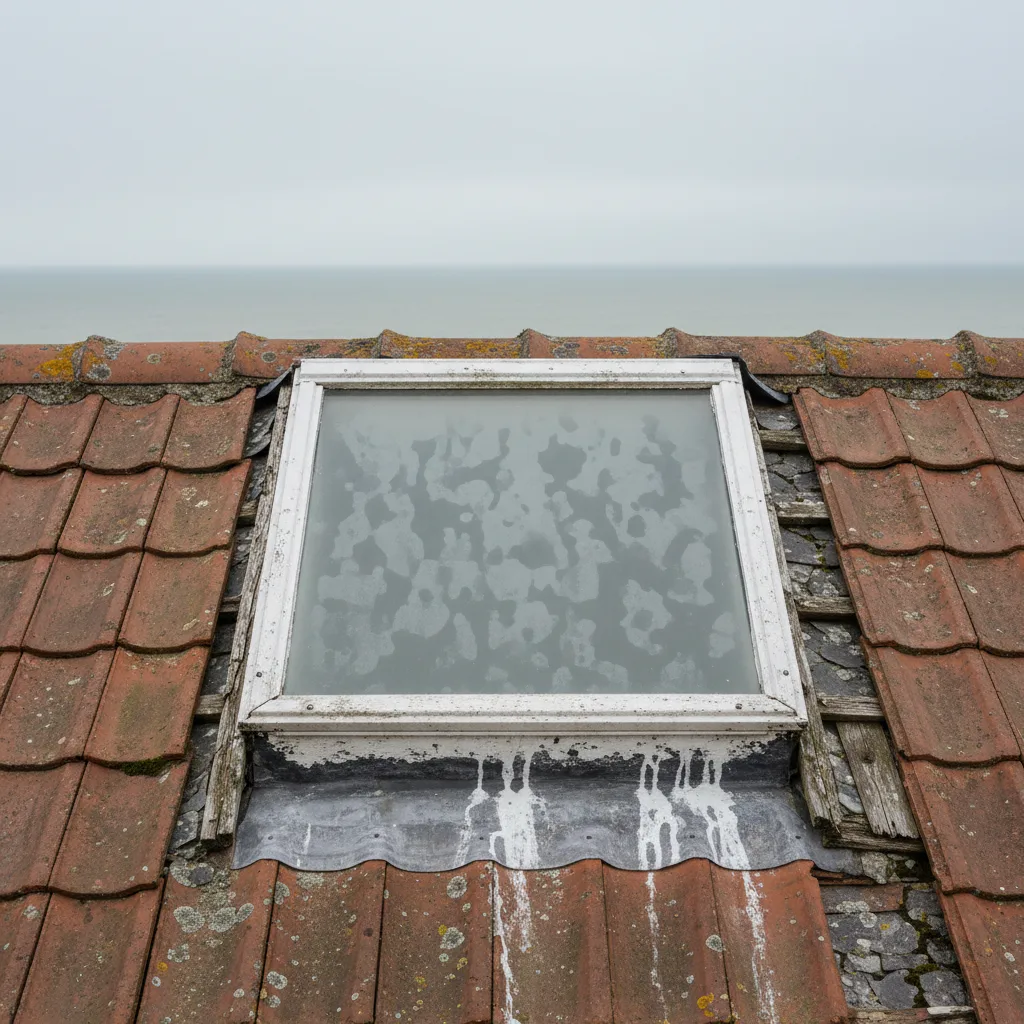
Dew on the outside face
Counter intuitive and entirely good.
A well insulated unit lets so little heat out that the outer pane cools to the temperature of the night sky, and dew forms on it exactly as it does on a car.
It clears within an hour of the sun reaching it.
Mist in one corner only
Usually where the seal went first.
A failure often begins at one corner, so an early failed unit fogs at one edge and clears elsewhere, which people read as condensation.
Both panes of a pair failing
Common, and it makes sense.
Two units installed at the same time on the same roof have had the same life, so where one has failed the other is generally not far behind.
It is worth deciding about both at once.
Whether a guarantee covers it
Frequently, and it is worth checking.
Sealed units carry a guarantee against this specific failure for a stated period, and a unit failing early is exactly what it exists for.
The paperwork or the spacer bar markings will identify the maker.
Where the date is marked
On the spacer bar, usually.
Many units carry a manufacturer mark and a date within the cavity, readable through the glass, and it tells you how old the unit actually is.
Whether to replace the whole rooflight
Depends on its age and its figure.
A recent unit is a pane replacement. A very old one is often replaced entirely for the thermal step rather than because it has failed.
The comparison is on will a new rooflight be warmer.
The question we start with on a replacement
We ask for the wipe test and a photograph before quoting, because a good proportion of misting enquiries turn out to be a room that needs venting rather than a unit that has failed.
The whole picture is on the replacing a failed or misted rooflight page.
Thinking about this job? We survey across Worthing, West Sussex and the South Downs and give you a fixed price before any work starts, with a 10-year workmanship guarantee.