VELUX Window Installation
- Fixed quote before we start
- Roof never left open overnight
- 10-year workmanship guarantee
- Fixed quote before we start
- 10 years workmanship guarantee
- 25 years fitting rooflights
- Skylights only, not a general roofer
VELUX window installation and replacement in Worthing
VELUX is the name most people arrive with, and for good reason: it has been the default roof window in this country for decades, so a large share of the pitched roofs in this radius already have one. That shapes the work. Most of what we do under this heading is replacement rather than a new opening.
We fit VELUX, and we also fit Keylite, Roto and Fakro. We are experienced installers of these products. We are not a manufacturer-certified partner and we will not claim to be, because that is a specific commercial relationship and saying otherwise would be a lie you could check.
Start with the data plate
Every VELUX carries a data plate, usually on the top edge of the sash, visible when the window is rotated or swung open. It gives the model, the size code and the year of manufacture.
That plate is the single most useful thing you can send us. A photograph of it usually gets you an indicative price without anyone visiting, because it tells us the size, the generation and therefore what will fit the existing opening.
The size code is two characters and a number, and it is not a dimension. It is a catalogue reference: an MK04 is 780mm by 980mm, a CK02 is 550mm by 780mm. The codes have been stable for a long time, which is why a window from the eighties can often be matched today even though the model name has changed three times.
Matching an obsolete size
Sometimes the code has been discontinued. Older roofs around Worthing and Hove carry sizes that no longer appear in any current range, and a few carry pre-code windows that predate the system.
There are three honest options. Fit the nearest current size and make good, which means adjusting the opening and disturbing the covering, and is fine on a concrete interlocking tile roof and unwelcome on a hand made peg tile one. Fit a made to measure unit from a manufacturer that offers one, which costs more and takes longer. Or reframe the opening to a standard size, which is the right answer when the timber around it needs attention anyway.
We set out which applies at survey, with the reason, rather than presenting one option as though it were the only one.
Kits are named by profile, and by frame size
The general point, that a flashing kit rather than the window is what keeps water out and that the kit must match the covering profile, is set out on flashing kits and roof coverings across Sussex and on the roof window installation page.
What is specific to this manufacturer is that a kit is ordered against two things rather than one: the covering profile, and the exact frame size code of the window it is going around. A kit for the right covering and the wrong size does not fit.
Which is why the size code comes off the data plate before anything is ordered, and why a replacement into an obsolete size is a kit question as well as a window question.
Recessed and combination kits
Two families worth knowing about, because they solve problems people do not know are solvable.
A recessed kit sets the window deeper into the plane of the covering, which makes it sit flatter and read as less of an object on the roof. On a slope that is visible in a designated area, that is occasionally what makes a proposal acceptable.
A combination kit weathers two or more windows installed side by side or stacked, with a designed detail between them rather than two separate kits butted together. Where two units are wanted on one slope, it is the correct way to do it and it has to be ordered as such.

Service parts, and how long they stay available
A practical advantage of a manufacturer this size, and it is worth knowing.
Handles, hinges, sash cords, gas struts, blind fittings and glazing units are available as parts for a long time after a window model has been superseded, which means a sound frame with a failed component is a repair rather than a replacement.
Where a window is structurally fine and something has worn or seized, we will say so and repair it. It costs the customer less and it is the right answer more often than people expect.
Pane replacement in a sound frame
The commonest repair of that kind, and it is worth separating from a full replacement.
Where a sealed unit has failed and misted internally but the frame, the hinges and the flashing are all sound, the glazing unit can frequently be changed on its own.
That is a considerably smaller job than replacing the window, it disturbs no covering and it needs no scaffold in many cases. Whether it is available depends on the model and the age, and it is the first thing we check on a misting complaint.
Blinds and accessories
Worth deciding at order rather than afterwards, and the reason is fixings.
Manufacturer blinds fit into channels and brackets designed into the frame, which makes them neat and makes them specific to the window. A generic blind fitted to a roof window rarely sits as well and frequently fouls the sash when it opens.
An electric blind also needs a supply, and the cable is far cheaper to run while a ceiling is open than afterwards. Both questions are asked at the quote.
Insect screens and ventilation
A small accessory with a real use in a loft bedroom.
A screen lets a window be left open on a summer night without the room filling with whatever the light attracts, which in a rural or downland village is a genuine consideration rather than a fussy one.
They fit into the same frame channels as a blind and they retract when not wanted. Like a blind, they are simplest specified at order.

Matching a kit to an old window
The situation we meet most often on a replacement here.
Where a window is being replaced and the covering has not changed, the existing kit is frequently reusable in principle and rarely worth reusing in practice. Twenty years of weather has worked the soakers, and the underlay collar is generally the part that has failed.
So a replacement includes a new kit as a matter of course. Reusing an old one to save a modest sum is how a sound new window ends up leaking at a detail nobody replaced.
What the coast does to the ironmongery
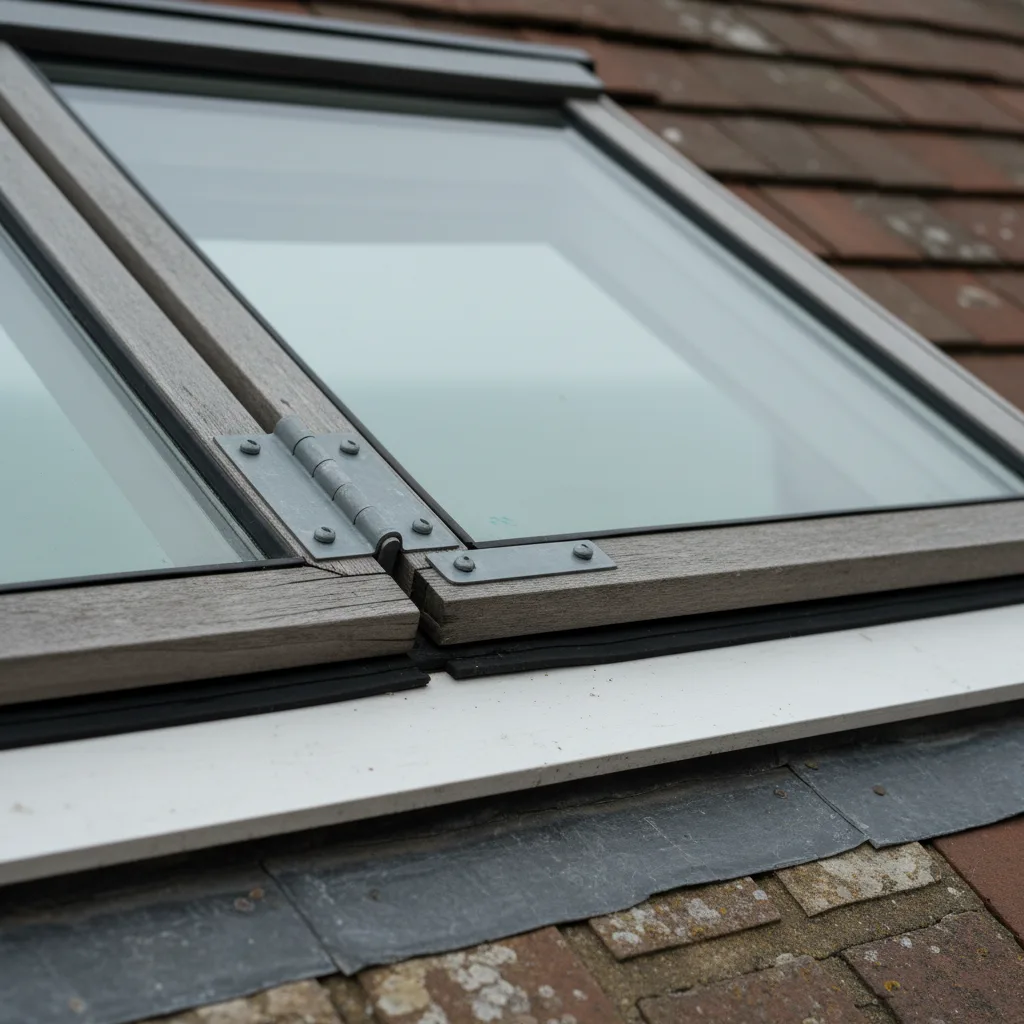
The frame and the sash of a modern roof window will survive salt air. The parts that suffer are the moving ones: the hinges, the friction stays, the locking mechanism and the fixings holding the flashing.
Within about a mile of the water we specify stainless fixings throughout, including the ones holding the kit rather than only the ones holding the frame. Plated fixings corrode from the shank outwards inside the timber, where nothing is visible from either side, and the failure is sudden rather than gradual.
The gaskets want a rinse with clean water two or three times a year. Salt crystals are abrasive, they collect in the gasket channel, and every closure grinds them into the seal. It takes five minutes and roughly doubles the working life of the seal. Nobody is ever told this.

Manual, electric and solar
A manual window operated by a pole is the simplest thing that works, and on a slope within reach of a pole from the floor it is usually right.
Electric operation matters where the window is out of reach, high on a slope, or above a stairwell. It needs a cable route, which has to exist before the ceiling closes, so it is a decision at survey rather than afterwards. A rain sensor closes the window when the weather turns, which on this coast earns its keep.
Solar operated units carry their own panel and battery and need no cable at all, which makes them the retrofit answer for a window that was never wired. The trade-off is a panel visible on the outside of the frame and a battery that will eventually need replacing.
Replacing without disturbing the covering
A like for like replacement into a sound opening is a one day job, and the aim is to disturb as little of the roof as possible.
The old kit comes off, the new frame goes into the existing opening, the new kit is dressed in, and the covering is put back. On a slate or peg tile roof we salvage and re-lay what comes off rather than substituting new material, because new slate against weathered slate is visible from the street for years and a hand made tile is not replaceable from stock.
The roof is never left open overnight. If the job cannot be finished in the day, it is made watertight before we leave.
What we find when the old one comes out
A window that has been failing for years has usually been letting a little water past for some of them, and the timber around the opening is where that shows.
Soft timber in the trimmer or the head of the opening has to be replaced. We flag it at quotation as a possibility with an indication of what it would add, rather than presenting it as a surprise once the roof is open. On an older coastal roof it is common enough that we would rather over-warn than under-warn.

Misting, and what it means
Misting between the panes means the sealed unit has failed and the cavity is breathing. It is not a cleaning problem and it does not recover.
On a relatively recent window with a sound frame, a replacement sealed unit is the smaller job. On a unit over about twenty five years old, the frame, the gaskets and the thermal break are all at the end of their life too, and a new sealed unit in a tired frame is money spent twice. We say which we think it is, and why.
Guarantees, and what they cover
Manufacturer guarantees on roof windows are generally good and generally cover the sealed unit and the frame for a stated period. What they do not cover is the installation, and an installation fault is by far the most likely thing to go wrong.
A failed flashing detail, an omitted underlay collar or a kit that never matched the covering are all workmanship, and no manufacturer will pay for them. Our ten year workmanship guarantee is the part that covers that, and its limits are written down rather than implied.

Planning, and the National Park
On an ordinary house a roof window is normally permitted development provided it projects no more than 150mm beyond the plane of the existing roof and sits no higher than the highest part of it. A standard VELUX sits within that.
In a conservation area, and anywhere inside the South Downs National Park where the Authority rather than the district council decides, that is not the end of it. A standard unit on a visible slope will frequently be refused in favour of a slim conservation rooflight sitting nearly flush. We check with the authority before quoting rather than after.
How we price it
Send a photograph of the data plate and a photograph of the roof from the ground. That is usually enough for an indicative range the same day, free.
Then a survey covering the covering type, the structure, the condition of the opening, the access and the room below, and a fixed written price that does not move afterwards.
In this section
Are VELUX windows worth the money?
Read moreCan a VELUX be an escape window?
Read moreCan a VELUX be fitted to a flat roof?
Read moreCan a VELUX be replaced like for like?
Read moreCan a VELUX window be repaired?
Read moreCan you fit a VELUX yourself?
Read moreCan you get a solar powered VELUX?
Read moreCondensation on a VELUX, and reading the weather it happens in
Read moreDo VELUX blinds fit any window?
Read moreDo VELUX windows come with flashing?
Read moreDo VELUX windows need planning permission?
Read moreFlat roof VELUX units on a kerb, which is a different product
Read moreHow do I find my VELUX size code?
Read moreHow do you clean a VELUX window?
Read moreHow long does a VELUX installation take?
Read moreHow long does a VELUX last?
Read moreHow much does a VELUX window cost?
Read moreIs VELUX the only brand of roof window?
Read moreManual, electric and solar operation compared
Read moreMatching an obsolete VELUX size on a Sussex roof
Read moreReading the data plate to identify an existing VELUX
Read moreRecessed installation, and when it is worth the extra work
Read moreReplacing a thirty year old VELUX without disturbing the covering
Read moreVELUX blinds fitted at installation against added later
Read moreVELUX in a listed or conservation roof at Arundel or Ditchling
Read moreVELUX on a coastal roof, and what salt does to the ironmongery
Read moreWhat is a VELUX recessed installation?
Read moreWhat is the difference between GGL and GGU?
Read moreWhat is the most common VELUX size?
Read moreWhat the VELUX guarantee does and does not cover
Read moreWhich VELUX flashing kit suits which covering here
Read moreWhy is my VELUX misted up?
Read moreThinking about this job? We survey across Worthing, West Sussex and the South Downs and give you a fixed price before any work starts, with a 10-year workmanship guarantee.