The instructions are clear and the components are designed to go together, but the work involves opening a roof, cutting structural timber, working at height and forming a weathering detail that has to last decades. It is not a first project. Some parts of it, the blind, the filter, a handle, are entirely reasonable to do yourself.
What the job actually involves
Four trades in sequence, in a day.
Setting out and carpentry to form the opening, roofing to cut and reinstate the covering, weathering to dress the flashing, and finishing to insulate and plaster the reveal.
Being good at one of those does not carry across to the others.
Where the risk actually is
Height first, and it is not close.
Working on a roof slope, handling a frame at height and moving covering material are the parts that hurt people, and a domestic ladder is not adequate access for any of it.
Proper access is the largest single cost of doing it properly.
The structural cut
Where a mistake is expensive rather than dangerous.
Cutting a rafter without forming the trimmers correctly transfers load into members that were not sized for it, and on a trussed roof cutting a member at all is a structural alteration.
Which is why the roof type is established first, as on can a roof window be fitted between trusses.
The weather window
The constraint an amateur most often underestimates.
The roof is open from the moment the covering comes off until the flashing is dressed, and that has to be inside one working session rather than spread across a weekend.
A sheet over an open roof overnight is not a plan.
The underlay collar
The detail that decides whether it leaks.
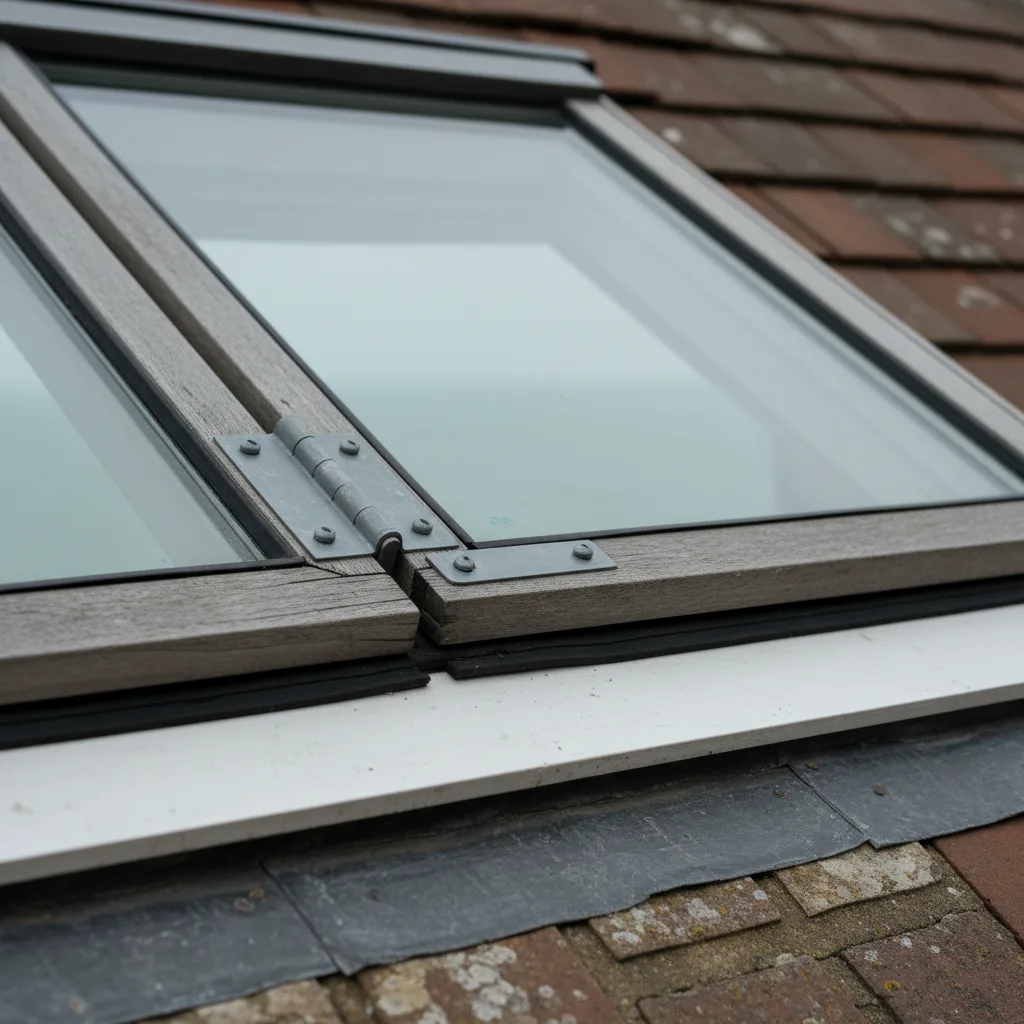
The underlay has to be cut, dressed around the opening and lapped so water is carried out over the flashing rather than behind it, and the direction of that lap is the whole of it.
It is invisible once finished, which is why it is the detail that gets rushed.
Cutting the covering
Harder on some roofs than others. Cutting concrete interlocking tiles is straightforward. Cutting natural slate without breaking it, or setting out hand made clay so the gauge still reads, is a skill rather than a task.
On an old covering the material is also brittle and finite.
Sourcing matching covering
The problem that stops a job dead.
Breakages happen, and on an old roof the replacement has to be found rather than bought, which can mean a reclamation yard and a wait.
An installer allows for it. A homeowner discovers it.
What is genuinely reasonable to do yourself
The things that do not involve the roof.
Fitting a blind, changing the ventilation filter, replacing a handle, cleaning the drainage channels and recoating a lacquered sash are all homeowner jobs with clear instructions.
None of them opens the weathering.
Replacing the pane
Possible in principle, and rarely a good idea.
Sealed units for current ranges are available as parts, but a pane is heavy, awkward at height and easy to damage, and getting the sash back to a proper seal matters.
The route is on can just the glass be replaced.
Building regulations
They apply to the work regardless of who does it.
Cutting structural members and forming a new opening engage the regulations, and a self installed window is assessed on the same basis as any other.
Which tests apply is on do roof windows need building regulations.
What that means at sale
The consequence that surfaces years later.
A buyer’s solicitor asks for evidence that notifiable work was signed off, and an undocumented roof alteration can hold up a sale or lead to an indemnity policy.
It is worth thinking about before the covering comes off.
Insurance
Worth a phone call rather than an assumption.
Some policies take a view on structural alterations carried out by the policyholder, and a leak traced to a self installed roof detail is exactly the sort of claim that gets examined.

The manufacturer guarantee
Generally intact, and the installation is the exposed part.
A product guarantee covers the product. It does not cover the weathering detail somebody else formed around it, which is where most water gets in.
Where a half way position works
More common than people think.
A homeowner clearing the loft, arranging the access and finishing the reveal, with the roof work done by an installer, splits the job at the point where the skill actually is.
It is worth discussing rather than assuming it is all or nothing.
What an installer brings that is not skill
Two things, and both are boring.
Access equipment that reaches the position safely, and a van carrying the flashing kit, the collars, spare battens, felt, sealant and a stock of covering material, so a missing item does not stop the day.
A homeowner doing this once buys or hires all of that for a single window.
Where a part fitted job goes wrong
At the handover, not in the work.
Where one person forms the opening and another dresses the flashing, the underlay collar sits between the two, and it is the detail each assumes the other has done.
Agreeing who owns it before anybody starts is what prevents it.
Time, honestly
The estimate people get wrong by the largest margin.
A day for an experienced installer is a weekend and an evening for somebody working it out as they go, and the roof cannot be left open across that period.
Where we stand
We are straightforward about which parts of a job are worth doing yourself and which are not, and where somebody has started one we finish it rather than making a point about it.
The rest is on the VELUX window installation page.
Thinking about this job? We survey across Worthing, West Sussex and the South Downs and give you a fixed price before any work starts, with a 10-year workmanship guarantee.