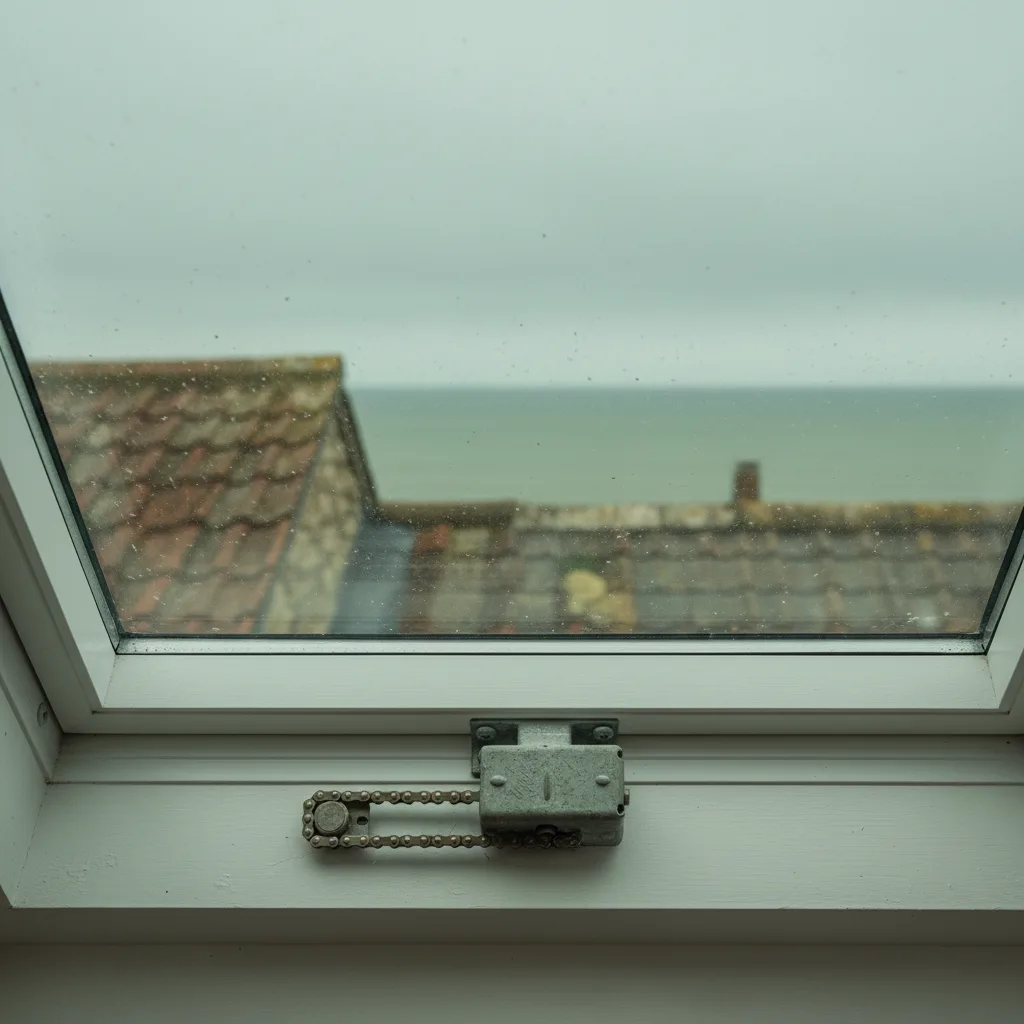
A chain actuator is the motor that opens a rooflight. Inside a slim housing, a small geared motor drives a chain out of the case, and because the links are made so they can only bend one way, the chain behaves as a rigid rod when it is pushed out. It extends to open the pane and retracts to pull it closed onto the seal.
Why a chain rather than a rod
Because it folds away.
A rigid rod long enough to open a rooflight would need a housing as long again to retract into. A chain coils inside a compact case and straightens only where it is needed.
That is the whole of the idea.
How the chain stays rigid
By the shape of the links.
The links are formed so that they articulate in one direction only, so as the chain leaves the housing it locks straight and can push.
Where it is mounted
On the frame, pushing the sash.
The housing fixes to the outer frame and the chain end fixes to the opening pane, so the visible part is a slim case along one edge.
The stroke
How far the chain extends, and it is a specification.
Actuators are supplied in different strokes, and the stroke decides how far the pane opens and therefore how much free area you actually get.
Why it matters is on how wide does an escape rooflight need to be.
The force rating
The other specification, and it does two jobs.
The actuator has to push the weight of the pane open against gravity and wind, and it has to pull it closed hard enough to compress the gasket evenly.
Closing force is the one people forget.
Why closing force matters
Because the seal is made by compression.
An underpowered actuator will open a pane perfectly well and fail to seat it properly, and the unit then passes water in wind driven rain while appearing shut.
That is on do opening rooflights leak more than fixed ones.
Limit switches
What stops it at each end.
The actuator senses when it has reached the end of its stroke or when the pane is home, and stops rather than continuing to drive.
Load sensing
Present on better units.
An actuator that detects unusual resistance will stop, which protects the mechanism and the frame if something obstructs the pane.
Two actuators on one pane
Standard above a certain width.
A wide sash pushed from one point twists, so two actuators are fitted and synchronised by the controller so they move together.
Why synchronisation matters
Because unequal push racks the frame.
Two motors out of step twist the sash, which strains the hinges and stops the gasket compressing evenly, so the controller keeps them together deliberately.
Holding position without power
An inherent property, and a useful one.
The gearing means the chain does not back drive, so a pane stays exactly where the actuator left it whether or not there is power.
What that means in an outage is on can an electric rooflight be opened in a power cut.
Voltage
Mains or low voltage, depending on the system.
Low voltage actuators run from a transformer, which changes the cabling at the unit though not the need for a supply to reach it.
What is involved is on do electric rooflights need an electrician.
Current draw
Small, and only while moving.
An actuator draws current for the seconds it runs and nothing at rest, which is why solar powered units are practical at all.
How it is controlled
Through a controller rather than directly.
Switches, handsets and sensors all talk to the controller, which drives the actuator, which is what allows several inputs and several units on one system.
The options are on how is an electric rooflight controlled.
Alternatives to a chain
Two, and they suit different products.
A spindle or rack actuator uses a rigid rod and needs the space for it. A linear screw actuator is compact and strong and is used on some heavier units.
What it sounds like
A soft hum for a few seconds.
The gearing and the chain articulating are what you hear, and a change in that sound is a maintenance signal rather than a characteristic.
That is on are electric rooflights noisy.
Its life
Many years, and it is a replaceable component.
An actuator is a serviceable part fixed to the frame, so it is changed on its own rather than with the rooflight when it eventually wears out.
What maintenance it wants
Exercise, mostly.
Running it through its full stroke a few times a year keeps it free, and a mechanism that has not moved for a year is the one that binds.
What else to do is on do electric rooflights need servicing.
Where the housing sits visually
Along one edge, and it is visible from inside.
The case runs along the frame at the hinge or the opening edge depending on the arrangement, and on a slim framed unit it is the most noticeable component in the assembly.
Concealed versions exist within the frame section on some systems and cost more.
What happens if something obstructs it
It stops, on a unit worth buying.
Load sensing halts the motor when the resistance is wrong, which protects a blind, a plant or a hand that has ended up where it should not be.
Replacing one
A component swap rather than a rooflight job.
The housing unbolts from the frame and the chain end from the sash, and a matched replacement goes back in the same positions with the stroke reset.
No covering is disturbed and the roof is not opened.
What we check on an opening unit
We check the stroke and the force rating against the pane rather than taking a standard actuator, because an underspecified one will open a rooflight perfectly and never close it properly.
The whole picture is on the electric rooflight installation page.
Thinking about this job? We survey across Worthing, West Sussex and the South Downs and give you a fixed price before any work starts, with a 10-year workmanship guarantee.