Outside, a dark frame is almost always better, because it reads against the sky and the bars visually recede. Inside, white or a light shade generally suits a ceiling and keeps the structure feeling open. A dual colour lantern gives you both, and it is a modest step in price for a difference you look at every day.
Why dark reads better outside
Because of what is behind it.
A lantern is seen against sky, and a white frame is a bright object against a bright background that draws the eye to the bars rather than to the glass.
A dark frame recedes and the structure reads as glass with a fine line through it.
What the common exterior choices are
Anthracite grey above everything else. It sits comfortably with grey window frames, dark rainwater goods and the greys and blacks that modern extensions use, and it is stocked by every manufacturer.
Black and dark bronze are the other two that turn up regularly.
Matching the doors
The single most useful rule. An extension usually has large doors, and matching the lantern frame to them makes the whole rear elevation read as one decision rather than two.
It costs nothing to get right at order.
Matching the rainwater goods
The second thing to check. Gutters, downpipes and fascias in a dark colour with a white lantern above them is a mismatch that is visible from the garden every day.
Why white inside
Because of what it sits against. A white frame against a white ceiling makes the bars disappear and the lantern feels larger and lighter, which is generally the point of having one.
When dark inside works
On a deliberate scheme. A dark frame inside reads as a strong graphic grid against the sky, which suits an industrial or contemporary kitchen and looks completely wrong in a soft traditional one.
It is a decision to make on purpose rather than by default.
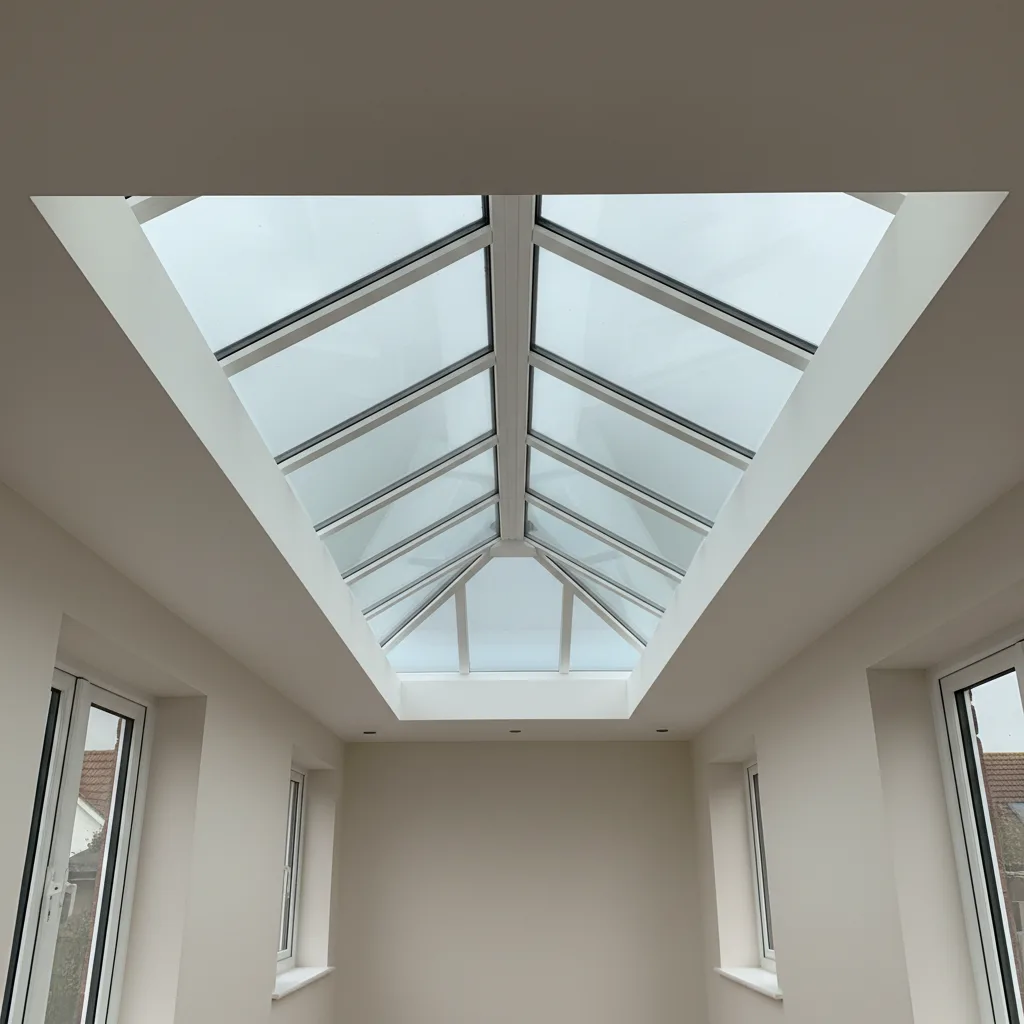
Dual colour
How most good lanterns are ordered. Anthracite outside and white inside is a standard combination, factory applied, and it gives the exterior that recedes and the interior that lifts.
It is a small step on the order rather than a bespoke process.
What it does to lead time
Usually nothing, occasionally something.
Standard colour combinations are held. A non standard colour, particularly inside, means a coating run and a wait.
Where that sits is on how much does a roof lantern cost.
How the finish is applied
Powder coated, and it matters. Aluminium sections are coated and cured in a factory, which gives a hard even finish over the whole profile including the parts nobody will see.
What the coastal position asks for
A marine grade specification. Within a few miles of the sea, salt works on a standard coating over years, and a marine specification with the appropriate pre treatment is what keeps a frame sound.
What that involves is on marine grade coatings against standard powder coat.
Why it matters more on dark colours
Because the failure shows. A dulled or pitted finish is visible on anthracite in a way it is not on white, so a dark frame near the sea is an argument for the better specification rather than against the colour.
How dark frames behave in the sun
Hotter, and it is designed for. A dark aluminium section in full sun reaches a considerably higher temperature than a white one, and the thermal movement that comes with it is why systems allow for expansion at their joints.
Whether it affects the room temperature
Barely. The glass rather than the frame decides how much heat enters a room, and the frame colour is a negligible part of that.
What does matter is on will a roof lantern make the room too hot.
Matching an existing lantern
Harder than it sounds. Coating batches and manufacturers vary slightly within the same nominal colour, so two lanterns on one roof are best ordered together.
The comparison is on can two lanterns go over one extension.

Timber lanterns
A different conversation entirely. A painted timber lantern suits a period property and is a maintained finish rather than a permanent one, which is the trade off for the appearance.
On a conservation area extension
Where the colour can be the point at issue.
An officer concerned about a modern element on a historic building will often be more comfortable with a dark recessive frame than a white one.
The position is on do roof lanterns need planning permission.
Can it be repainted later
Possible and rarely satisfactory. A powder coated frame can be prepared and coated on site, but it is a different finish from the factory one and it will not last as well.
The colour is a decision to get right at order.
Seeing a sample
Worth insisting on. Colours look different on a large section in daylight than on a chart indoors, and a sample piece held up against the doors settles the question in a minute.
Bare or brushed metal finishes
Available, and worth thinking twice about here.
Mill finish and anodised aluminium have their admirers, and within a few miles of the sea an uncoated or lightly finished surface has far less protecting it than a properly specified powder coat does.
On an inland village it is a fair choice, on a seafront elevation it is not.
What the internal colour does to the light
A small effect that is visible every day.
A light internal frame bounces daylight off the bars into the room, and a dark one absorbs it, so the same lantern feels a little brighter inside in white.
What we order
We order dual colour as a matter of course and we take the exterior from whatever the doors are, because a lantern that matches the rest of the elevation is the one nobody notices.
The whole picture is on the roof lantern installation page.
Thinking about this job? We survey across Worthing, West Sussex and the South Downs and give you a fixed price before any work starts, with a 10-year workmanship guarantee.