Rooflight and Skylight Installation in Slindon
- Fixed quote before we start
- Roof never left open overnight
- 10-year workmanship guarantee

- Fixed quote before we start
- 10 years workmanship guarantee
- 25 years fitting rooflights
- Skylights only, not a general roofer
Most of Slindon belongs to the National Trust, and that changes the process more than anything else about the village. A great many properties here are let rather than owned, and an alteration needs the landlord’s agreement as well as the planning authority’s. The two are separate, they ask different questions, and the landlord’s is generally the harder one.
What we install in Slindon
Conservation rooflights, and consent is required for almost everything.
The village is designated, a great many buildings are listed, it sits inside the National Park, and most of it is estate owned. Four layers, and a proposal has to satisfy all of them.
Which means the survey here begins with the tenure rather than the roof.
Owned, or tenanted
The first question, and it determines everything that follows.
Where a property is owned outright, the process is the ordinary one for a listed building in a National Park village. Where it is let by the estate, the tenant is proposing an alteration to somebody else’s building.
A tenancy generally requires the landlord’s written consent for any alteration, and a rooflight is unambiguously one. Nothing proceeds without it, whatever a planning authority might say.
| Who | Asks | When |
|---|---|---|
| The estate as landlord | Should this building change at all | First |
| Listed building consent | Does it harm significance | After landlord consent |
| The National Park | How does it read in the landscape | Same application |
| Conservation area | Character and appearance | Where unlisted |
| Building Control | Is it safe, dry and warm | Last |
| A tenant alone | Cannot authorise any of it | Not applicable |
What a conservation landlord asks
A different question from a planning authority’s, and it is worth understanding.
A commercial landlord asks whether an alteration damages the value of their asset. A conservation charity asks whether it is consistent with why they hold the building at all.
Which means arguments about daylight and amenity carry less weight than they would with a private landlord, and arguments about reversibility, minimal fabric loss and appropriateness carry considerably more.
What helps with an estate
Four things, and they are close to what helps a listed building application.
A concealed slope. A slim flush unit. A position that cuts no historic timber. And a proposal that could be reversed leaving the building as it was.
Beyond those, a proposal that is modest for the room rather than maximal helps, because it signals that the alteration is being kept to what is needed rather than what is possible.
Standing repairs and who does them
A practical point that catches tenants out.
An estate generally has its own arrangements for repairs and its own contractors, and work on the fabric of a let building may need to be done by them or by somebody they approve.
Which is worth establishing before a quote rather than after, because a tenant who has commissioned work the estate will not accept is in an awkward position through no fault of their own.
Insurance and liability on estate property
The other administrative item, and it is straightforward to satisfy.
An estate will want to see public liability cover, a specification, and generally a method statement covering how the building will be protected. Producing all three with the request shortens the process.
We supply them as a matter of course on estate property rather than waiting to be asked.

The village, and why it looks as it does
Worth understanding, because it explains the consistency an officer and a landlord are both protecting.
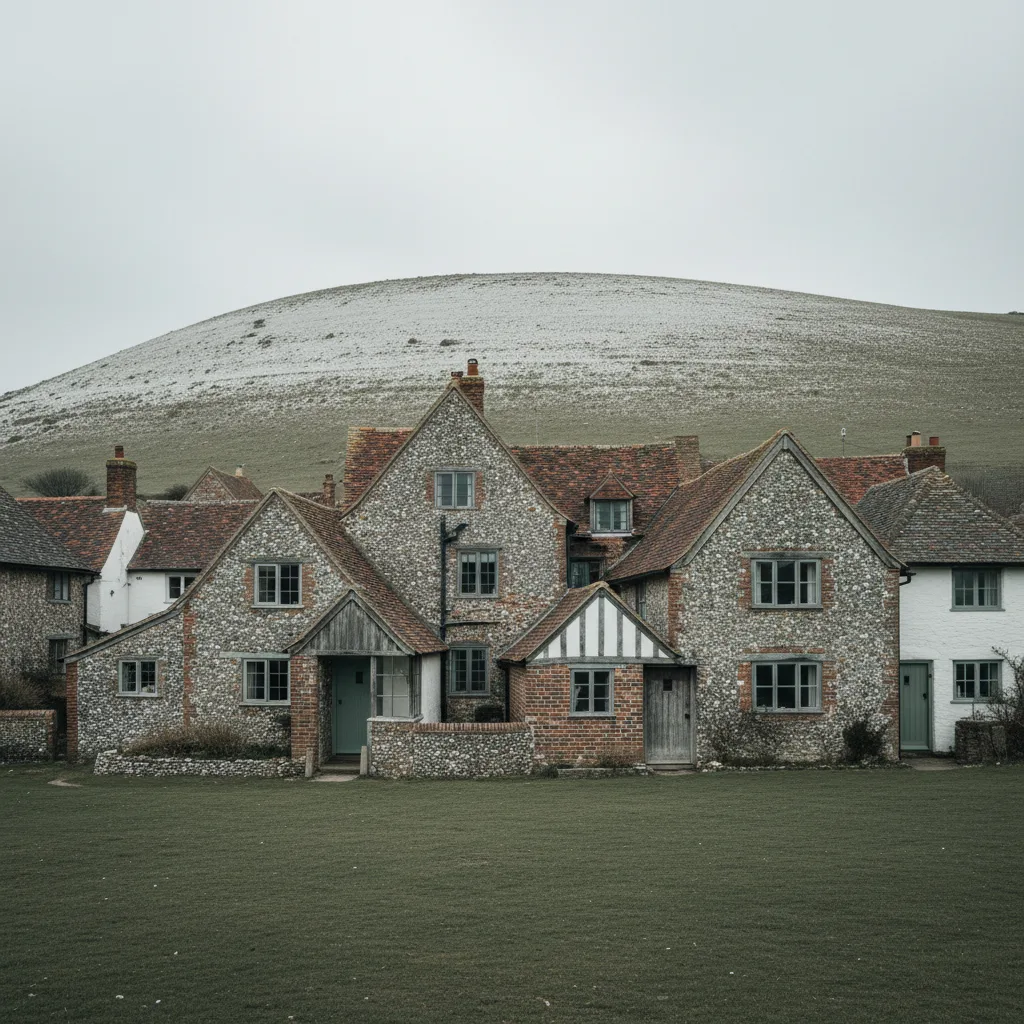
Single ownership over a long period produced a village of consistent materials and detailing, maintained to one standard, without the piecemeal alteration most villages have had.
That consistency is the reason the place is significant and the reason an individual change is looked at carefully. A row of unaltered roofs is a different thing from a row of mostly unaltered ones.
Group value
The concept that follows, and it applies here as strongly as anywhere we work.
What is protected is the run rather than the individual building, and an alteration is assessed for what it does to the whole and for what it sets up.
How that changes a proposal, and why precedent cuts both ways in a designed group, is on the Walberton page.
The National Park is the planning authority
For planning purposes the authority is the South Downs National Park Authority, not the district council, and applications go there.
Its remit includes landscape and scenic beauty as well as settlement character, and the village sits in a well wooded landscape that is part of what the Park exists to protect.
The detail is on who is the planning authority in the South Downs National Park.
The woods, and what they give and take
The setting, and it has two effects on a rooflight.
Beech hangers and estate woodland shelter the village substantially, so the wind loading here is mild for a downland village and standard coatings hold up comfortably.
They also shade. A rear slope under mature beech delivers considerably less daylight than the same slope in the open, and in summer the difference is at its largest. Where that is the case we say so before a unit is ordered.
Leaf litter
The other consequence of heavy tree cover, and it is a maintenance item.
Litter around a kerb or in a valley holds water against a detail, and outlets block. On a deck with a shallow fall that is how a sound detail becomes a wet one over several autumns.
A clear at the end of each autumn deals with it entirely, and in this village it matters more than in most.
Thatch, where it survives
Present on a small number of roofs here and the position is straightforward.
A rooflight in thatch is not something we offer. What that means, and why a later tiled addition is frequently the answer instead, is on the Amberley page.
A scaffold beside thatch is a fire consideration in its own right and it is planned rather than assumed.
What the Slindon stock asks for
Four conditions apply across the village and each is set out elsewhere.
Timber frames are on the Steyning page. Hand made clay tile is on Sussex clay peg tile. Flint and brick elevations are on the Poynings page. What helps a listed application is on the Arundel page.
Each is established at survey and on a building here two or three commonly apply at once.

What a tenant should ask first
- Does the tenancy require written consent for alterations, and in what form.
- Whether the estate has a standing view on rooflights in this kind of building.
- Whether work must be done by an approved contractor.
- Who holds responsibility for the roof and its future maintenance.
- Whether the building is listed, including by curtilage.
- What happens to the alteration at the end of the tenancy.
The last of those is worth asking explicitly. A tenant paying for an improvement to somebody else’s building should know whether they are expected to reinstate it, and the answer varies.
Estate outbuildings
Common here, and they are frequently the building somebody wants the rooflight in.
Former agricultural and service buildings converted to houses, workshops and stores, a good number of them curtilage listed regardless of appearance.
What that means is on the Thakeham page. Here it is compounded by the estate’s own view of what its buildings should look like.
Nore Hill, and the wider setting
A landscape point that the Park authority weighs and local knowledge frequently overlooks.
The village sits below the wooded scarp with open downland above it, and it is seen from the paths on that high ground as a group of roofs among trees rather than as a street.
Which means an assessment here considers the view from above as well as from the lane, and it is checked from the footpath before a position is proposed rather than after an officer raises it.
Why we still take the work
Worth saying, given everything above. These are good buildings, the estate maintains them properly, and a job done here is done to a standard nobody is arguing about. The constraints exist because the place is worth constraining.
What we ask of a customer is patience with the process and honesty about what a concealed slope will actually deliver. Given both, the work here is among the most satisfying we do.
How long the process takes
Worth setting expectations, because it is longer here than almost anywhere.
Landlord consent, then a listed building application, then Building Control, with the first of those on the estate’s own timetable rather than a statutory one. Three to six months from first enquiry to work is realistic.
None of that is anybody being difficult. It is what four layers of permission take, and it is far better known at the outset than discovered a month at a time.
Long term maintenance on estate property
A question worth settling at the outset, because it outlives the installation.
Where a landlord holds responsibility for the roof, a rooflight added by a tenant sits inside something the landlord maintains. Who cleans it, who repairs it and who replaces it in twenty years should be written down rather than assumed.
It is not our decision and it is the kind of thing that is easy to agree at the start and difficult to resolve later. We raise it because nobody else in the process does.
Public access through the village
A characteristic of estate land in charitable ownership, and it affects visibility.
Footpaths and permissive routes run through and around the village, bringing people close to buildings and to rear elevations that in another village would be private.
Which means the assessment of what is visible is wider here than the road frontage suggests, and it is checked on foot before a position is proposed.
Access on the lanes
Narrow, wooded overhead, and with limited turning.
A lorry with a made to size unit is limited by branch height as much as by width, and the route is driven at survey rather than looked at on a map.
Where trees would need cutting for access, that is an estate matter and a protected tree matter, and it is settled well before a date rather than on the morning.
What the survey establishes
- Whether the property is owned or let, and by whom.
- What the tenancy requires, and whether landlord consent is in place.
- Whether the estate requires its own or an approved contractor.
- Whether the building is listed, including by curtilage.
- What is visible from the footpaths as well as the lane.
- The lane route, driven, including branch height.
Building Control
A replacement into an existing opening is not normally notifiable, though the unit still has to meet the limiting thermal standard. A new opening is, and goes to the South Downs National Park Authority or an approved inspector.
The thresholds are on do flat rooflights need Building Control.
Permitted development
On a listed building permitted development is not the relevant question, because consent is required regardless.
On an unlisted building inside the conservation area those rights are narrowed. And on a let property, permitted development says nothing at all about what a tenancy allows, so the landlord’s position is established first rather than last.
How we quote
A free indicative range by email from photographs, then a survey, then a fixed itemised written price that does not move afterwards. Anything we misjudge at survey is ours to absorb.
What is measured at each step is on the how we price and quote page.
Guarantee
Ten years on our workmanship, on every job, limits written down. The manufacturer stands behind the unit; we stand behind the kerb, the flashing and the making good.
The terms, and the accreditations we do not claim, are on the our guarantee page.
Skylight services in this area
Conservation Rooflight Installation
Read moreElectric and Opening Rooflight Installation
Read moreEnergy Efficient Rooflights
Read moreFlat Roof Rooflight Installation
Read moreReplacing a Failed or Misted Rooflight
Read moreRoof Lantern Installation
Read moreRoof Window Installation
Read moreSun Tunnel Installation
Read moreVELUX Window Installation
Read moreWalk-On Rooflight Installation
Read moreThinking about this job? We survey across Worthing, West Sussex and the South Downs and give you a fixed price before any work starts, with a 10-year workmanship guarantee.