How much ventilation does an opening rooflight or skylight give?
More than the same opening would give in a wall, because a rooflight sits at the highest point of a room and warm air is trying to leave there anyway. What it actually moves depends on the free area of the opening, the temperature difference, and above all on whether there is somewhere lower for replacement air to come in.
Why height matters
Because warm air rises and has to go somewhere.
The warmest, most humid air in a room collects at the ceiling, and an opening there lets it out directly rather than waiting for it to find a window at head height.
That is the whole of the advantage.
The stack effect
What drives the flow without any fan.
Warm air leaving at the top creates a slight negative pressure that draws cooler air in lower down, and the taller the difference between the two openings the stronger the effect.
Why a low opening is essential
Because air cannot leave without air arriving.
An opening rooflight on its own in a sealed room does very little. Open a door or a window at low level and the same rooflight moves a great deal of air.
It is the pair that works rather than either alone.
Free area
The number that describes the opening. Free area is the unobstructed opening the unit actually provides when fully open, which on a hinged pane is smaller than the frame and depends on the stroke.
Why is on how wide does an escape rooflight need to be.
Why the stroke matters here too
Because a short opening is a small aperture.
A comfort stroke gives a modest gap, and doubling the stroke roughly doubles what the unit will pass, so the actuator specification is a ventilation decision.
Purge ventilation
The term the regulations use. Rapid ventilation to clear a room of pollutants or moisture after cooking or a shower is called purge ventilation, and openings are assessed against the floor area of the room.
Background ventilation
A different requirement, met differently. Continuous low level ventilation is provided by trickle vents or a mechanical system rather than by an opening rooflight, which is not left open all year.
Extract ventilation
The third, and it is not replaced by an opening.
Kitchens and bathrooms require mechanical extract at stated rates, and a rooflight helps considerably while not satisfying that requirement.
What a kitchen needs is on do I need an opening rooflight in a kitchen.
What it does for cooking smells
A great deal, and quickly. Steam and cooking smells rise, and a rooflight open over a kitchen clears them in minutes where an extract hood alone takes longer and is noisier.
What it does for overheating
More than a blind does.
Letting hot air out of the top of a room is the most effective thing available once the heat is already in, and it works with solar control glass rather than instead of it.
That is on will a rooflight make my room too hot.
Night cooling
Where it earns most in summer.
A rooflight open overnight flushes the day’s heat out of a room and the structure, which makes the following day start cooler.
A rain sensor and a backup are what make that practical.
Two openings across a room
Considerably better than one.
Two units at opposite ends set up a movement across the room rather than a single point of escape, and the difference in a long kitchen is obvious.
That is on can two rooflights open together.
Wind
Helps and occasionally overwhelms.
A breeze across an opening increases the flow considerably, and on an exposed coastal site a fully open rooflight in a strong wind is more than most rooms want.
Partial opening positions are useful for exactly this.
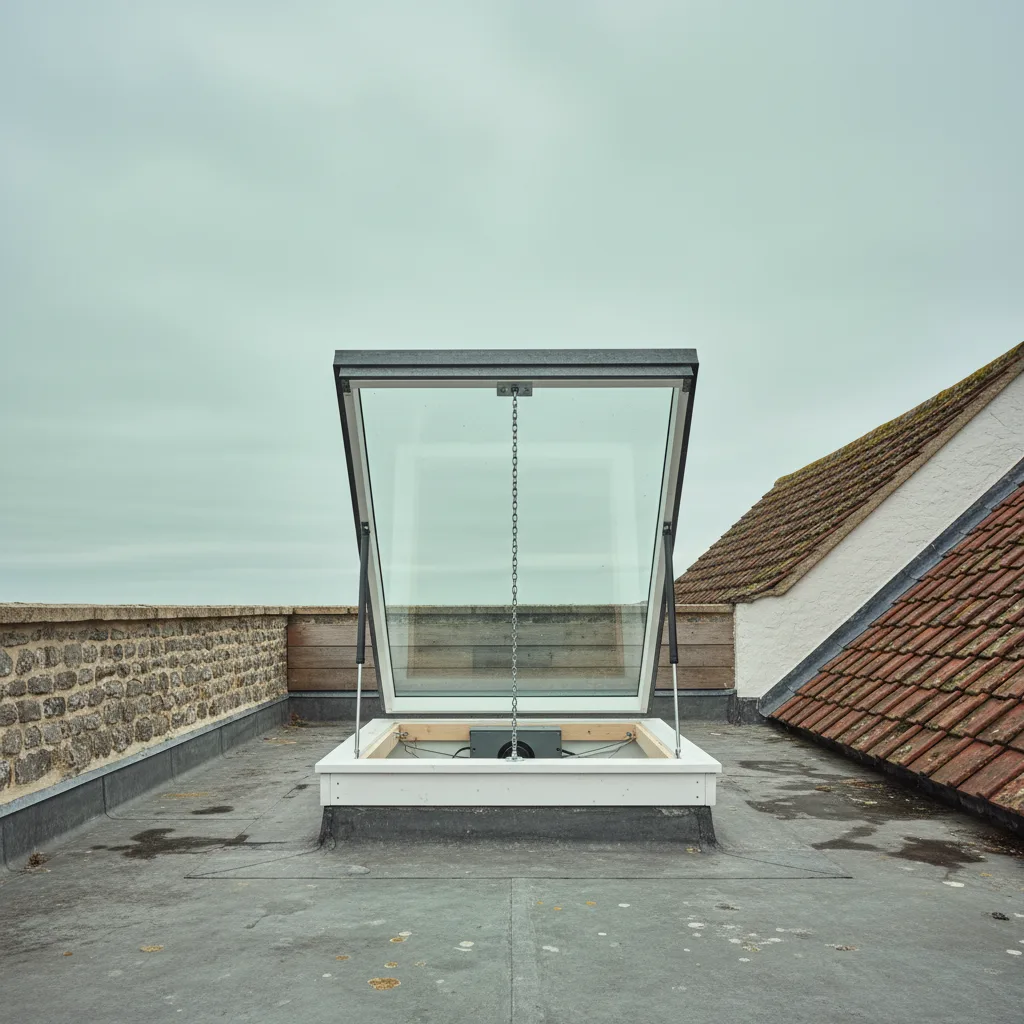
What a partial opening gives
Most of the benefit for a fraction of the draught.
A small opening at ceiling level still lets the warmest air out, and in winter that is generally all a room wants.
In winter
Short bursts rather than a constant gap.
Opening fully for a few minutes clears the moisture without cooling the fabric of the room, which is more effective and cheaper than leaving a gap all day.
What it does for condensation
Directly addresses the cause.
Condensation is moist air meeting a cold surface, and venting the moist air is the intervention that works.
The mechanism is on how do I stop condensation on a rooflight.
Insect screens and flow
A small reduction, worth accepting.
A mesh reduces the free area slightly, and on a summer evening with the lights on it is the difference between using the rooflight and not.
That is on do opening rooflights come with insect screens.
Security while open
Worth a thought on a low roof.
A rooflight open on a single storey extension reachable from a garden is a consideration, and a limited opening position or a restricted stroke answers it.
How the room shape changes it
A tall room ventilates better than a low one.
The stack effect depends on the height between the low inlet and the high outlet, so a vaulted ceiling or a lantern gives a stronger flow than a flat ceiling at ordinary head height.
It is one of the quieter arguments for a lantern.
What a still day does
Reduces it, and does not remove it.
Without wind the flow depends on the temperature difference alone, which is weakest on a warm still day, exactly when a room most wants air moving.
It is why an opening rooflight complements a fan rather than replacing one.
What we ask first on an opening unit
We ask where the replacement air comes from before promising anything about ventilation, because a rooflight with nothing open at low level does a fraction of what it should.
The whole picture is on the electric rooflight installation page.
Thinking about this job? We survey across Worthing, West Sussex and the South Downs and give you a fixed price before any work starts, with a 10-year workmanship guarantee.