A correctly specified and installed one does not, and the reputation comes from the many that were not. When a flat roof rooflight leaks, the cause is almost always the upstand it sits on, the way the covering terminates against it, or a deck that ponds. The unit itself is rarely the fault.
The four things that actually leak
In order of how often we find them.
A kerb too low for the water that reaches it. A covering terminated badly at the upstand. A deck that ponds around the kerb. And, occasionally, a failed seal in the unit itself.
Three of those four are the roof rather than the rooflight.
A kerb that is too low
The commonest single cause.
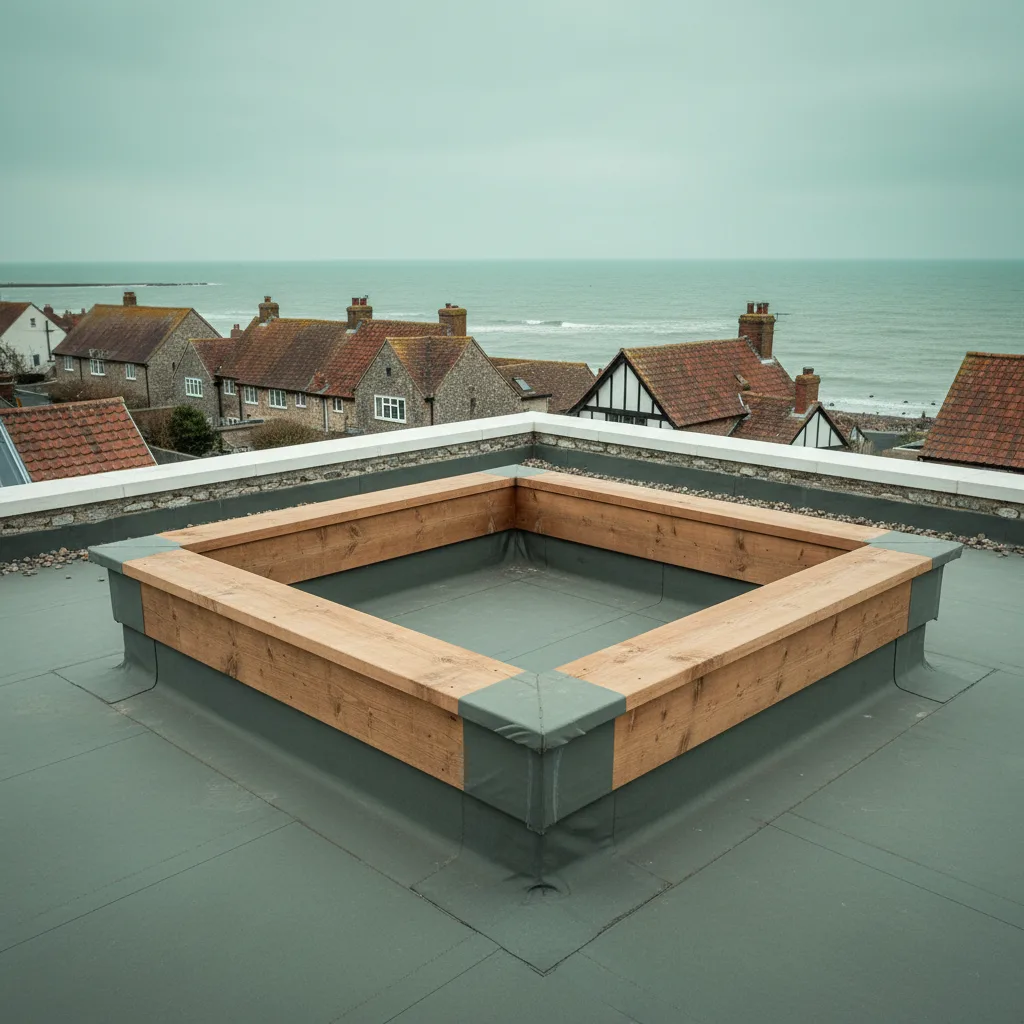
The upstand height is the weatherproofing on a flat roof, and a short one is overtopped in ponding, in driven rain, and under drifted snow.
What the height should be is on how high should a rooflight kerb be.
A bad covering termination
The second, and it is a roofing fault rather than a rooflight one.
The covering has to be carried up the upstand and secured near the top, in the way that covering is designed to terminate. Felt, single ply, GRP, liquid and asphalt each do it differently.
A covering simply lapped up and sealed with mastic is a repair waiting to happen.
Ponding
The third, and it turns a marginal detail into a failing one.
Water standing against a kerb finds any weakness given time, and it does not need a storm to do it.
What an adequate fall is is on the minimum fall for a flat roof with a rooflight.
Sealant as evidence
The most useful thing to look for on an existing installation.
A bead of mastic around a rooflight is somebody’s attempt to stop a leak that a proper detail should have stopped, and frequently there are two or three generations of it.
It tells you the unit has been leaking for years and the underlying fault was never addressed.
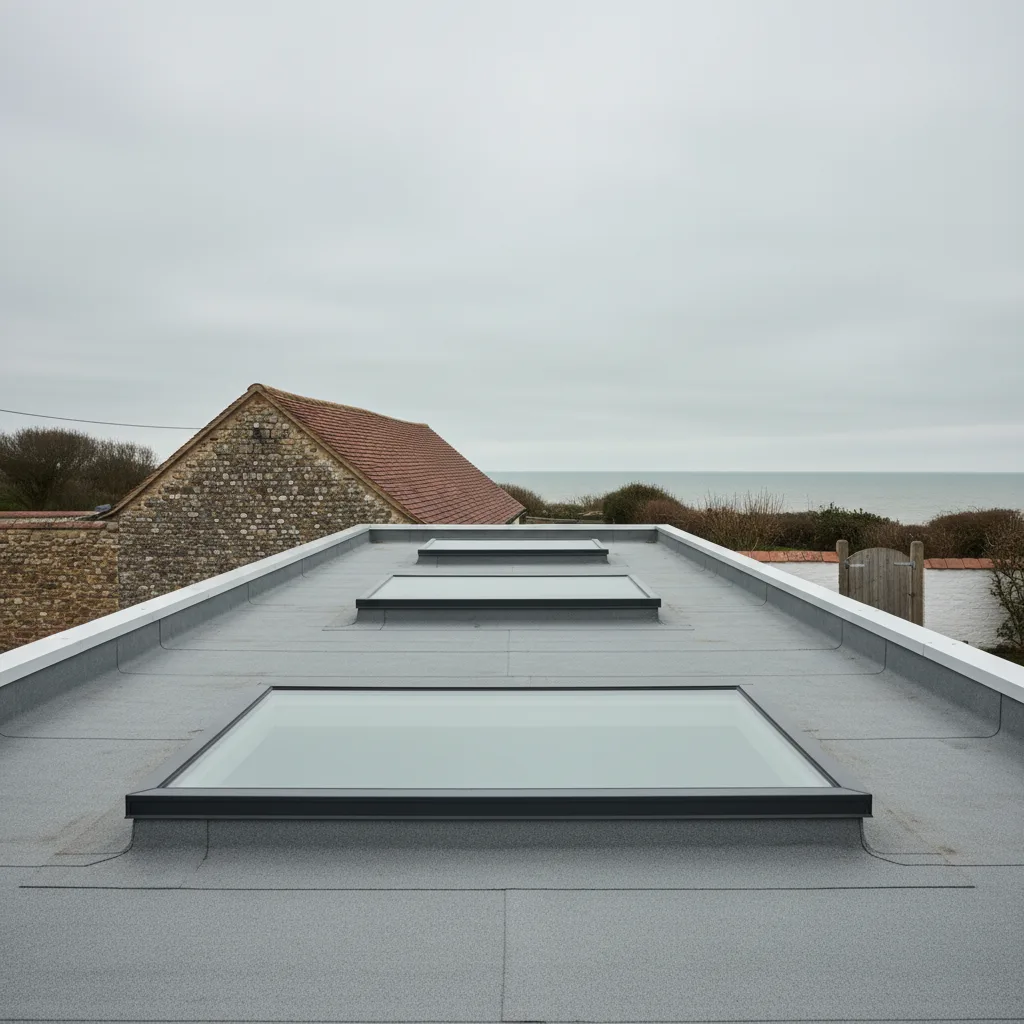
When it is genuinely the unit
Two situations, and both are identifiable.
A failed perimeter seal, which shows as misting between the panes rather than water in the room. And a failed gasket on an opening unit, which shows as water at one edge in driven rain.
Neither is common on a well made unit properly drained.
What is not a leak at all
The complaint we are called to most often on a flat roof.
Water running down the inside of the frame on cold mornings is condensation from an uninsulated kerb, not water from outside.
How to tell them apart is below, and the mechanism is on why is there condensation on my flat rooflight.
The timing test
The diagnostic that costs nothing and settles it.
Water appearing during or after rain, and only then, is ingress. Water appearing on cold clear mornings, particularly in a kitchen, is condensation.
A fortnight of noting the date and the weather answers it more reliably than an inspection.
The direction test
The second diagnostic, and it narrows an ingress fault.
Water appearing only in driven rain from one direction points at a detail on that side, generally the upslope or windward edge, rather than at the unit.
What we find when the unit comes off
On a rooflight that has leaked for years, generally the same picture.
Soft timber at the base of the upstand, torn or perished covering at the termination, and fixings into timber that no longer holds them.
Which is why a replacement quote states what would be extra if the substrate is bad rather than pretending it can be known in advance.
Why replacing the unit alone rarely works
Because it does not touch three of the four causes.
A new rooflight on the same low kerb, with the same covering termination, on the same ponding deck, will do exactly what the old one did.
We would rather say that than take the order twice.
Reusing an old flashing or trim
A false economy on any installation more than a decade old.
The termination and any trim have taken years of weather, and reusing them to save a modest sum is how a sound new unit leaks at a detail nobody replaced.
Whether a flat roof unit is riskier than a roof window
Not inherently, and the failure modes differ.
A roof window relies on a flashing kit matched to a covering profile. A flat roof unit relies on an upstand height and a covering termination.
Both are reliable done properly and both fail predictably when they are not.
Guarantees, and what they cover
Worth reading, because the split matters here.
A manufacturer guarantees the unit. The installation, the kerb and the covering termination are the installer’s, and that is where the failures are.
Which is why we guarantee our workmanship in writing with its limits set out.
Tracing where the water actually enters
Harder than it sounds, and worth doing before anything is replaced.
Water entering at an upstand can travel along a deck, down a joist and appear at a ceiling some distance from where it came in, which is why the stain is a poor guide to the fault.
The method is elimination: check the timing, check the direction, and where necessary test one part of the detail at a time rather than replacing everything.
The hose test
A simple procedure that identifies a leak without guesswork.
Water is applied to one part of the installation at a time, starting low and working up, with somebody watching inside, so the first point at which water appears identifies the detail that failed.
It takes an hour and it is considerably cheaper than replacing a sound unit.
How we treat it on a flat roof
We treat the kerb, the fall and the covering termination as the job and the unit as a component, because that is the order in which flat roof rooflights actually fail.
The whole picture is on the flat roof rooflight installation page.
Thinking about this job? We survey across Worthing, West Sussex and the South Downs and give you a fixed price before any work starts, with a 10-year workmanship guarantee.