Rooflight and Skylight Installation in Aldwick
- Fixed quote before we start
- Roof never left open overnight
- 10-year workmanship guarantee
- Fixed quote before we start
- 10 years workmanship guarantee
- 25 years fitting rooflights
- Skylights only, not a general roofer
Aldwick contains several private estates, and on those a rooflight needs permission from more than one place. The council decides the planning question; the estate decides whether the scheme complies with the covenants everybody who bought there agreed to. The second is a private matter, it is enforceable, and it is the one people forget.
What we install in Aldwick
Replacement to a marine specification, on a stock of substantial houses close to the beach.
The exposure is severe and the specification follows from it. What varies here, and what makes the place worth its own page, is the layer of private control sitting over the ordinary process.
What a private estate actually is
Worth explaining, because it is not a planning designation and it is frequently mistaken for one.
A private estate here is an area laid out and sold with a scheme of covenants attached to each plot, and generally with an estate company or residents’ association that administers them and maintains the roads.
The covenants are contractual obligations that run with the land. They are nothing to do with the local authority, and complying with planning does not satisfy them.
| Planning | Estate covenant | |
|---|---|---|
| Who decides | Arun District Council | The estate company |
| What it protects | Public amenity | The character residents bought into |
| Enforced by | The council | Neighbours, in the courts |
| Remedy if breached | Enforcement notice | Injunction or damages |
| Timescale | Weeks, defined | Depends on the committee |
| Needed for a rooflight | Sometimes | Frequently |
What covenants typically say
They vary and there are recurring themes worth knowing about.
Approval of plans before any external alteration. Restrictions on materials and colours. Limits on what may be visible from the road or the beach. Sometimes a requirement that work be carried out by a contractor the estate is content with.
None of that is unreasonable and all of it takes time. The deeds say what applies to a particular plot, and reading them is the first step rather than the last.
Approval before work, not after
The point worth emphasising, because retrospective approval is not a thing here.
Where a covenant requires plans to be approved before work, doing the work first leaves an owner in breach regardless of how sympathetic the result is. The remedy available to a neighbour is an injunction, and it can require removal.
We will ask whether an estate scheme applies before quoting, and where one does we will not start until approval is in writing.
Unadopted roads
The practical consequence of a private estate and it affects every delivery.
Estate roads here are frequently private and maintained by the residents, which means their condition varies, weight limits may apply informally, and damage caused by a heavy vehicle is somebody’s bill rather than the council’s.
A scaffold lorry or a delivery is arranged with that in mind, boards are used where a verge or a surface would be marked, and the estate is told what is coming and when.
Where a scaffold stands
A second consequence, and it is worth agreeing in advance.
Standing anything on a private road, or on a verge the estate maintains, is a matter for the estate rather than the highway authority. There is no licence to apply for and there is somebody to ask.
On plots of this size a scaffold generally stands within the boundary, which avoids the question entirely. Where it cannot, it is agreed before a date is set.
The character the covenants protect
Worth understanding, because it shapes what will be approved.
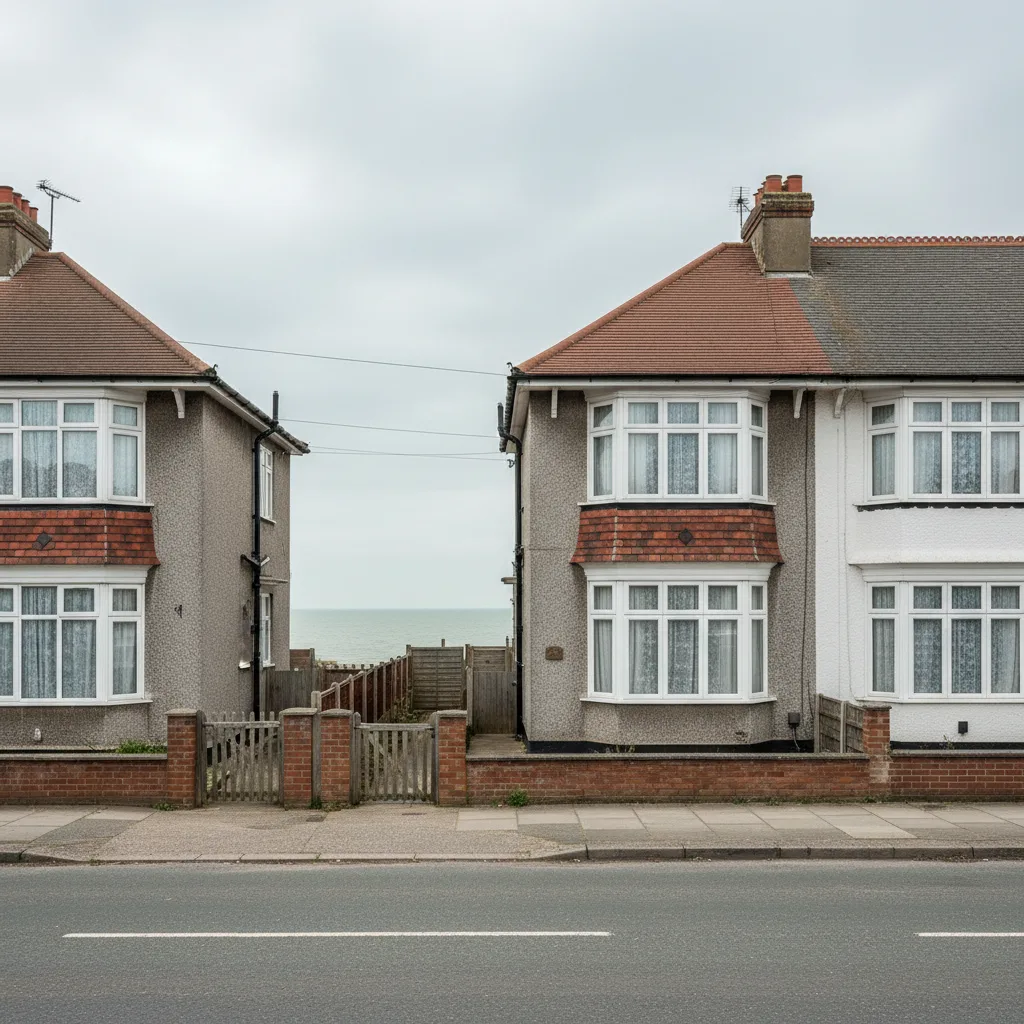
These estates were laid out as low density, well planted, informal in layout and consistent in material. What a committee is protecting is that quality rather than any individual building.
Which means a proposal that is modest, low and unobtrusive is received well, and one that adds a visible object to a roofline is not. A slim flush unit is easier to get through than a domed or raised one for reasons that have nothing to do with planning.
The old village and the designation
Separate from the estates, and it is the ordinary conservation position.
A conservation area over the older village and part of the estate development, within which the usual considerations apply: what reads from the street, slim flush units on anything visible.
How designation narrows permitted development is on article 2(3) land and permitted development. On a plot inside both a designation and an estate scheme, both apply.
Beachfront specification
The environmental condition, and it is not negotiable here.
These plots sit close to an open beach with nothing between them and the Channel. Salt arrives continuously, and it works on coatings, fixings and ironmongery rather than on glass.
Marine grade throughout, stainless on anything exposed, ironmongery rated for the environment, and fixings to the exposed schedule. It is the baseline rather than an upgrade.
Wind on an open plot
The other half, and low density makes it worse rather than better.
Houses set well apart in generous plots shelter each other far less than a terrace does, so a roof here takes more wind than its height suggests.
What that does to a fixing schedule, and why the loads concentrate at roof edges, is on the Washington page. It applies here with salt added.
Trees, and what an estate plants
A characteristic of these estates with two consequences.
Mature planting is part of what the covenants protect, and it shelters roofs from salt-laden air noticeably. Plots behind a good windbreak are in a materially easier environment than the same distance from the beach in the open.
It also costs daylight. A rear slope under a mature canopy delivers considerably less than the same slope in the open, and in summer the gap is widest. Where that is the case we say so before a unit is ordered.
Tree preservation
Worth a note, because it occasionally intersects with access.
Trees in a conservation area are protected, and individual trees anywhere may be subject to an order. Cutting a branch to get a scaffold or a lorry in is not a decision to take on the day.
Where access requires anything to be cut, that is established and consented before a date is set rather than dealt with by a driver with a saw.

Who to approach, and in what order
The sequence that works, and it saves a good deal of waiting.
Read the deeds first, so it is clear what the scheme actually requires. Approach the estate with a specification and a drawing rather than a question, because a committee can approve a proposal and cannot approve an intention.
Then planning, if it is needed, then Building Control, then the work. Approaching the estate last is the commonest way a job here takes six months instead of six weeks.
What a committee meets and when
A practical detail that decides the timescale more than anything else.
Estate committees are volunteers and they meet periodically rather than continuously. A proposal submitted the week after a meeting waits for the next one.
It is worth asking when they sit before submitting, because on a scheme with quarterly meetings the difference between one week and another is three months.
The house stock
Substantial detached houses, mostly twentieth century, on cut roofs with clay plain tile.
That structure allows a good deal: rafters and purlins rather than trusses, so an opening can be trimmed and the widths are not fixed by member spacing. The purlin is the constraint rather than the rafters.
Where it runs is established from inside the roof rather than assumed from the pitch.
Craigweil, and the estates by name
Worth being concrete, because people want to know whether this page applies to them.
The private estate arrangements here attach to defined areas laid out in the twentieth century, and not to every address with an Aldwick postcode. Some of the village is ordinary freehold with no scheme at all.
Which applies to a specific plot is in the deeds rather than in local knowledge, and it is the first thing we ask a customer to check. It takes one look at a title and it changes the whole shape of the job.
Neighbours who will see it
A dimension of the covenant question that is easy to forget and matters most.
Covenants on these estates are enforceable by the other owners rather than only by a committee, because each plot was sold with the benefit of the scheme as well as the burden of it.
Which means a neighbour who objects has a remedy of their own, quite separate from anything the estate does. Talking to the houses that will see the work, before it happens, is worth more here than almost anywhere else we operate.
Sand, and cleaning a unit near the beach
The maintenance point specific to a plot this close to the shingle.
Wind blown sand on glass is abrasive, and wiping a dry unit drags it across the surface. Rinsing first and then wiping keeps a unit clear; dry polishing every spring dulls it within a few years.
It costs nothing to say once and it is worth more over ten years than most of the specification decisions above it.
Large plots, and what they make easy
The compensation for the estate process.
Space on all sides, room for a scaffold within the boundary, and a lorry that can get close to the house. None of that is available on a seafront terrace.
Which makes the physical work here among the more straightforward on this coast, and it is the paperwork rather than the roof that sets the timescale.
Rinsing, and who does it
The maintenance habit that extends a unit’s life in this position.
Fresh water over the frame and the fixings twice a year lifts the salt film before it works on the metal. On a two storey house that means a ladder or somebody with one.
It is worth putting on a household’s list rather than assuming it happens, because on this stretch the difference between a rinsed unit and an unrinsed one is measured in years.
What the survey establishes
- Whether an estate scheme of covenants applies, and what it requires.
- Whether approval must precede work, and who gives it.
- Whether the property is also inside the conservation area.
- What stands between the plot and the sea from the south.
- Where the purlins run in the roof.
- Whether access requires anything to be cut, and whether it is protected.
Building Control
A replacement into an existing opening is not normally notifiable, though the unit still has to meet the limiting thermal standard. A new opening is, and goes to Arun District Council or an approved inspector.
The thresholds are on do flat rooflights need Building Control.
Permitted development
Outside the designation the ordinary rules apply, subject to the projection limit above the plane of the roof and nothing forward of the principal elevation.
Permitted development says nothing about covenants. A scheme that needs no planning application can still need estate approval, and the two are established separately at the outset rather than one being taken to imply the other.
How we quote
A free indicative range by email from photographs, then a survey, then a fixed itemised written price that does not move afterwards. Anything we misjudge at survey is ours to absorb.
What is measured at each step is on the how we price and quote page.
Guarantee
Ten years on our workmanship, on every job, limits written down. The manufacturer stands behind the unit; we stand behind the kerb, the flashing and the making good.
The terms, and the accreditations we do not claim, are on the our guarantee page.
Skylight services in this area
Conservation Rooflight Installation
Read moreElectric and Opening Rooflight Installation
Read moreEnergy Efficient Rooflights
Read moreFlat Roof Rooflight Installation
Read moreReplacing a Failed or Misted Rooflight
Read moreRoof Lantern Installation
Read moreRoof Window Installation
Read moreSun Tunnel Installation
Read moreVELUX Window Installation
Read moreWalk-On Rooflight Installation
Read moreThinking about this job? We survey across Worthing, West Sussex and the South Downs and give you a fixed price before any work starts, with a 10-year workmanship guarantee.