Yes, and outside is where the great majority of it is used. A terrace, a balcony, a patio light panel or a walkway are all external, and walk on units are made for exactly those. What external use asks for is a specification that suits weather as well as load: the right interlayer, a durable surface treatment and drainage that keeps water moving.
What outside actually demands
Weather on top of load.
An external panel takes rain, ultraviolet, freezing, heat and the thermal cycling that goes with them, all while doing the structural job it was specified for.
The interlayer
Where external specification matters most.
Structural interlayers differ in how they behave with moisture at the exposed edges, and a specification suited to external use is chosen deliberately rather than by default.
Edge exposure
The detail that follows from it.
A laminate edge sitting in standing water for years is the condition to design against, and it is why the drainage around a panel matters as much as the glass.
Why is on do walk on rooflights leak.
Ultraviolet
Handled by the material rather than by a coating.
Glass does not degrade under sunlight, and the interlayers used in walk on laminates are chosen for stability, so an external panel does not yellow or craze.
What that means against a polymer
A clear advantage.
An old polycarbonate panel outside embrittles and yellows within a couple of decades where glass does not change at all.
The comparison is on can a dome rooflight be replaced with glass.
Thermal cycling
Accounted for in the frame.
An external panel gets hot in sun and cold at night, so the frame allows for expansion and the setting blocks let the glass move without being pinched.
Frost
A surface question rather than a structural one.
Freezing does not harm the glass, and it makes the surface as slippery as any other hard external floor, which is a caution rather than a specification issue.
The anti slip surface outdoors
Effectively mandatory.
An external panel is walked on wet, so a fired frit or an etched finish is specified as a matter of course rather than as an option.
How it performs is on is walk on glass slippery when wet.
Algae outside
The maintenance item unique to external use.
A shaded external panel grows a green film that is very slippery when wet, and it is dealt with by cleaning rather than by anything in the specification.
A coastal position
Relevant across our area. Salt works on frames and on fixings rather than on glass, so an external panel near the sea wants the frame specified for the exposure.
What that means is on marine grade coatings against standard powder coat.
Wind uplift
Considered where the panel is exposed. A panel in an exposed terrace is designed against uplift as well as downward load, and the fixings into the structure are what resist it.
Where it is not over a room
A different and simpler case. A panel over an external undercroft, a light well or a passage is not a thermal element, so it can be a single laminate rather than an insulated unit.
Where it is over a heated room
An insulated unit is required. The walk on laminate becomes the outer leaf of a sealed unit with a cavity and an inner pane, and the thermal requirement applies as to any rooflight.
The figures are on what U value should a rooflight have.
External glass floors and bridges
The same product in a different setting.
A glazed bridge, a viewing platform or a step in a garden uses the same technology, designed against the same loads with the same surface treatments.
Steps and stair treads
A related specialist product. Glass treads are made with the same principles, and each tread is designed individually for its span and support.
Standing water on the surface
What the fall is for.
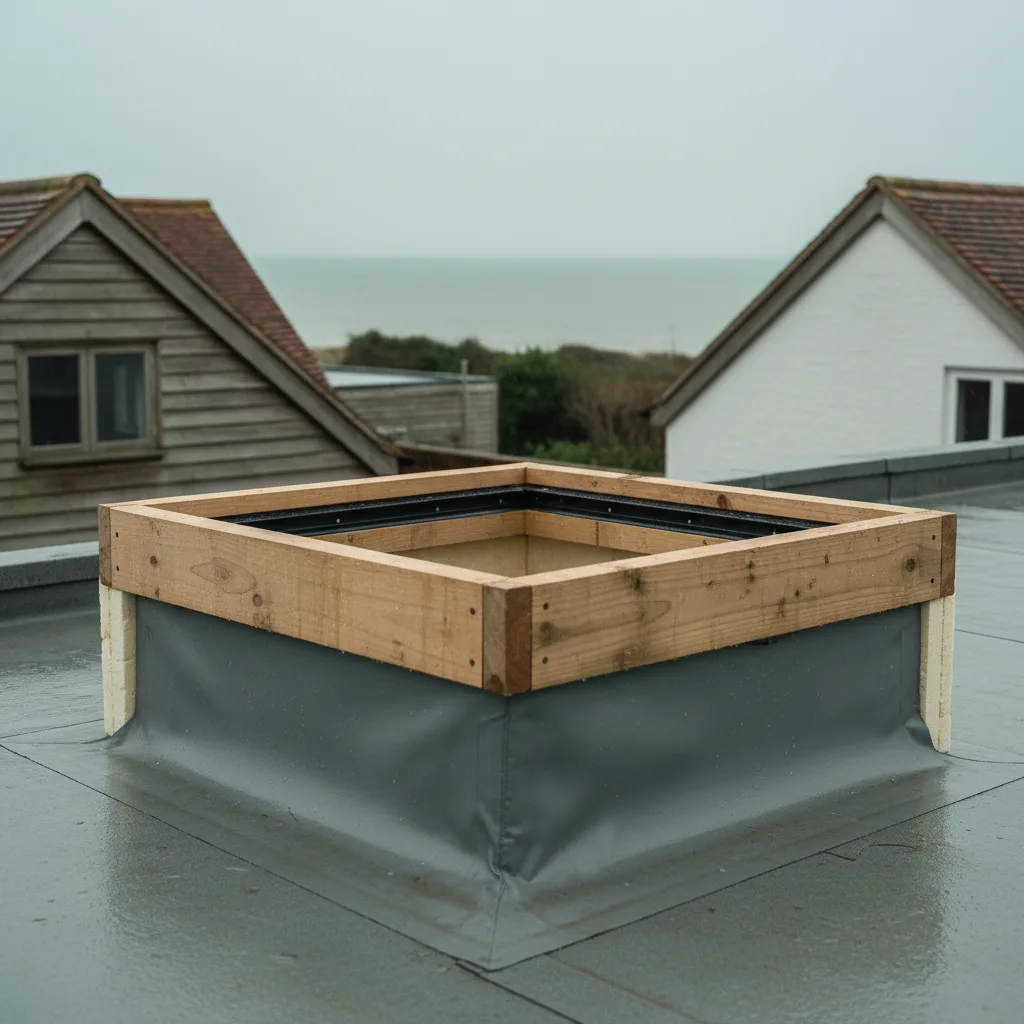
An external panel should shed water rather than hold it, and a terrace laid without a fall leaves puddles that encourage algae and stay slippery.
The general point is on what is the minimum fall for a flat roof with a rooflight.
Leaf litter
The seasonal maintenance.
Leaves on a panel block the drainage around it and stain the surface, and clearing them in autumn is worth more than any amount of cleaning later.
What the light does inside
The reason it is there. An external panel over a basement or a lower ground room delivers overhead daylight that nothing else in that position can provide.
Solar gain
Less than a clear rooflight. The thickness of the build up and the anti slip pattern together cut the solar transmission, so an external walk on panel is less prone to overheating a room.
Cleaning it
More often than a rooflight, for grip as much as light.
An external panel gets walked on and rained on, so it wants attention several times a year rather than annually.
How is on how do you clean a walk on rooflight.
Snow sitting on it
Designed for, and it clears itself slowly.
A level external panel holds snow rather than shedding it, which is a distributed load the design accounts for, and the room below sees very little light until it goes.
Salt and de icing
Worth avoiding on the glass.
Rock salt scattered on a terrace is abrasive underfoot and aggressive to the frame and fixings, and sweeping is the better answer on a walk on panel.
What we always specify on walk on glass
We specify external panels for the drainage first and the load second, because the load case is a calculation anybody can do and the water sitting at the edges is what actually shortens an installation.
The whole picture is on the walk on rooflight installation page.
Thinking about this job? We survey across Worthing, West Sussex and the South Downs and give you a fixed price before any work starts, with a 10-year workmanship guarantee.