Wind and opening rooflights on the Downs edge
Wind loading on a closed rooflight is a question about fixings and the covering around it, and it is covered on the roof windows and wind page. This one is about the other case, which is what happens while the window is open, and it behaves quite differently.
An open sash is a sail
A closed rooflight is part of a roof surface, and wind acts on it as suction distributed across a plane.
An open sash is a flat panel standing at an angle to the airflow, attached along one edge. Wind arriving at it produces a force acting through the middle of the panel, and that force is carried by the hinges at one edge and the actuator at the other.
Those are point loads on components sized for the weight of the sash and the friction of the seal, not for a gust. It is a completely different load case from the closed one and it is the reason this page exists.
What the load actually does
Three things, and they compound on an exposed site.
- It loads the hinges. A panel being pushed at its centre with its edge held is a lever, and the hinge takes the reaction.
- It loads the actuator. The chain is holding the sash at a position and wind is trying to move it.
- It resists closing. Wind blowing onto the open sash from the right direction holds it open against the motor.
The third is the one that produces the complaint, because a window that will not close in weather is a window letting rain in during exactly the conditions that brought the rain.
Why the Downs edge is a worse case
Wind accelerates as it rises over a slope and over a crest, so a site on the scarp takes a faster wind than the coastal plain a few miles south, at the same time, from the same weather system.
Add altitude, which raises the basic wind speed, and open downland upwind with nothing to slow the air, and a house at Findon, High Salvington, Poynings, Fulking or Pyecombe is a genuinely different design case from one in central Worthing.
The prevailing wind here is a south westerly that has crossed open sea, crossed a narrow plain, and then been lifted. It arrives with very little having taken energy out of it.
Direction matters more than it does when closed
A closed unit takes whatever the roof takes. An open sash has a face and a back, and which way it faces changes everything.
Wind onto the open face pushes the sash toward closed, which sounds helpful and means the actuator is holding against it. Wind onto the back pushes it further open, loading the hinges and the chain in the direction they are least happy about, and resisting the motor when it tries to shut.
Which case you have depends on the hinge position relative to the prevailing wind, and it is decided when the unit is specified. On an exposed site it is worth thinking about rather than accepting the default.
Opening angle
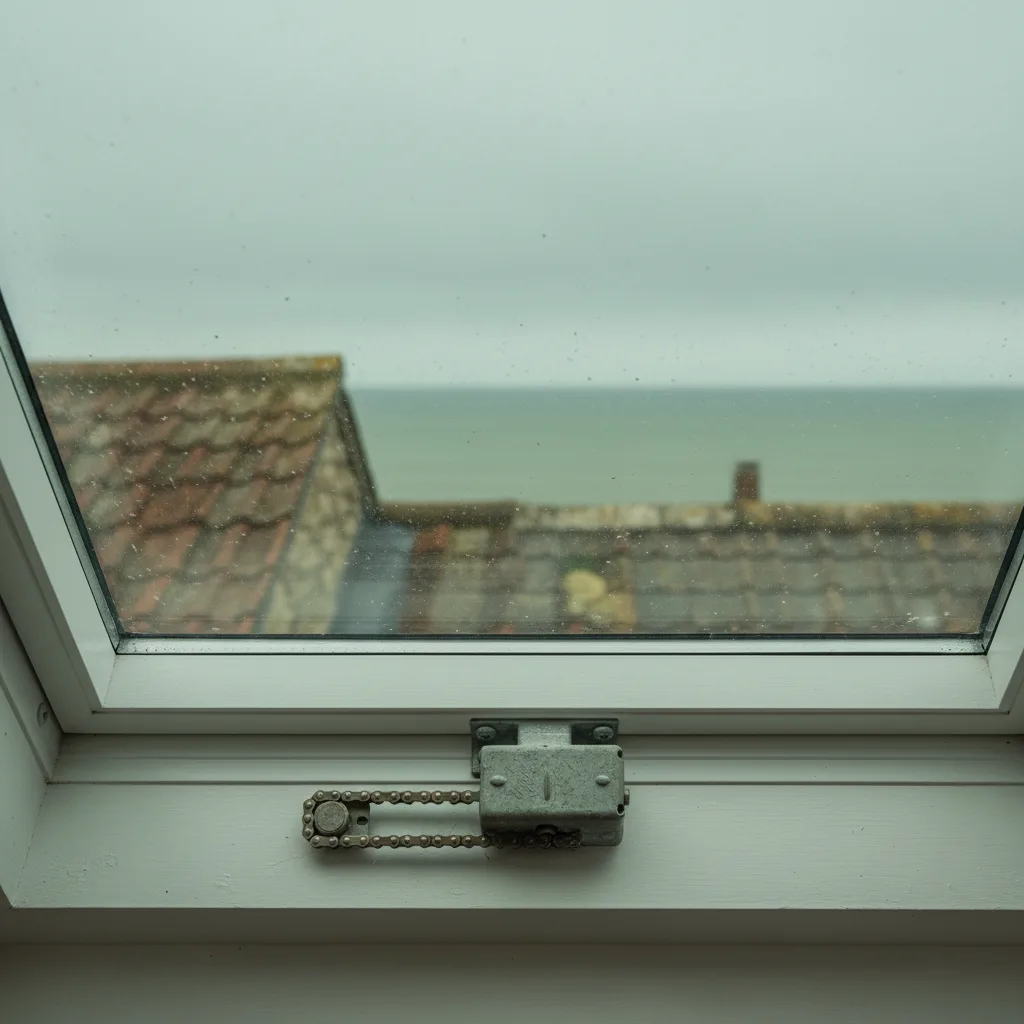
A sash open a little presents a small area at a shallow angle. A sash open wide presents its whole area close to the airflow.
So on an exposed roof there is a real argument for a shorter stroke, or for a controller that can be set to a partial opening for normal use with the full travel available when it is wanted.
Where a wide opening is needed for purge ventilation or for escape, the answer is not a shorter stroke. It is an actuator specified for the loads the full opening will meet.
Sizing the actuator for wind
The push rating opens the sash and the pull rating closes it, and it is the pull figure that wind attacks.
An actuator chosen against the weight of the sash alone will open a window it cannot reliably shut on a gusty day. That is not a fault when it happens; it is a specification that did not account for the site.
On an exposed roof we specify against the sash weight, the seal friction and the wind pressure together, and where a manufacturer publishes a wind rating for a unit we work to it rather than to the weight.
Wind sensors
A rain sensor closes a unit when it detects water and does nothing about a dry gale, which is the gap.
A wind sensor closes it when wind speed passes a threshold, which addresses exactly this case: a rising south westerly on a dry afternoon with a sash standing open.
It is a separate component with its own mounting and commissioning, specified with the controller rather than added to one. On most domestic roofs in the towns it is unnecessary. On a scarp or seafront installation with a large opening sash it is worth the conversation.
Where the sensor goes
A wind sensor has to see the wind the window is actually in, which is less obvious than it sounds.
Mounted in the lee of a chimney, a parapet or a taller part of the building, it reads a sheltered pocket rather than the roof, and the window stays open in conditions the sensor never sees. Mounted on the exposed face, clear of obstruction, it reads the roof.
On a complicated roof this is worth thinking about rather than mounting it where the cable happens to reach.
What changes with exposure, in one place
| Item | Sheltered town site | Scarp or seafront |
|---|---|---|
| Actuator sizing | Against sash weight and seal | Against weight, seal and wind pressure together |
| Opening angle | Full stroke, as wanted | Partial for normal use, full when needed |
| Hinge position | Whatever suits the room | Considered against the prevailing south westerly |
| Rain sensor | Worth having | Standard |
| Wind sensor | Rarely needed | Worth the conversation on a large sash |
| Manual override | Useful | Specified, and demonstrated |
| Leaving it open unattended | Ordinary | Not advisable |
Snow, and the sash left ajar
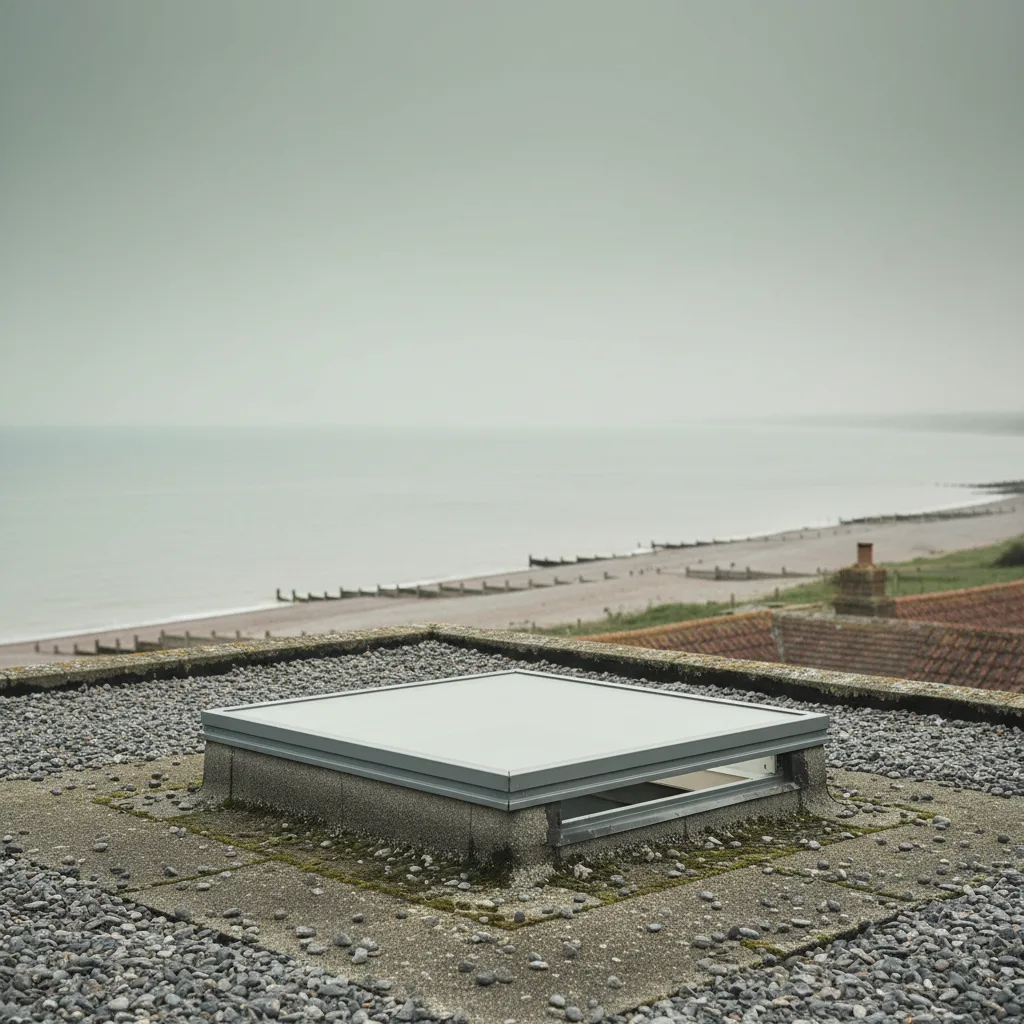
Snow is rare on this coast and it lies on the higher ground toward the Downs, which is exactly where this page applies.
A sash left partly open in falling snow collects it on the opening light and in the seal channel, and snow melting and refreezing in a channel is what stops a unit sealing. The actuator then meets a frozen obstruction, reads it correctly, and reverses.
It is a once or twice a decade problem here and it is worth knowing, because the response is to clear the channel rather than to conclude the motor has failed in the cold.
Debris arriving on an open sash
Wind on the scarp carries more than air, and an open rooflight is a hole in the roof.
Leaves, twigs, and on the coast fine grit and gull material all arrive through an opening that is standing there collecting them. Some of it lands in the room, and some of it lands in the seal channel and the chain track, which is where it does the damage.
It is one more reason a unit on an exposed site benefits from being closed when nobody is in the room, and one more argument for a sensor doing that automatically.
Closing onto something that is in the way
An actuator closing against wind is already working hard, and debris in the seal makes it work harder.
Most controllers will read that combined resistance as an obstruction and reverse, which is the safety behaviour working correctly. What the owner sees is a window that opens fine and refuses to close on a windy day, and concludes the motor is failing.
Clearing the seal channel, which takes a minute with the unit open, resolves a surprising proportion of exactly this complaint.
Noise while it is open
An open sash in wind makes noise, and knowing which noises mean something is useful.
A low note or a flutter as air passes the opening is ordinary and is not a fault. A rattle or a knock as the sash moves against its stays or its chain is worth reporting, because it usually means a mounting has worked loose. And a chain that ticks under load has grit in the track.
Leaving it open unattended
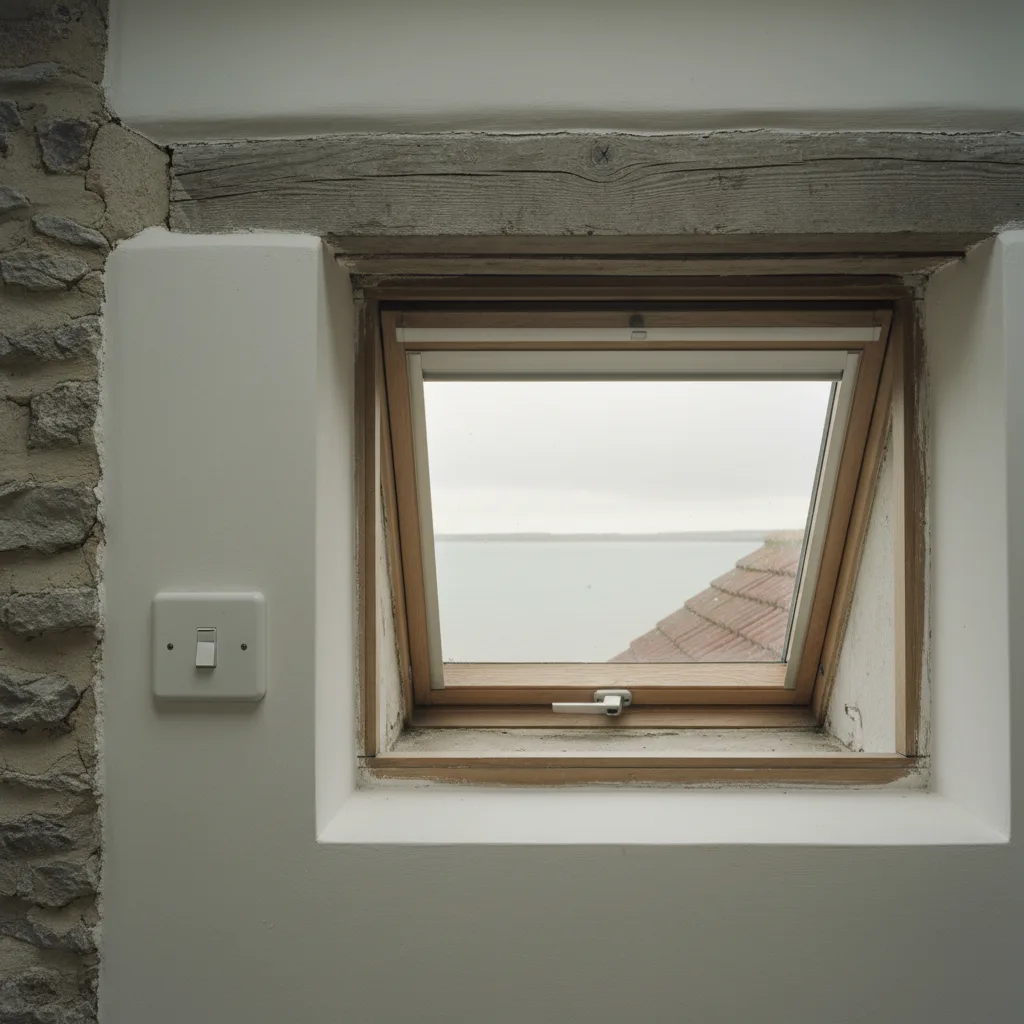
The honest advice on an exposed site is not to, and the reason is the compounding rather than any single risk.
Weather here changes fast off the Channel, wind and rain arrive together, and a sash held open by pressure is one the motor may not shut. A house nobody is in for eight hours with a large rooflight open on the scarp in April is a real risk rather than a theoretical one.
Sensors reduce it considerably and do not eliminate it, because a sensor acts once the condition arrives rather than before.
The manual override, in this specific case
Where a powered unit can be released from its actuator and moved by hand, that is worth knowing before a gale rather than during one.
A window stuck open in weather, with a motor reporting an obstruction, is precisely the situation the override exists for. Getting to it may not be easy on a high unit, and knowing whether it exists at all changes what you do.
Like every mechanism, it seizes if it is never used, so operating it once a year belongs in the annual routine.
Fixed units, and the case for them here
The most reliable opening rooflight on an exposed downland roof is the one that does not open, and it is worth saying.
A fixed unit has no sash to load, no chain holding against wind, and nothing to be left open. Where a room has adequate ventilation from elsewhere and no escape requirement, fixed removes this entire page from your life.
Where ventilation genuinely is needed, an opening unit is right and it is specified for the site rather than avoided.
Working on an exposed roof
Exposure changes the installation as well as the specification.
Glass is not handled in strong wind, because a pane is a sail and it is a genuine hazard to the people carrying it. Temporary covering is fixed rather than weighted. The roof is opened and closed within the day. And on the scarp the wind is watched as closely as the rain when choosing a start date.
How we size it on an opening unit
We size the actuator against the sash weight, the seal and the wind pressure together on an exposed site, and consider which way the sash faces relative to the prevailing south westerly rather than accepting a default. Where a large opening sash sits on the scarp or the seafront we raise the wind sensor question explicitly. We fit the manual override where the unit offers one and show you how to use it.
Closed, a rooflight is part of the roof. Open, it is a panel in a gale held by two brackets and a chain.
Thinking about this job? We survey across Worthing, West Sussex and the South Downs and give you a fixed price before any work starts, with a 10-year workmanship guarantee.