Reflectivity, run length and how much light actually arrives
A sun tunnel collects daylight at the roof and delivers some of it to a ceiling. How much arrives depends on four things, they interact rather than add up, and understanding how is what separates a tunnel that transforms a room from one that disappoints.
Light in a tube bounces
The mechanism, and everything follows from it.
Daylight entering the dome arrives from all directions across the sky. Some of it travels almost straight down the tube. Most of it hits the wall, reflects, hits the opposite wall, reflects again, and works its way along by a series of bounces.
Each bounce loses a fraction. That fraction is small on a good surface and it happens many times, and the losses multiply rather than add.
Why multiplying matters
The single most useful idea on this page.
If each bounce returns a high proportion of the light, one bounce costs little. Ten bounces cost that proportion ten times over, compounding, and the result falls away faster than intuition suggests.
Which is why a small difference in reflectivity between two products produces a large difference in delivered light over a long run, and almost no difference over a short one.
It is also why the manufacturers who publish a reflectivity figure are the ones worth comparing.
Reflectivity
The property of the tube lining, expressed as a percentage of light returned at each reflection.
Good rigid systems use a highly specular reflective material with a figure in the high nineties. Lesser products are lower, and a corrugated flexible lining is lower again in practice because the surface is not smooth.
The difference between a very good lining and an ordinary one is a few percentage points per bounce, which over a run with many bounces is the difference between a bright room and a dim one.
Run length
Longer runs mean more bounces, so light falls away with distance, and it falls away faster than proportionally.
| Run | Typical situation | Delivered light |
|---|---|---|
| Short | Bungalow, dome directly above the ceiling | Excellent. The best case for this product |
| Moderate | House, through a roof space to a landing | Good on a rigid tube |
| Long | Through a deep roof space, or two storeys | Falls away. Diameter matters a great deal |
| Very long | Beyond the manufacturer maximum | Not a sun tunnel job |
Manufacturers publish a maximum run for each system and it is a real limit rather than a caution. Beyond it, enough light is lost that the product stops doing its job.

Bends
The most expensive thing you can do to a run, and the least obvious.
A bend turns the light back on itself, which forces additional bounces immediately and changes the angles at which light travels afterwards. A single bend costs more light than a substantial extra length of straight tube.
Two bends cost more than twice one, because the second is working on light already reduced by the first.
Which produces the practical rule: a longer straight run beats a shorter bent one, almost always, and moving the dome position on the roof to achieve straightness is worth doing.
Diameter
The lever with the largest effect and the one people economise on.
A wider tube has more cross sectional area, so it collects more light at the dome. It also gives light a shallower average angle to the wall, so it travels further between bounces and there are fewer of them over the same run.
Both effects work in the same direction. Which is why going up a diameter improves delivered light considerably more than the increase in area alone would suggest, and why it is the first thing to increase on a long run.
Choosing a diameter has its own page.
The four together
They interact, and the interaction is what makes a specification rather than a shopping list.
A short run tolerates a lower reflectivity, a bend, and a modest diameter. A long run needs high reflectivity, no bends if possible, and a generous diameter, because it is already spending its light on distance.
Which means the same product is an excellent choice in one house and a poor one in another, and the run is what decides.
What the dome contributes
The collection end, and it matters more than people assume.
The dome gathers light from across the sky and directs it into the tube. Some are simple clear domes; better ones use a profiled or prismatic surface to redirect low angle light down the tube rather than letting it skim off.
That matters most in winter, when the sun is low and a plain dome collects poorly, and at the ends of the day. A dome designed to capture low angle light gives a noticeably longer useful day.
The diffuser at the other end
The delivery end, and it spreads what arrives rather than adding to it.
A diffuser takes the light coming down the tube and spreads it across the room, rather than letting it fall as a bright circle directly below. What it cannot do is deliver more than the tube brought.
Different diffusers spread differently and lose slightly different amounts, and they have their own page.
Orientation of the dome
Less important than on a rooflight, and not irrelevant.
A dome collects from the whole sky, so it works on any orientation, which is one of the product’s advantages: a north facing slope is a perfectly good position.
What orientation changes is when the peak arrives and how much direct sun contributes. A south facing dome gets a strong direct component in the middle of the day; a north facing one gets steady diffuse light. In a hallway or a bathroom the second is frequently preferable.

What a good installation delivers
Setting expectations honestly, because this is a product that gets oversold and undersold in turn.
A generous diameter rigid tunnel on a short straight run, into a small internal room, delivers a genuinely useful amount of daylight. People consistently describe the room as transformed, and they frequently think a light has been left on.
A narrow flexible tunnel on a long bent run into a large room delivers a noticeable glow and not much more. Both are sun tunnels.
It follows the weather
An honest characteristic rather than a limitation.
A sun tunnel delivers what the sky is giving. On a bright day the room is properly lit; on a dull February afternoon it is dim; at night it does nothing at all unless a light kit is fitted.
People find that variation pleasant rather than annoying, because it connects an internal room to the time of day and the weather, which is exactly what a windowless room lacks. It is worth setting the expectation that it is daylight rather than lighting.
Where the losses actually are
- The dome surface, which reflects a small proportion away before anything enters.
- Every bounce along the tube, compounding.
- Every bend, disproportionately.
- Any dust settled on the reflective surface over years.
- The diffuser at the ceiling.
Two, three and four are within the specification and the installation. One and five are properties of the components chosen.
Dust, and why joints are sealed
The slow loss nobody plans for.
A tube with unsealed joints admits dust from the roof space, which settles on the reflective surface and reduces it permanently. Over decades that is a real reduction and it cannot be cleaned out of a long run.
Which is why joints are taped and sealed as a matter of course, and why a well made installation stays bright while a hurried one dims.
Comparing two quotations
The questions that make them comparable.
What diameter. What tube type. What published reflectivity. How many bends in the proposed route. And what the manufacturer’s own figures say that combination delivers over the run length in this house.
A supplier working from the manufacturer’s performance data can answer all five. One quoting a product without a route has not designed anything.
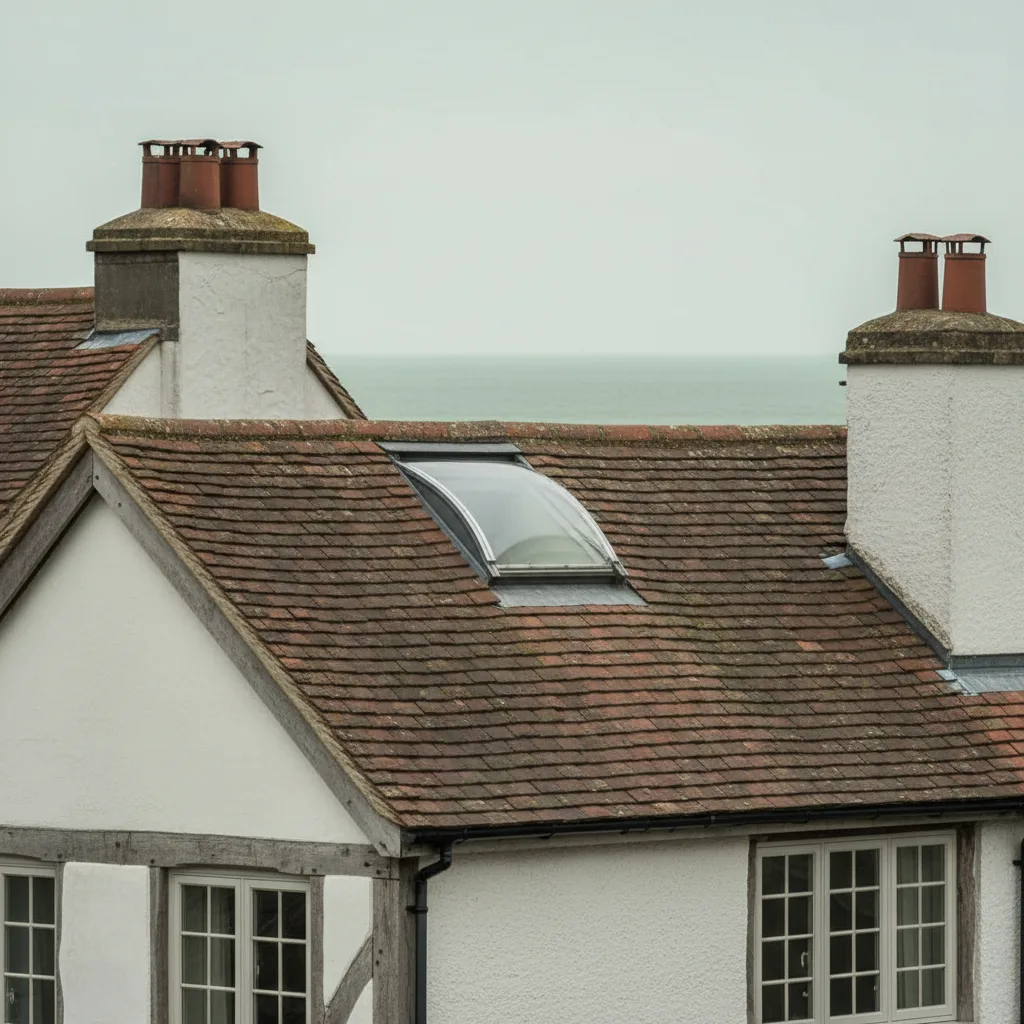
The seasonal picture on this coast
Worth setting out, because the useful comparison is not summer against winter but what the sky is doing.
The light here is frequently bright overcast rather than clear sun: a high thin cloud layer with the sea reflecting under it. That is a good sky for a sun tunnel, because the dome collects from the whole hemisphere rather than depending on a beam, and an overcast sky is uniformly bright.
Which means a sun tunnel on this coast performs more consistently than people expect. It is less dependent on orientation and less dependent on sun than a rooflight, and a dull bright day still delivers usefully.
What it does badly is a dark December afternoon, and so does everything else.
Two tunnels instead of one
Worth raising where a room is larger than one tunnel serves.
Two smaller tunnels distribute light more evenly across a room than a single one of the same total area, and they give two shorter runs if the roof positions are chosen well.
Against that, two roof penetrations and two ceiling openings cost more than one. In a long hallway it is frequently the better answer; in a small room it is unnecessary.
What the room below does with it
The last variable, and it is free.
Light arriving at a ceiling diffuser is then reflected around the room, and how much of it stays useful depends on what the surfaces are. Pale walls, a light floor and a white ceiling return most of it; dark surfaces absorb it.
In a small internal room lit only by a tunnel, that effect is substantial. A hallway painted white measurably outperforms the same hallway in a strong colour with the same tunnel above it.
It is worth mentioning because it is the cheapest improvement available and because people decorate after the installation rather than before.
Measuring what you got
Worth knowing that it can be done, because expectations and reality are hard to compare from memory.
A simple light meter, or the one in a phone, gives a reading on the floor of the room before and after. It is not a laboratory measurement and it does show the change, and the change in a previously windowless room is generally dramatic.
Where a tunnel has disappointed, a reading taken at midday on a bright day and compared with the manufacturer’s figures for that diameter and run is the way to establish whether it is underperforming or whether the expectation was wrong.
What we survey on a sun tunnel
We survey the roof space and design the route before quoting a product, because the route decides how much light arrives. We favour a straight run over a short one, specify a generous diameter rather than the minimum, use the manufacturer’s own performance figures for the actual run rather than a general claim, and seal the joints.
Reflectivity, length, bends and diameter. Get the route straight and the diameter generous, and the rest looks after itself.
Thinking about this job? We survey across Worthing, West Sussex and the South Downs and give you a fixed price before any work starts, with a 10-year workmanship guarantee.