How long does a flat roof rooflight or skylight take to install?
A single unit into a sound existing opening is generally a day on site. Where the kerb has to be raised, squared or insulated first, allow two. Where the covering is being renewed or the substrate turns out to be soft, longer. The variable is almost never the rooflight; it is what it is being fitted onto.
What a day actually contains
Six stages, and they run in order.
Protecting the room, removing the old unit, inspecting the substrate, making any repair, fitting and flashing the new unit, and making good.
On a sound roof those fit comfortably into a working day with the roof watertight well before the end of it.
What is done before the day
Rather more than people expect, and it is why the day itself is short.
The survey, the kerb measurements on four sides and both diagonals, the order, and the lead time on a made to size unit.
The unit is held until the morning it goes in rather than delivered to stand in a garden.
The lead time
Frequently the longest part of the whole process.
A standard size is generally available quickly. A made to size unit is manufactured to order, and several weeks is normal.
Which is why a date is given after the order rather than at the quote.
Where a second day comes from
The kerb, almost always. Raising a low upstand means building up in timber, extending the covering up the new face and terminating it properly, which is roofing work with a curing or setting time on some coverings.
That is a day of its own before the unit goes anywhere near the roof.
Where a third comes from
The substrate, and it cannot be known in advance.
Soft timber at the base of an upstand, a covering perished at the termination, or insulation that turns out not to be there all add work that is only visible once the old unit is off.
We price the known work and state what would be extra, rather than promising a day that does not survive the first hour.
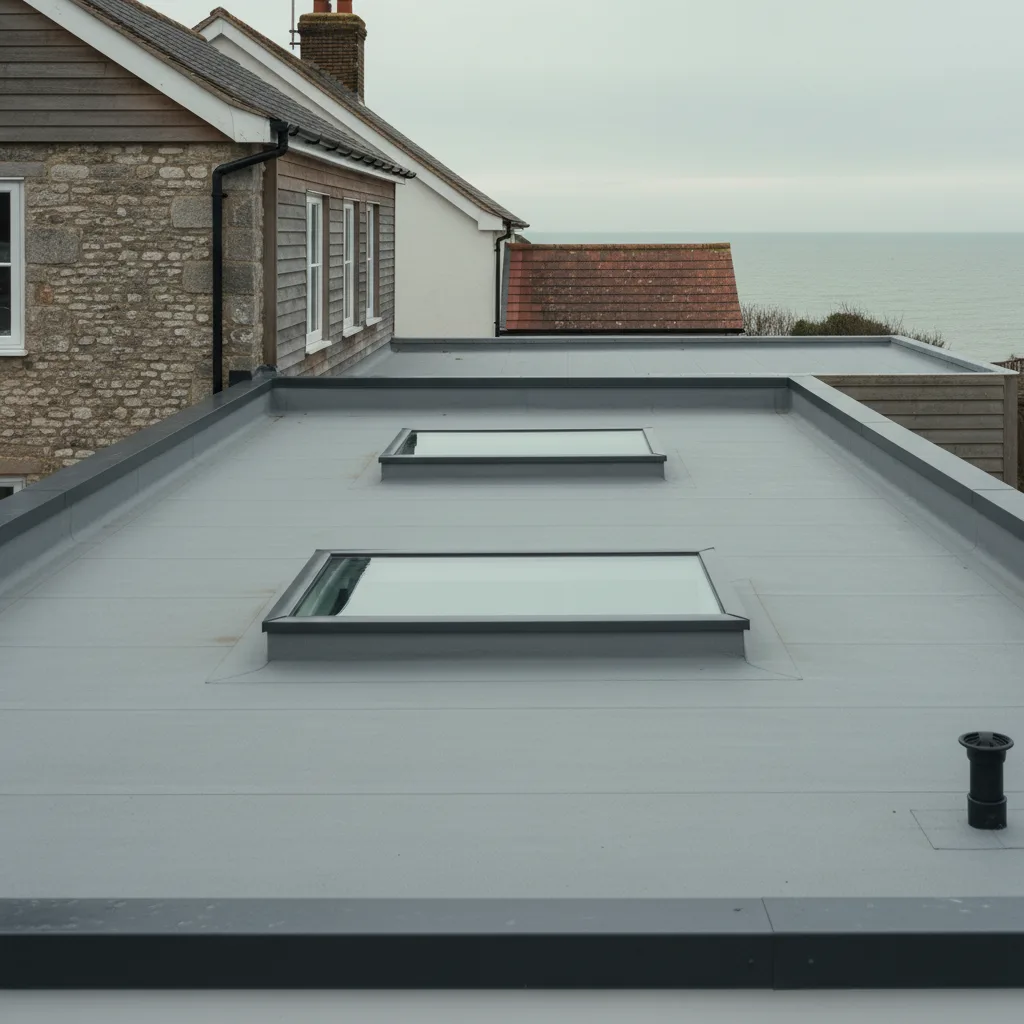
The rule that governs the day
An opening is never left unweathered overnight.
If a job cannot reach a watertight point before the light goes, the roof is not opened that day. Everything about how the work is scoped follows from that.
Winter against summer
The same work, a different working day.
Around eight hours of usable light in December against sixteen in June, with a later start because a wet or frosted roof is not walked on.
Which means a winter job is scoped smaller and planned with a margin. The detail is on the Wick page.
Weather that stops work
Wind before rain, which surprises people. Working at height stops in wind well before it stops in drizzle, and a large glazed unit being lifted onto a roof is exactly what wind makes dangerous.
We ring in the morning rather than arriving and standing about.
Two units on one deck
Not twice the time, and generally a comfortable day and a half.
The protection, the access and the set up are shared, so the second opening adds the forming, fitting and making good rather than the whole sequence again.
Which is part of why two units cost less than twice one.
A lantern
A different order of work. Two to three days typically, because the kerb is more demanding, the structure frequently needs attention, and assembling a lantern on a roof is not a single lift.
New build against retrofit
Considerably quicker during a build, and it is barely a separate job.
Where an extension is being built, the kerb is formed as part of the deck and the unit goes on when the covering is done. There is no cutting into a finished roof and no ceiling to make good.
The making good
Frequently a separate visit, and it is worth knowing.
Plastering a reveal wants the opening finished and then time to dry before decorating, so a splayed reveal on a retrofit is generally a plasterer returning rather than the same day.
It is arranged rather than left to the householder to organise.

Living through it
One room, one day, and it is dusty rather than disruptive.
The room is sheeted, the floor covered, and the opening sealed while it is being cut so the dust stays contained. Debris is carried out rather than swept aside.
In a kitchen that means the room is out of use for the day and usable that evening.
What delays a start
Three things, and none is the work.
A made to size lead time, a scaffold date where one is needed, and on a designated or listed building, a consent.
All three run in parallel rather than in sequence where we are organising them.
How far ahead to book
A few weeks in ordinary conditions, longer through autumn.
Autumn is when leaks announce themselves and everybody rings at once, so a job that could be done in a week in May takes longer to schedule in October.
What we need from a household on the day
Very little, and it helps to know in advance.
The room cleared or clearable, access to a tap and a socket, and somewhere a tower can stand. Where the route to the back is through the house, an agreed time to bring materials through.
Nobody needs to be present all day, and somebody should be there at the start and the finish.
What is left at the end
A watertight roof, the room swept, and the debris taken away rather than left in a garden.
Where a plasterer is returning to finish a reveal, that date is confirmed before we leave rather than arranged afterwards.
How we scope it
We scope the day so it reaches a watertight point with margin, hold the unit until the morning it goes in, and say at the quote what would extend it rather than discovering it on site.
The whole picture is on the flat roof rooflight installation page.
Thinking about this job? We survey across Worthing, West Sussex and the South Downs and give you a fixed price before any work starts, with a 10-year workmanship guarantee.