Controls, remotes and integrating with a home system
A powered rooflight is a motor and a controller, and the controller is what you actually live with. It decides how the window is operated, whether it can be grouped with others, and whether it will ever talk to anything else in the house.
The three ways people operate one
Handheld remote, wall control, or an app. Most installations end up with two of the three, and which two matters.
The handheld remote
Supplied with almost every unit. It works, it needs no wiring, and it is lost within a year in most households. A second one is worth having from the start.
The wall control
A switch or keypad mounted beside the light switch. It is what households actually use day to day, because it is always in the same place. It needs a cable and a back box, which is a decision made before the plaster.
The app
Where the system supports it, control from a phone. Genuinely useful for closing a window you have left open, and dependent on a network, an account and a manufacturer continuing to support it.
Pairing, and where the controller has to be
A remote has to be paired with the controller, and pairing generally requires physical access to put the controller into a learning mode.
Which is the practical reason the controller position matters. A lost remote should be a ten minute problem. Where the controller is buried in a ceiling void above a finished room, it is a plasterer.
Somewhere accessible, labelled, and known about. It costs nothing at installation.
Groups and scenes
Where a room has more than one powered rooflight, the controller can usually operate them together, individually, or both.
Both is what you want. Opening everything on a warm afternoon is one command; closing one and leaving another open overnight is a different one, and a system set up only for group control removes that choice.
Setting it up with a group command and individual addresses is done at commissioning and is fiddly to change later. It is worth asking for explicitly rather than accepting whatever the default is.
Blinds on the same system
Powered blinds are frequently the same manufacturer and the same control system as the window.
Where they are, a single control operates both and a scene can do something genuinely useful: close the blind and leave the window open on a summer night, or open both in the morning. Where they are not, you have two remotes and two systems, which is how remotes get lost.
If blinds are likely at any point, establishing compatibility before the window is ordered is worth five minutes.
Integration with a wider home system
| Question | Why it matters | Settle it |
|---|---|---|
| What protocol does the house use? | Compatibility is decided by the system, not the window | Before ordering |
| Does the window system have a bridge or gateway? | Frequently the piece that makes it work | Before ordering |
| Is a hub or account required? | Adds a dependency and sometimes a subscription | Before ordering |
| Does it still work if the network is down? | Local control should not depend on the internet | Before ordering |
| Who commissions the integration? | Rarely the rooflight installer | Before the work starts |
Compatibility is decided by the system, not the window
This is the point worth taking away.
A rooflight manufacturer supports a set of control protocols, and a home automation system supports another set. Integration is possible where those overlap, or where a bridge exists that translates between them.
Which means the question is never simply whether a window is smart. It is whether that window’s control system and your house’s control system have something in common, and that is answered by looking at both.
Local control should survive everything
A rooflight is part of a building rather than a gadget, and it should still work when other things do not.
The test is simple: does the wall control still open and close the window with the internet down, the hub unplugged and the phone in another county? On a well arranged system it does, because the wall control talks to the controller directly and everything else is an addition on top.
Where local control depends on a cloud service, that is a dependency on a company continuing to exist. Worth knowing before rather than after.
What automation is actually good for
Two things, genuinely, and a long tail of things that sound better than they are.
Closing on rain is the first, and it is what a sensor does anyway without any automation. Closing everything when the house is empty is the second, and it removes the main risk of a powered rooflight.
Opening on temperature sounds excellent and is frequently disappointing, because a room being warm is not the same as it being a good moment to open the roof. Most households end up using the wall switch.
The exception is a room nobody is in during the day, such as a landing or a stairwell, where scheduled ventilation genuinely helps.
The sensor overrides everything
However clever the control arrangement, the rain sensor takes priority.
An automation that opens a window on a schedule has to yield to a sensor that has detected rain, and on any properly arranged system it does. Where a window is also an escape opening, the escape function overrides both.
That hierarchy is set at commissioning, and it is worth confirming rather than assuming, because it is the sort of thing that is only tested by weather.
Battery powered wall controls
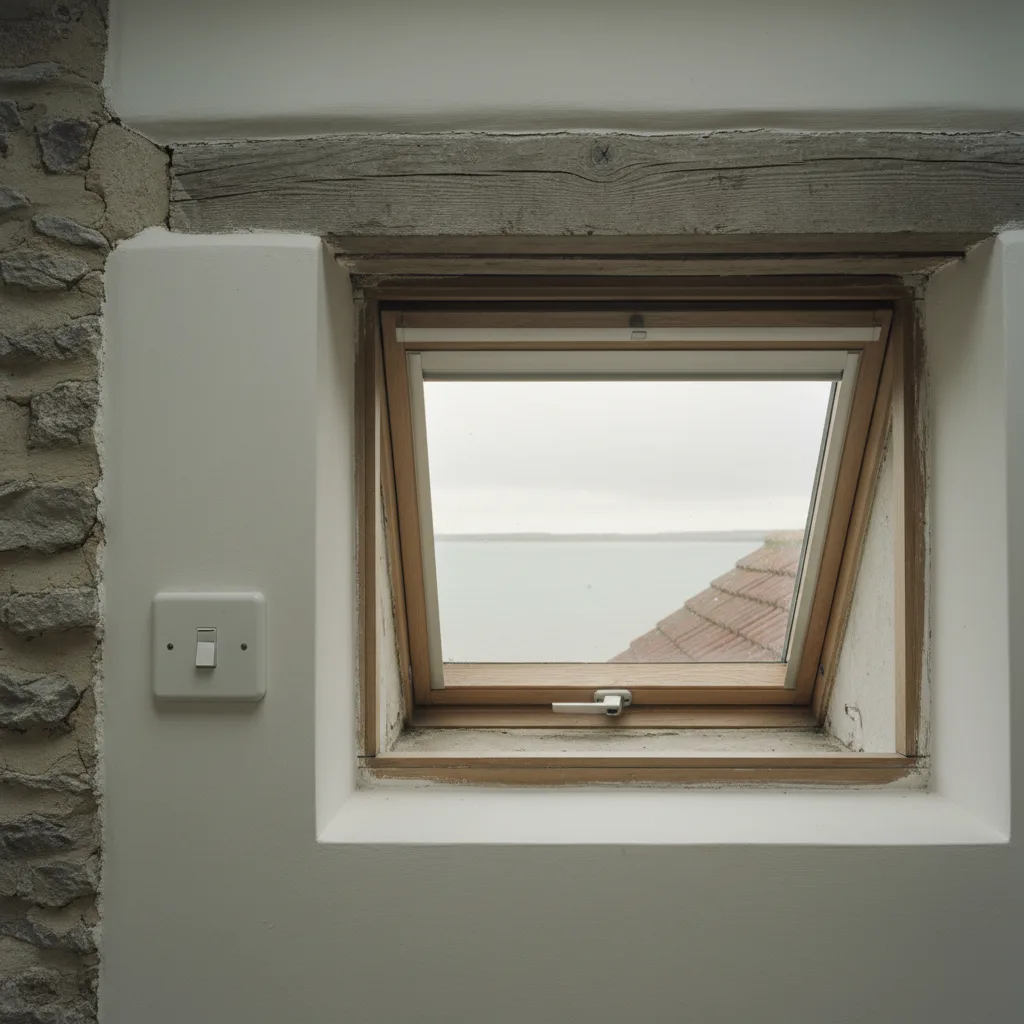
Where no cable was run, wireless wall controls exist and they solve the retrofit problem neatly.
They stick or screw to the wall wherever you want them, and they talk to the controller by radio. The battery lasts a long time and it does eventually need replacing, which nobody remembers, so a control that has stopped working is worth trying a battery in before anything else.
On a new installation a wired control is better and costs almost nothing while the wall is open.
Range, and the walls in between
Wireless controls have a stated range and that figure is measured in open air, which is not where anybody lives.
What reduces it is mass between the transmitter and the controller: masonry walls, a concrete floor, foil faced insulation in a roof build-up, and metal ductwork. Foil facings are the one people do not anticipate, and a roof insulated with foil faced board is a partial radio shield sitting directly between a handheld remote and a controller mounted above the ceiling.
The practical consequence is a remote that works from directly beneath the window and not from the doorway. It is a positioning problem rather than a fault, and it is far easier to solve at installation by moving the controller than afterwards.
Interference and shared frequencies
Wireless controls share the airwaves with a great deal else in a modern house.
Most systems handle that well, and where a control has become intermittent for no obvious reason, something new in the house is worth considering: a new router, a wireless doorbell, a neighbour’s equipment through a party wall in a terrace.
It is rarely the cause and it is worth ruling in or out before assuming a component has failed, because the diagnosis is free and the alternative is a call-out.
What happens when the manufacturer moves on
A rooflight lasts decades and a control platform does not, which is a real consideration rather than a cynical one.
App based control depends on a company maintaining an app, a server and an account system. Over twenty five years that is a long commitment, and platforms are retired.
Which is the strongest argument for the arrangement recommended below: keep the everyday operation local and simple, on a wall control talking directly to the controller, and treat the app as a convenience layer. If the app disappears, the window still opens.
Naming things properly
On a house with several powered units, what they are called matters more than it sounds.
Kitchen, landing, bathroom. Not Window 1, Window 2, Window 3, which is what the default frequently is and which nobody can map to a room after a month.
It takes a minute at commissioning and it is the difference between a system people use and one they poke at.

Handover
A control system handed over without a demonstration is a control system running on its defaults for ever.
What a proper handover covers: every control tested, the group and individual commands demonstrated, the rain sensor tested with actual water, the manual override shown, the controller position pointed out, and the spare remote handed over rather than left in a box.
It takes fifteen minutes and it is the difference between a household that uses the window and one that opens it twice a year.
What to keep
- The controller model and where it is.
- Pairing instructions for adding a remote.
- The window type and size code, for parts.
- Any account details for an app, which the next owner will need.
- The electrical certificate for the supply.
Selling the house
Worth a mention, because it is where control systems fall over.
A powered rooflight with a lost remote, an unlabelled controller in a ceiling void, and an app tied to an email address nobody has access to is a window that does not work as far as the new owner is concerned.
Leaving the documentation together, the controller labelled, and any account transferable is a small courtesy that saves somebody a call-out.
Keeping it simple
The most reliable arrangement we install is not the cleverest one.
A wall control beside the light switch, a rain sensor, a spare remote in a drawer, and a labelled controller somewhere reachable. It works in a power cut on a solar unit, it works with the internet down on any unit, and anybody who walks into the room can operate it.
Integration is worth doing where a house already has a system and somebody who maintains it. Where it does not, it adds dependencies to a window that will outlast several generations of home automation.
What we ask first on an opening unit
We ask what the house already uses before assuming anything integrates, and check compatibility against both systems rather than the window alone. We put the controller somewhere reachable and label it, set up group and individual control rather than one or the other, and run a cable for a wall switch while the wall is open. We commission with the sensor tested and demonstrate everything at handover.
Where a household simply wants a window that opens, we will say so rather than selling an integration nobody asked for. A wall switch, a sensor and a spare remote is a complete answer, and it is what most of the installations we are happiest with look like five years later.
The motor lasts decades. The control system is the part that dates, so it is worth keeping the everyday operation simple and local.
Thinking about this job? We survey across Worthing, West Sussex and the South Downs and give you a fixed price before any work starts, with a 10-year workmanship guarantee.