Chain actuators, rain sensors and the cable route planned before the ceiling closes
An opening rooflight out of reach is opened by a motor, the motor needs a supply, and the supply needs a route. That last item is the one that decides everything, because the route is available for about a day and then it is not.
What a chain actuator is
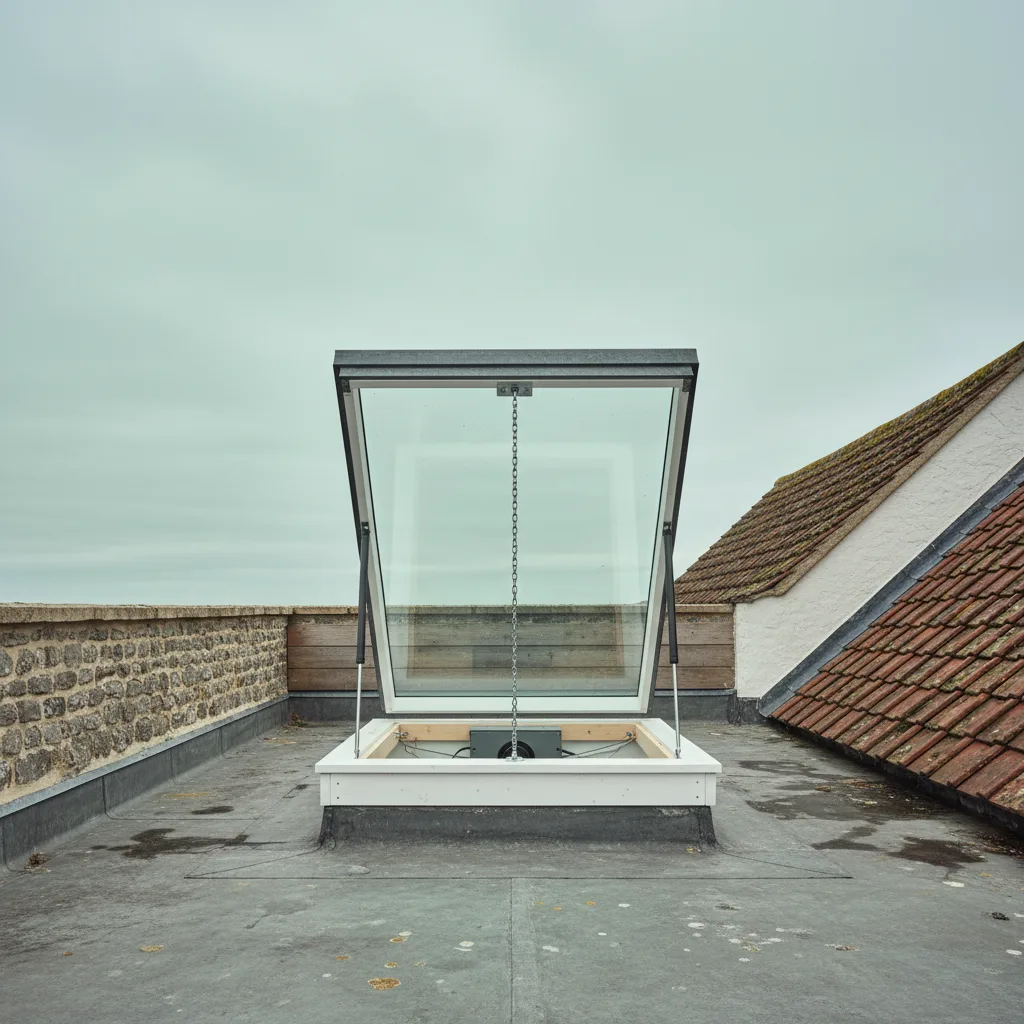
A small electric motor driving a chain that is rigid in compression, housed in a case fixed to the frame, with the free end of the chain attached to the opening sash.
Running the motor one way pushes the chain out and the sash open. Running it the other pulls the chain back into the case and the sash shut, and it pulls it into a seal rather than merely letting it fall closed.
The chain is the clever part. An ordinary chain can only pull; this one is made so its links lock straight as they leave the housing, so it can push a sash open against its own weight and against wind.
Stroke, and how far it opens
Stroke is how far the chain extends, and it sets the opening angle of the sash.
A short stroke gives a small opening, enough for background ventilation and not much air movement. A long stroke gives a wide opening that clears a room quickly and, on a rooflight that has to serve as an escape opening, is what makes the clear dimensions achievable.
It is specified with the unit and it is not adjustable afterwards in any meaningful way. Deciding it means deciding what the window is for.
Force, and why it is not just about weight
An actuator has a rated force, and it has to overcome three things at once.
- The weight of the sash, which on a large glazed unit is considerable and acts against the motor for the whole of the opening stroke.
- The friction of the seals, which is highest at the moment the sash breaks away from closed.
- Wind pressure on the sash while it is open, which is what decides whether it can be closed again in weather.
The third is the one people do not anticipate, and on an exposed site it is the one that matters. An actuator sized for the sash weight alone may open a window it cannot reliably shut in a south westerly.
Closing force is a separate rating
Actuators are rated separately for push and pull, and the pull figure is what matters for closing against a seal and against wind.
A window that opens smoothly and then does not quite seal, or that reports an error and reverses, is usually a closing force problem rather than a fault. On a large unit or an exposed roof, that is a specification question at ordering rather than something to discover.
One actuator or two
A wide sash on a single central actuator is being pushed at one point, and the sash has to be stiff enough to carry that without twisting.
Beyond a certain width, manufacturers specify two actuators working in synchronisation, one toward each end. That spreads the load, keeps the sash square as it moves, and seals evenly along the whole edge.
Two actuators need a controller that drives them together, which is a specification decision rather than a wiring one, and it is another reason the electrical arrangement is settled before the order.
The cable route
| Stage | Cost of running a cable | Notes |
|---|---|---|
| Roof open, ceiling not formed | Minutes | The right moment, every time |
| Ceiling formed, not plastered | An hour | Still straightforward |
| Plastered, not decorated | Chasing and making good | Disruptive and visible until decorated |
| Finished room | Boards up or a surface run | This is where solar earns its place |
Where the cable actually goes
The supply arrives at the head of the frame, which means it has to reach the top of the opening from wherever the circuit is.
On a flat roof that is through the ceiling void and along to the kerb, entering near the head of the unit. On a pitched roof it runs in the rafter zone to the head of the window. Either way it crosses the insulation line and the vapour control layer, and that crossing has to be sealed.
An unsealed cable penetration through a vapour control layer is a hole in it, and holes are where moisture gets into a roof build-up. It is a small detail and it belongs in the same conversation as the collar.
Leaving a cable for later
The cheapest thing anybody can do on a project that might want a powered rooflight one day is to run the cable now and leave it coiled.
It costs the price of the cable and ten minutes while the ceiling is open. If the motor is never fitted, nothing is lost. If it is fitted in five years, the difference is a morning rather than a redecoration.
We raise this at survey even where the customer has said they want a manual unit, because the moment does not come round again.
Where that moment has already passed, a solar powered actuator needs no supply at all and is the usual answer. How the three options compare across cost, reliability and power failure is set out on the manual, electric and solar page.
The cable is not the only thing to leave
Two other provisions are worth making at the same moment and cost almost nothing while the ceiling is open.
A draw cord left in a conduit, rather than a bare cable, means a cable can be replaced or upgraded later without opening anything. It is a few metres of cord and it turns a future problem into a five minute job.
And where a controller might one day be wall mounted, a back box and a cable to it now is far easier than chasing plaster afterwards. Even where the immediate plan is a handheld remote, people move to a wall switch eventually because remotes get lost.
Wiring, and who does it
The connection to a circuit is electrical work and it is done by an electrician, working to the current wiring regulations.
What the rooflight side needs is straightforward: a supply of the right type at the head of the frame, terminated where the controller expects it. What it must not be is an improvised connection made because the cable was ten centimetres short.
Where the work is part of a wider project, coordinating with whoever is doing the electrics before the ceiling closes is the whole of the arrangement.
Isolation, and getting at it afterwards
A powered unit needs to be isolatable for servicing, and the isolator has to be somewhere a person can reach.
An isolator buried in a ceiling void above a finished room is not reachable, and it means any future service visit starts by taking a ceiling down. Putting it somewhere accessible costs nothing at the time.
It is one of the details that separates an installation somebody thought about from one that was simply completed.
Fire compartments and the route
Where a cable crosses a floor or a wall that is doing a fire resisting job, the penetration has to be made good so the compartment still performs.
In a loft conversion that matters, because the new floor is frequently fire resisting construction and a cable passing through it is a hole in that. The remedy is ordinary and it has to be done deliberately.
It is another argument for planning the route rather than improvising it, and for having the electrician involved before the boards go down.
Synchronisation, where there are two
Two actuators on one sash have to move together, and what makes that happen is the controller rather than the motors.
Drive them independently and small differences in load or in mechanical friction put one ahead of the other. The sash then racks slightly as it opens, which loads the hinges unevenly and stops it seating square when it comes back down.
A synchronising controller keeps them in step by monitoring both, and it is specified with the pair rather than added afterwards. It is the reason a two actuator unit is a system rather than two of the same part.
Speed, and why it is slow on purpose
An actuator moves a sash slowly, and people occasionally ask whether a faster one is available.
The speed is deliberate. A heavy glazed sash moving quickly carries momentum that has to be stopped at the end of travel, and stopping it loads the chain, the mountings and the frame. Slow movement keeps the loads at each end of the stroke small.
The exception is smoke ventilation, where an opening has to be achieved within a defined time and the equipment is engineered for it. That is a different product and it has its own page.
Manual override
Some actuators can be released from the sash so the window can be moved by hand, and whether yours can is worth knowing before you need to.
It matters in three situations: a power failure with the window open in rain, a motor fault, and an escape opening where a person has to be able to open it regardless. On an escape unit it is not a convenience but part of what makes the arrangement acceptable.
The release mechanism is another thing that seizes if it is never used, so operating it once a year belongs in the same annual routine as everything else.
Where the actuator sits, inside or out
Actuators are mounted either inside the room, on the frame at the head of the sash, or externally within the frame profile, and which one a product uses changes what you live with.
An internally mounted actuator is visible as a slim case across the top of the window. It is protected from the weather, easy to reach for service, and it is a thing in the room. An externally mounted or concealed unit is invisible from inside, sits in the weather, and needs the roof to get at it.
On a coastal roof there is a real argument for the protected position, because everything mechanical lasts longer out of the salt. On a unit where appearance matters, the concealed version wins. It is worth looking at both before choosing rather than discovering afterwards that there is a box across the top of the glass.
Limit switches, and the fault that looks like a breakdown
An actuator knows where the ends of its travel are, either from limit switches or from sensing the load as the sash meets its seal.
When a unit starts stopping short, reversing, or refusing to seal, the first suspicion is usually the motor and the cause is usually something else: debris in the seal raising the closing load, a gasket that has hardened, or a sash that has moved slightly on a frame that was never quite square.
The motor is reporting a real obstruction rather than failing. Clearing the seal and checking the gasket resolves a good proportion of these, and it is worth doing before anybody quotes for a new actuator.
Mounting into something that will hold
An actuator pushes and pulls with real force, and everything it is bolted to takes that force every time the window moves.
The case is fixed to the frame and the chain end to the sash, and both fixings are working in tension and compression thousands of times over the life of the unit. Fixed into the frame section they were designed for, that is nothing. Fixed into a packer, a lining or a soft spot in old timber, it works loose.
On a retrofit to an existing unit this is the question that decides whether the upgrade is possible at all, which is covered on the retrofitting page. On new work it is simply a matter of using the mounting points the frame provides rather than the ones that are convenient.
The question we start with on an opening unit
We ask about powered operation at survey even where nobody has raised it, because the cable route closes with the ceiling. Where a room is finished we specify solar rather than proposing to chase plaster. We size the actuator against the sash and the exposure rather than the sash alone, seal the cable penetration through the vapour control layer, and put the isolator somewhere reachable.
The motor can be changed. The cable route cannot.
Thinking about this job? We survey across Worthing, West Sussex and the South Downs and give you a fixed price before any work starts, with a 10-year workmanship guarantee.