Almost always because the kerb it sits on is uninsulated, which puts a cold bridge directly under the frame in a room that is humid. Water forms along the frame on cold mornings and runs down the inside. It looks exactly like a leaking rooflight and it is not one, and the remedy is the kerb rather than the unit.
How to tell it from a leak
Two tests, and they cost nothing.
Timing: water on cold clear mornings, particularly after cooking or bathing, is condensation. Water during or after rain, and only then, is ingress.
Position: a neat line of water along the frame perimeter is condensation. Water at one point, or running from a corner in driven rain, is ingress.
Why the kerb is the culprit
Because it is a continuous path around the whole opening.
An uninsulated timber upstand connects the warm room air to the cold outside around the entire perimeter, so the frame sitting on it stays cold even when the glass does not.
The detail is on insulating a kerb so the frame does not run.
Why a kitchen is the usual room
Because it is where the moisture is.
Most flat roof rooflights in this country are over rear extensions, and most of those extensions are kitchens. Cooking puts a great deal of water into the air.
The same unit over a study would show nothing.
Why it is worse than on a pitched roof
The kerb, again, and the geometry. A roof window sits in a covering with insulation carried around it. A flat roof unit sits on an upstand that has to be insulated deliberately, and on a builder’s kerb it frequently was not.
What actually fixes it
Four things, and the first is the one that matters.
Insulating the kerb. Reducing the humidity at source. Ventilating the room. And, where the unit itself is poor, replacing it with one that keeps a warmer inner surface.
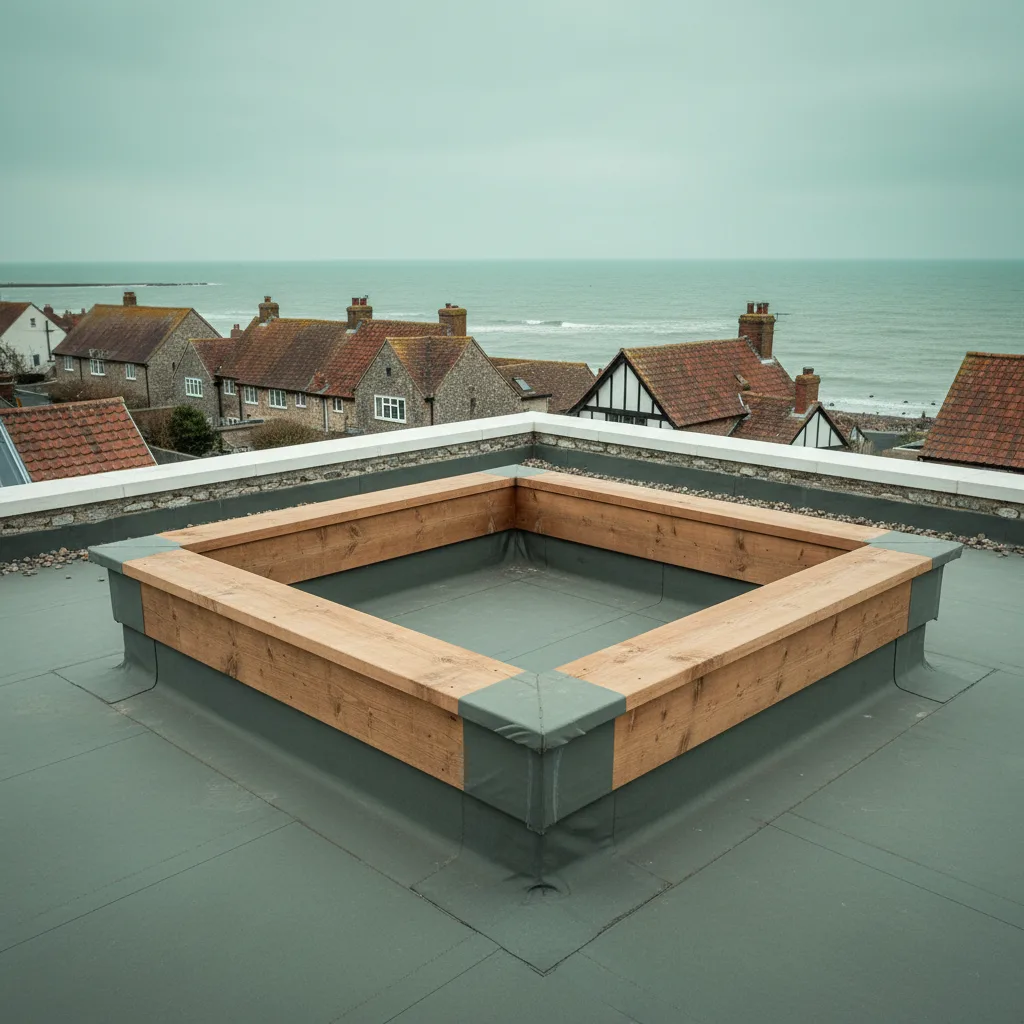
Insulating an existing kerb
Possible, and it is not a five minute job.
Insulation is added within or around the upstand, which generally means lifting the covering at the kerb or working from inside, and then making good.
It is worth doing properly, because a partial job leaves a bridge somewhere and the water simply appears there instead.
Reducing the humidity
Where the moisture comes from rather than where it lands.
An extract over the hob used while cooking, an extract in a bathroom that runs on, and not drying washing in the room all make a substantial difference.
A single bath or a pan of pasta puts a surprising quantity of water into a small house.
Ventilating the room
Moving the humid air out before it can condense.
An opening rooflight at the highest point is the most effective vent position a single storey room has, and using it after cooking clears the moisture that would otherwise settle overnight.
The unit itself
A factor rather than the main one, and it is worth checking.
An old single skin dome will run with water in almost any humid room. A modern glazed unit with a warm edge spacer and a thermal break keeps a warmer inner surface.
What the spacer does is on what is a warm edge spacer.
Water in the reveal rather than on the frame
A variant worth naming, and it points at the same cause.
Where the plasterboard reveal around the opening is damp or discoloured rather than the frame being wet, the insulation is stopping short at the reveal rather than at the kerb.
Both are the same fault in different places.
Misting between the panes
A different failure entirely, and it is not condensation in the room.
Water inside a sealed unit cannot be wiped away, and it means the perimeter seal has failed. The unit is finished and the glazing is replaced.

Water on the outside
The third possibility, and it means the unit is performing well.
External dew on a clear morning forms because the outer pane is losing so little heat from inside that it drops below the dew point of the outside air.
It clears with the sun and it is a sign of a good unit rather than a problem.
The first winter
Worth ruling out before treating anything.
A new extension, a new screed or a newly plastered ceiling releases construction moisture for a season, and condensation that appears once and never returns is that.
Whether a blind makes it worse
Sometimes, and it is easily managed.
A closed blind isolates the glass from the room, making it colder and letting moisture sit undisturbed on it. Opening it for part of the day clears the glass.
The vapour control layer
The other half of the insulation detail, and it is what stops moisture reaching cold surfaces inside the build up.
A warm roof has a vapour control layer below the insulation, and where a rooflight opening is cut through it, that layer has to be continued and sealed to the frame rather than left cut.
Where it is not, humid room air enters the roof build up itself, which is a slower and more serious problem than water on a frame.
Interstitial condensation
The version of this that happens where nobody sees it.
Moist air reaching a cold surface inside a roof build up condenses there, wetting insulation and timber over years without ever showing in the room.
It is why the vapour control detail matters as much as the insulation, and why both are done at installation or not at all.
The question we start with on a flat roof
We ask when the water appears and where it sits before assuming anything, and we insulate the kerb as standard on any new installation because it is the single detail that prevents this.
The whole picture is on the flat roof rooflight installation page.
Thinking about this job? We survey across Worthing, West Sussex and the South Downs and give you a fixed price before any work starts, with a 10-year workmanship guarantee.