Yes, and rather better than people expect. Most of the useful daylight in a British sky is diffuse skylight rather than direct sun, and a dome collects that regardless of which way the slope faces. A north facing tunnel gives a steadier, cooler light than a south facing one, and on the majority of days the difference between them is small.
Why orientation matters less here
Because of the sky we have.
Britain is overcast for a large part of the year, and under a uniform grey sky there is no preferred direction, so a dome on any slope collects much the same.
What a dome actually sees
A wide arc of sky.
A domed collector gathers light arriving from a broad range of angles rather than only from directly in front of it, which is why it is domed.
What a south slope adds
Peaks, on a clear day.
When the sun is at a favourable angle to a south facing dome, the light in the room brightens noticeably, and that is a bonus on top of the baseline.
What a north slope gives instead
Consistency.
North facing light is steadier through the day, without the sharp variation as the sun comes on and off the dome, which some people prefer.
Colour of the light
A real and subtle difference.
North light is cooler and bluer, and south light is warmer at the ends of the day, which shows in a room with white walls more than anywhere.
Where it matters
A room where colour is judged.
A dressing room, a studio or a bathroom where somebody applies make up is a case where the steadiness of north light is genuinely an advantage.
What matters far more than orientation
The length of the run.
A short run on a north slope beats a long one on a south slope comfortably, because length costs light steadily and orientation does not.
The reasoning is on how long can a sun tunnel run be.
And the tube type
The other larger factor.
A rigid tube on a north slope will deliver more than a flexible one on a south slope, so the tube decision outweighs the orientation decision.
The comparison is on what is the difference between rigid and flexible sun tunnels.
And bends
The third.
An elbow costs a meaningful proportion of the light, so a straight north run beats a bent south one without much argument.
That is on can a sun tunnel go round a corner.
The order to decide in
Route first, orientation last. Choose the shortest straightest route to the nearest slope, and treat the orientation as a tiebreaker rather than as the starting point.
An east slope
Bright mornings. An east facing dome catches early sun, which suits a bathroom or a landing used first thing and fades through the afternoon.
A west slope
Bright evenings. A west facing dome comes into its own late in the day, which suits a hallway or a utility used in the evening.
Overshadowing
Matters more than orientation. A tall tree, a neighbouring building or a chimney shading the dome for much of the day costs more light than facing north does.
Checking for shade
Worth doing at survey. Looking at what stands above the proposed position, and thinking about where the sun tracks across it, takes a minute and occasionally moves a decision.
Overshadowing by the roof itself
A dormer or a hip. A dome tucked beside a dormer cheek or close under a hip sees less sky than one in an open part of the slope, and it is worth moving clear.

A flat roof
Where orientation disappears entirely. A dome on a flat roof faces straight up and collects from the whole sky, so there is no orientation question at all.
That is on can a sun tunnel be fitted to a flat roof.
Winter performance
Reduced on any slope. Shorter days and a lower sun mean less light through any tunnel in December, and the difference between orientations is smallest exactly then.
Summer performance
Ample on all of them. In June a tunnel on any slope delivers more than a small room needs, and the orientation question effectively disappears.
What a north tunnel will not do
Overheat anything. Solar gain through a small diffuse aperture is negligible in any orientation, and on a north slope it is smaller still.
The rooflight case is on will a rooflight make my room too hot.
Two tunnels on different slopes
Occasionally the best answer in one room.
A hallway served by one tunnel on an east slope and one on a west slope stays evenly lit from morning to evening, which a single unit cannot do.
Where the house faces the sea
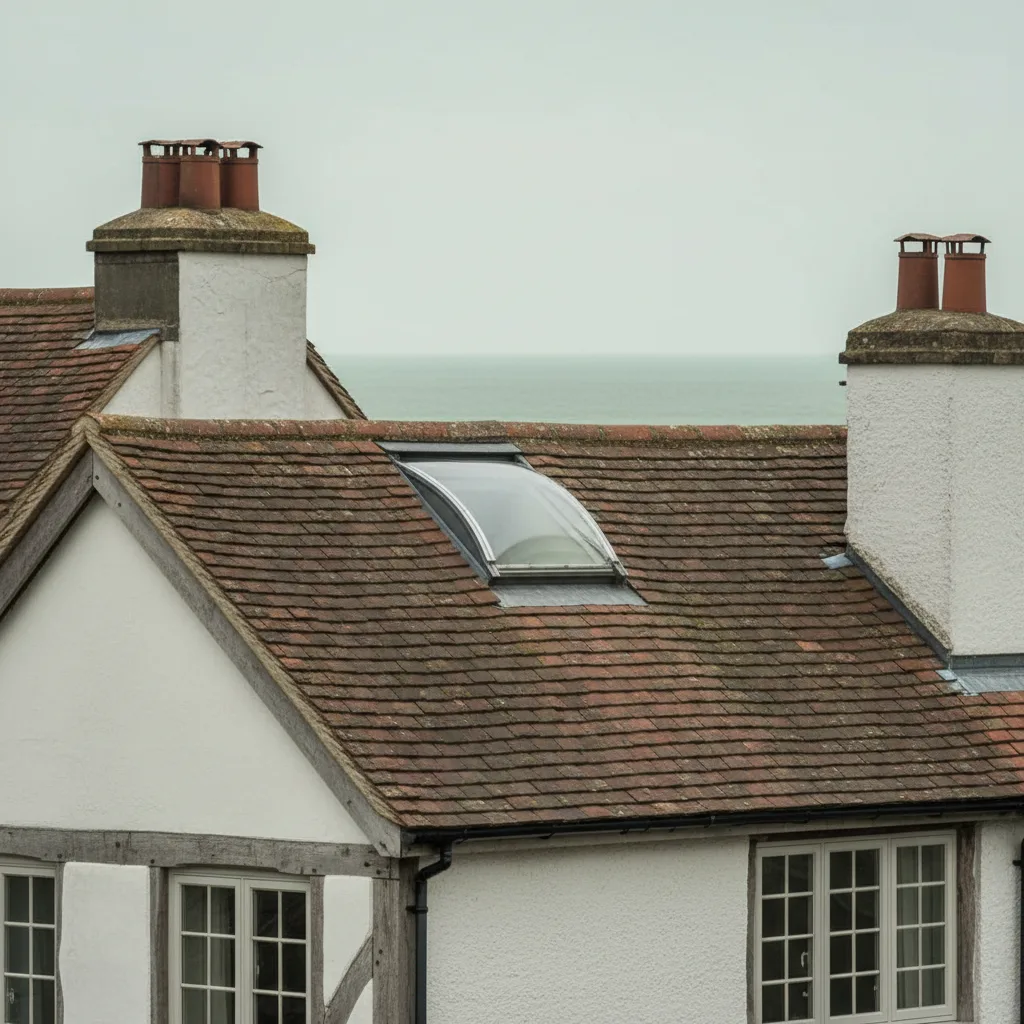
Bright, and it wants cleaning. A south facing coastal roof gets a great deal of light and a great deal of salt, and a dome dulled by salt loses more than the orientation gained.
What to do is on do sun tunnels leak.
What the dome finish changes
A little, and it is worth knowing.
A clear dome passes marginally more light than a textured one, and a textured one is less prone to showing dirt and to concentrating direct sun into a beam.
How we choose
We choose the slope by the route rather than by the compass, because on a British roof the length of the tube is worth far more than the direction the dome faces.
The whole picture is on the sun tunnel installation page.
Thinking about this job? We survey across Worthing, West Sussex and the South Downs and give you a fixed price before any work starts, with a 10-year workmanship guarantee.