Maintenance an opening rooflight or skylight actually needs
An opening rooflight needs less looking after than most people expect and more than almost anybody gives it. This page is the schedule: what to do, when, and what each check is actually catching.
Twice a year is the whole of it
Two sessions a year, of about fifteen minutes each, covers everything on this page.
Spring, after the winter weather and before the season when the window is used most. And autumn, after leaf fall and before the gales. Everything else is responding to something you have noticed.
Almost nobody does this, which is why the faults on this page are the ones we get called about.
The spring session
- Open the unit fully and leave it open while you work.
- Wipe the gasket along its whole length, looking for hardening, splits or grit trapped in it.
- Brush the chain track clear, along the full stroke.
- Clean the rain sensor face with fresh water.
- Rinse the frame and the visible ironmongery with fresh water.
- Close it fully and confirm it seals evenly along the edge.
- Test the rain sensor with a little water and confirm it closes and then releases.
- Operate the manual override, if the unit has one, and re-engage it.
The autumn session
- Clear the roof around the unit, especially the uphill side of a kerb where debris dams water.
- Clear the outlet the roof drains to, which matters more than the window itself.
- Check the flashing or the kerb termination from a safe position for anything standing proud.
- Operate the unit fully several times.
- Check the seal and the track again, since autumn brings the debris.
- Check any battery powered control still responds, and change the battery if it is hesitant.
Why operating it matters most
If only one thing on this page gets done, make it this one.
A mechanism that moves stays free. A mechanism that sits in one position for two years develops resistance in every clearance, and the first time it is asked to move it meets that resistance all at once.
That applies to the actuator, the hinges, the cleaning catch, the manual override and the ventilation flap. Every one of them is a thing that seizes from disuse rather than from use.
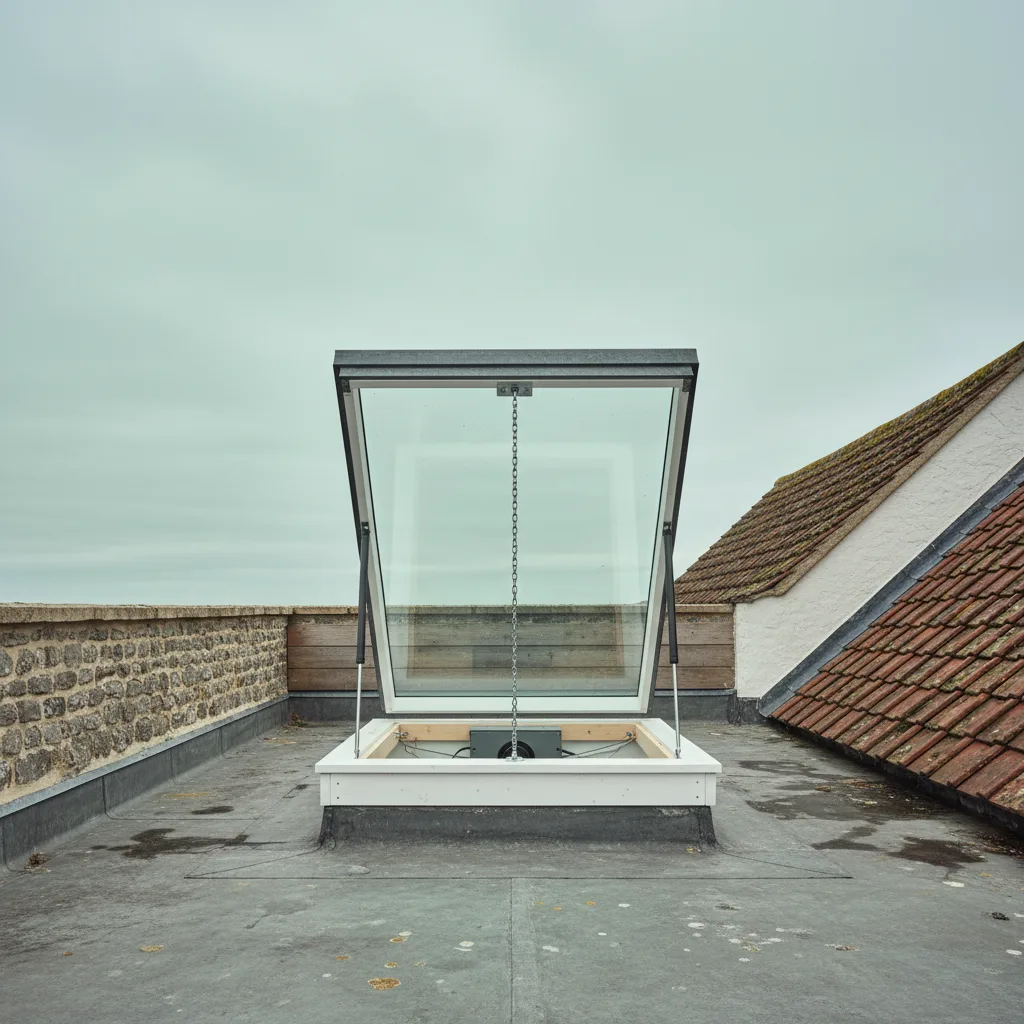
The five faults that are service items
| Symptom | Usually | Response |
|---|---|---|
| Slower than it was | Grit or corrosion in the track | Clear and clean the track |
| Stops short or reverses | A real obstruction: debris or a hard gasket | Clear the seal, check the gasket |
| Will not seal fully | Hardened gasket, or debris in the channel | Replace the gasket |
| Draughty or noisier in rain | Gasket no longer compressing | Replace the gasket |
| Closes on damp mornings | Dirty or salted sensor board | Clean the sensor |
Four of the five are a gasket or a clean. Very few complaints about powered rooflights turn out to be the motor.
Gaskets are the consumable
If a powered rooflight has one wear item, it is the gasket.
It is compressed and released thousands of times, exposed to ultraviolet along its whole length whenever the unit is open, and it hardens with age. A hardened gasket stops sealing, which produces draughts and rain noise, and it raises the force needed to close, which the actuator reports as an obstruction.
It is a replaceable part ordered against the unit’s type and size code, and replacing one is a fraction of the cost of anything else. Expect to do it at least once in the life of a window.
Lubrication, and the wrong kind
Some components benefit from lubrication and some are made not to need it, and the manufacturer’s instruction is the one to follow.
The error worth avoiding is a general purpose oil or grease on a chain track. It attracts dust, sand and grit, and turns a dry surface that sheds debris into a sticky one that collects it. On a coastal roof, where fine sand is blowing about, that accelerates wear rather than reducing it.
Where a lubricant is specified, use that one. Where none is, clean and leave dry.
The sensor
The rain sensor reads conductivity across a small exposed board, so anything conductive lying on it reads as rain.
Cleaning it with fresh water, twice a year, is the whole of its maintenance. On this coast it matters more than inland, and why is set out on the sea fret page.
Testing it afterwards, with a small amount of water, is what confirms both the sensor and the controller are still doing their job.
Batteries
Three things in a powered rooflight installation may have batteries, and all three are forgotten.
The handheld remote, which is the commonest cause of a system that has apparently stopped working. A wireless wall control, same story. And on a solar unit, the internal battery, which has a service life measured in years and is replaceable.
Before concluding a system has failed, change the remote battery. It resolves a genuinely surprising proportion of calls.
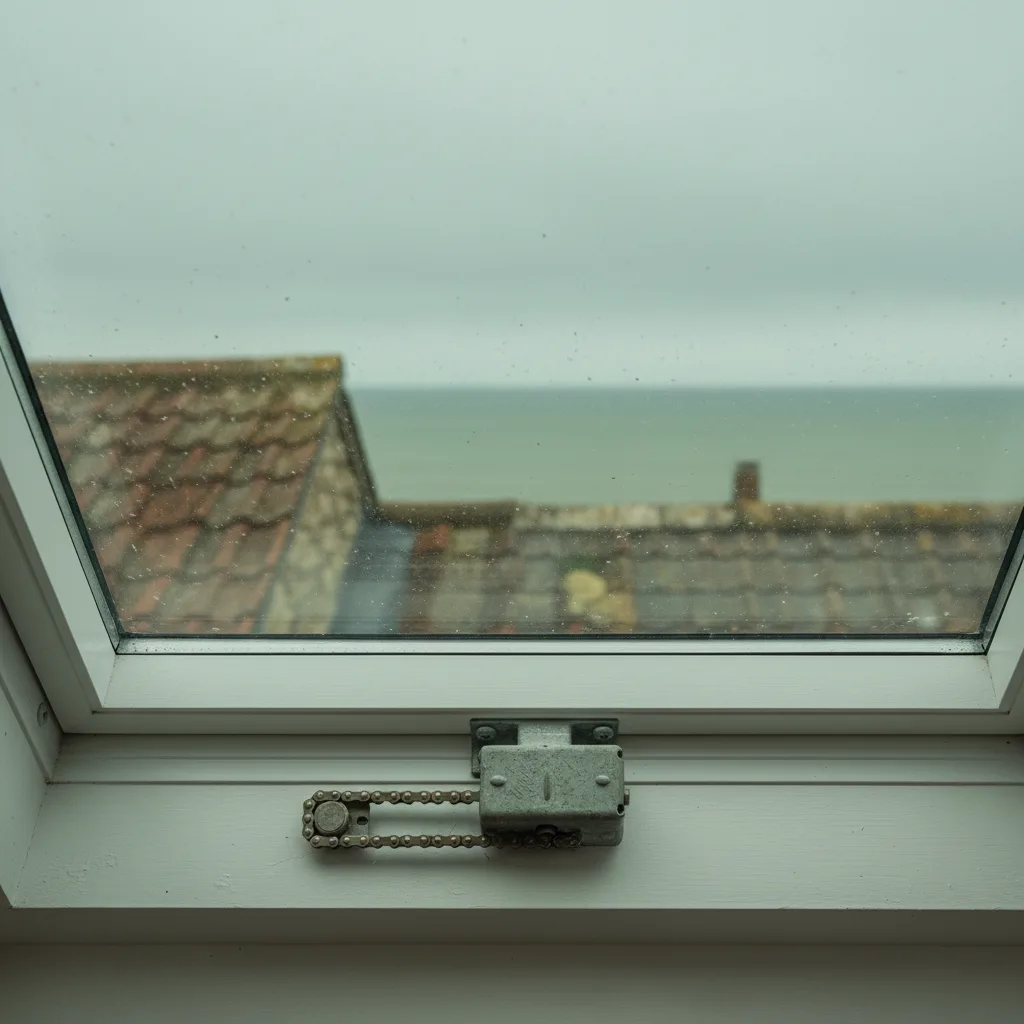
What needs somebody with a ladder
Almost everything above is done from inside with the unit open. A few things are not.
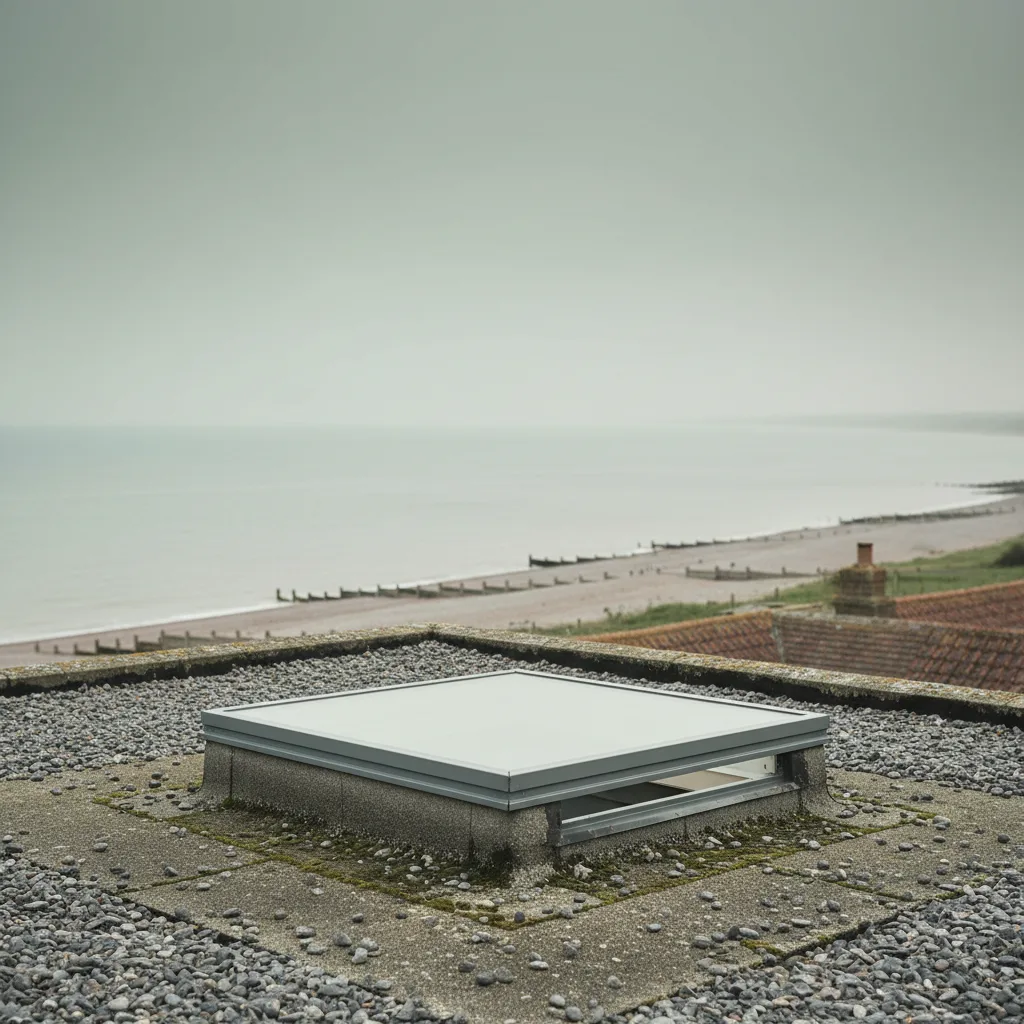
The condition of the flashing or the kerb termination, the state of the covering around the opening, and clearing the roof around a flat roof unit all need roof access. On a bungalow that is a short ladder; on a terrace it is a proper arrangement.
The general rule is that if it needs going onto a roof, it needs doing properly rather than opportunistically, and the surveying page covers why.
Listening to it
The most useful diagnostic tool for a powered rooflight is standing under it with the room quiet and running it through a full cycle.
A healthy unit makes a steady low hum, at an even pitch, for the whole of the travel. What is worth noticing is a change: a note that rises and falls as the sash moves, which suggests uneven resistance; a ticking or grinding, which is grit in the track; a clunk at one point in the travel, which is usually a mounting; and a motor that labours near the end of closing, which is the gasket.
None of those needs a ladder or a tool, and each one is a different fault. It is thirty seconds and it is the check that catches things earliest.
The room tells you things too
Some symptoms show up in the room rather than at the window.
A room that has become draughty near the rooflight, or noticeably louder in rain, points at a gasket that is no longer compressing. Water at the frame and reveal on cold clear nights is the insulation detail rather than the mechanism. A stain appearing only in driving rain from one direction is the underlay collar.
None of those is a maintenance item and all three are frequently reported as the window having failed. Knowing which is which saves replacing a unit that is working perfectly.
Who is going to do this
Worth being realistic, because a schedule nobody follows is not a schedule.
Most of what is on this page can be done by anybody standing under the window with a cloth and a jug of water, and takes a quarter of an hour. The parts that need roof access do not, and on a two storey house or a terrace they are not a homeowner job.
Where the roof is not easily accessible, or where somebody would rather it was simply looked after, a service visit every couple of years covers the whole of it including the parts that need a ladder. Either arrangement works. Neither happening is what produces the call-outs.
What we look at on a service visit
- Full operation, both directions, listening as much as looking.
- The gasket along its whole length.
- The chain track and the drive.
- Every mounting, for anything that has worked loose.
- The travel limits, at both ends.
- The sensor, cleaned and tested with water.
- The manual override, operated and re-engaged.
- The flashing or kerb termination, and the covering around it.
- The reveal inside, for any sign of a cold bridge or a leak.
Do not force anything
The single most damaging thing an owner can do is push harder.
Stiffness is information. A mechanism reporting resistance is reporting a real obstruction, and force turns a service item into a sheared part, a rounded fixing or a bent chain. On a coastal unit with corrosion in the clearances it is exactly how a repairable window becomes a replacement.
If it does not move as it used to, stop and look at why.
Keeping a record
A note of what was done and when is worth more than it sounds.
Gaskets replaced in a given year, a sensor cleaned, a battery changed: those dates tell you whether a symptom is new. They also tell whoever owns the house next that the thing has been looked after, which is worth something at a sale.
The unit’s type and size code belongs in the same place, because every part is ordered against it.
What ages and what does not
Over twenty five years, the pattern is consistent.
The glass is usually fine unless the edge seal has failed. The frame is sound, though the coating may have chalked. The gaskets will have been replaced at least once. The actuator may have been replaced. And the fixings are the part that quietly goes, particularly within reach of the Channel.
Almost all of that is parts rather than a new window, which is the useful message.
When to call rather than carry on
- Anything that needs force.
- Misting between the panes, which is a failed unit and will not recover.
- Water at the frame or reveal every cold night, which is the insulation detail.
- Water in rain from one wind direction, which is the underlay collar.
- A mounting that has worked loose, before it works further loose.
- A sensor that no longer responds to water after cleaning.
What we hand over
We hand over a unit with the schedule explained rather than assuming it will be worked out, and we tell you which parts are consumable so a hardened gasket is not a surprise in year twelve. On a service visit we operate everything rather than only looking at it, clean and test the sensor with water, and say when a part is stiff before it becomes a broken one.
Where something does need attention, catching it in the spring session rather than in the middle of an October gale is the whole benefit. Every fault in the table above is cheap at the point it first appears and expensive three years later, and none of them announces itself any more clearly than a window that is slightly slower than it used to be.
Fifteen minutes, twice a year, and almost nothing on this page ever becomes a call-out.
Thinking about this job? We survey across Worthing, West Sussex and the South Downs and give you a fixed price before any work starts, with a 10-year workmanship guarantee.