Opening rooflights and skylights on an exposed coastal roof
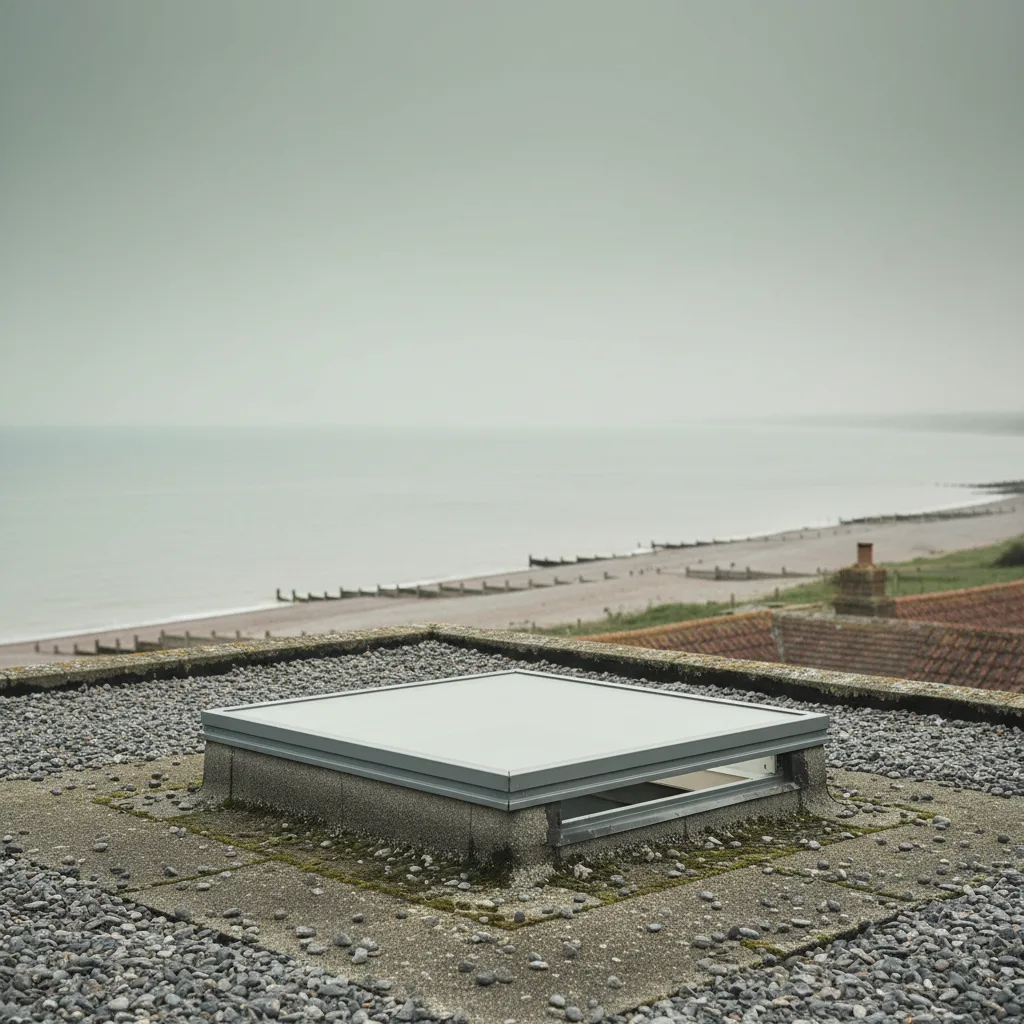
An opening rooflight has more to go wrong on the coast than a fixed one, because it has a mechanism, a moving seal and an electronic sensor, and all three are in salt laden air permanently. This page is about what that costs and what to specify against it.
The four things salt attacks
- The actuator. A motor, a chain and a track, with clearances that corrosion products fill.
- The seal. A gasket that has to compress and release thousands of times and keep sealing.
- The sensor. An exposed electronic component with contacts on it.
- The frame and its fixings. The same story as any exposed metal on a coastal roof.
A fixed rooflight has only the last of those. Every additional item is another thing to specify properly.
The mechanism, in one paragraph
Sea salt aerosol settles on every surface within reach of the Channel, holds moisture against the metal, and conducts current between dissimilar metals in contact. Why that happens, how far inland it reaches and what grade of fixing answers it are set out on the stainless fixings page, which owns that argument for the whole site.
What this page adds is what it does to the four things a fixed rooflight does not have: a motor, a chain, a moving gasket and a sensor.
What it does to a chain actuator
The characteristic coastal failure is binding rather than breaking.
Corrosion products occupy more volume than the metal they came from. A chain track with a small amount of corrosion in its clearances has less clearance than it was made with, so the chain runs stiffer, the motor works harder, and the load the actuator reports at the end of travel rises.
What the owner sees is a window that has become slower, then one that stops short or reverses, then one that stops. Every stage is a warning and none of them is usually recognised as one.
Grit as well as salt
On the coastal strip there is a second abrasive nobody expects.
Fine sand blows off the beach and settles on every roof within a few hundred metres of it. In a chain track it is an abrasive paste with the salt film, and it wears the running surfaces as well as corroding them.
Keeping the track clear is therefore worth more here than inland, and it is a two minute job rather than a service operation.
Seals, and the open unit problem
A fixed rooflight has a seal that is compressed once and stays compressed. An opening one has a gasket that is repeatedly compressed and released, and it is exposed to ultraviolet along the whole of its length when the unit is open.
Gaskets harden with age and ultraviolet rather than with salt, and a hardened gasket does two things: it stops sealing, so the unit leaks or draughts, and it raises the force needed to close it, which the actuator then reports as an obstruction.
They are a replaceable part with a service life, and replacing one is a fraction of the cost of anything else on this page.
The rain sensor in salt air
A rain sensor works by detecting water bridging an exposed contact surface, and salt film is conductive.
The practical consequence is that a sensor on a coastal roof can behave differently from one inland, and behaviour varies between products. Some are more prone to reading a heavy salt deposit or a damp sea fret as rain than others.
Rinsing the sensor with fresh water when the frame is rinsed keeps it reading what it is supposed to read. How sensors behave in a sea fret specifically has its own page.
Drainage on an open kerb unit
A point specific to flat roof opening units, and it is worth understanding.
When the sash is open, the frame perimeter and the kerb top are exposed to rain arriving directly rather than being covered by the sash. Well designed units drain that away round the outside of the kerb, and the drainage path is a detail that can block.
Debris in that path, which on a coastal roof means sand and gull material, puts water where it was designed not to sit. It shows as water appearing at one corner in rain on a unit that is otherwise sound, and it is a clearing job rather than a repair.
Gulls
Worth its own section because everybody along this coast already knows.
Gulls nest on flat roofs, and a nest against the kerb of a rooflight is a dam made of sticks that fills with everything else. Droppings are corrosive to some coatings and acidic enough to mark glass. Shell debris dropped onto glass scratches it.
On an opening unit there is a further point: nesting material in the path of a sash is an obstruction the actuator will meet, and it is a common cause of a unit that has suddenly stopped closing properly in spring.
What we specify on a coastal roof
| Component | Specification | Why |
|---|---|---|
| Frame coating | Marine grade | Standard powder coat chalks within years |
| Fixings, all of them | A4 stainless | Chlorides attack A2 by pitting |
| Actuator mountings | Stainless, isolated from dissimilar metals | The joint is where galvanic corrosion starts |
| Trims and cappings | Marine grade, stainless fixed | Fully exposed, horizontal, fails first |
| Glass | Toughened outer, laminated inner | Standard overhead specification |
| Sensor | Fitted, and included in the annual rinse | Weather arrives fast off the Channel |
Spare parts, and why generic ones are worse here
An actuator assembly contains several metals in contact, and the manufacturer chose them to sit close together on the galvanic series and to be isolated where they do not.
A generic replacement bracket, pin or fixing dropped into that assembly is an unknown metal introduced into a designed combination, and with a salt film between the parts it is the thing that corrodes and jams the clearances.
Inland that is a minor compromise. Within reach of the Channel it is the difference between a mechanism that lasts and one that binds in five years. On a coastal roof we replace parts with the maker’s own, and where they are no longer available that is an argument for a new unit rather than for improvising.
Reading the warning signs
A coastal opening rooflight almost never fails without notice. It gives three or four seasons of warning and none of the signs look like a fault.
- Slower. The sash takes longer to complete its travel than it used to.
- Noisier. A grinding or ticking note that was not there, which is grit in the track.
- Stopping short. The unit halts before it is fully open or fully shut.
- Reversing. The controller reads an obstruction and backs off, which is a real reading rather than a glitch.
- Not sealing. Draughts, or rain noise that has got louder, meaning the gasket is no longer compressing.
Any one of those is a service item at the point it appears and a replacement unit if it is left for another three years.
The maintenance that actually works
- Rinse with fresh water over the frame, the visible mechanism and the sensor, once or twice a year. The single most effective thing anybody can do.
- Operate it fully several times a year. A mechanism that moves does not seize.
- Keep the chain track and the drainage path clear of sand, grit and nesting material.
- Clear the kerb perimeter, particularly the uphill side, where debris dams water.
- Do not force anything. Stiffness is a signal, and force turns a service item into a broken part.
The one job that is specific to an opening unit
Rinsing the frame is worth doing on any coastal roof and it is covered elsewhere. What is specific to an opening unit is the track and the seal, and they need a different action.
The chain track wants clearing rather than rinsing, because water alone moves salt and leaves sand. A brush along the track, with the unit fully open so the whole length is exposed, takes a minute and removes the abrasive that is doing the wear.
The gasket wants wiping along its full length, again with the unit open, because grit trapped in a gasket both damages it and raises the closing load the actuator has to overcome. Neither job is possible with the window shut, which is the reason to do them at the same time as the annual full operation.

Where the unit sits on the roof
Position does more for the life of a coastal opening rooflight than most people would guess, and it is free at design stage.
A unit set well in from the edges of a flat roof sits in the calmest part of it, out of the zone where wind suction peaks and away from the perimeter where wind driven spray concentrates. One set close to a parapet or a corner takes considerably more of everything.
Where the room below allows any latitude at all, moving a unit in from the edge costs nothing and reduces the exposure it has to survive for thirty years.
Screens and covers are usually a mistake
The instinct on a coastal roof is to shelter the mechanism, and it generally makes things worse.
A cover over an actuator keeps rain off and it also keeps rain off, which means the fresh water that would have rinsed salt away no longer reaches it. Salt still gets in as aerosol, and now nothing washes it out. The sheltered detail under a trim is already the worst place on a roof for exactly this reason.
The exception is a manufacturer’s own cover designed as part of the product, which is drained and detailed for it. An improvised one is a salt trap.
Fixed, where it will do
The most reliable opening rooflight on a coastal roof is the one that does not open, and it is worth saying.
A fixed unit has no actuator, no moving gasket and no sensor. It is cheaper, quieter in rain, better sealed against air leakage and has nothing to age. Where a room has adequate ventilation from elsewhere and no escape requirement, fixed is frequently the better specification on an exposed roof.
Where ventilation genuinely is needed, an opening unit is the right answer and it is specified accordingly rather than avoided.
What we find on twenty year old coastal units
The pattern is consistent. The glass is usually fine. The frame is chalked but sound. The gaskets are hard. The actuator is stiff or seized. The fixings are the part that has genuinely gone, and heads shear on removal.
Which means the decision is rarely about the glass. It is about whether the mechanism and the fixings can be recovered, and a good deal more can than people expect: gaskets, actuators, sensors and controls are all parts.
What we specify on an opening unit
We specify marine grade coating and A4 stainless throughout on the coastal strip, isolate dissimilar metals in the mechanism, and choose a coastal product variant where the range offers one. On a service visit we operate the unit fully rather than only looking at it, clear the track and the drainage path, and say when a part is stiff before it becomes a broken part.
Salt does not usually break an opening rooflight. It jams it, slowly, and the warning signs are all things that look like nothing.
Thinking about this job? We survey across Worthing, West Sussex and the South Downs and give you a fixed price before any work starts, with a 10-year workmanship guarantee.