VELUX on a coastal roof, and what salt does to the ironmongery
The structural fixings on a coastal roof window are a specification question, and they are dealt with elsewhere. The ironmongery is a different problem: the hinges, the catches, the handle and the operating gear are moving parts, they are in the weather, and salt attacks them in a way that shows as stiffness long before it shows as rust.
What the ironmongery is
Everything on a roof window that moves or holds something in place.
- The pivot bearings or the friction hinges, which carry the sash and hold it where you leave it.
- The handle and the latch, which is the most operated part on the window.
- The cleaning catch, which releases the sash to rotate through.
- The ventilation flap and its mechanism, on windows that have one.
- On a powered unit, the chain actuator, its track and its mountings.
All of them are partly outside, all of them are partly inside, and all of them are exposed to the salt film that settles on a coastal roof.
Why salt is different from ordinary weather
Sea salt aerosol settles on every surface within reach of the Channel and it does not blow away. It is hygroscopic, so it draws moisture from the air and holds it against the metal as a damp salty film.
Two consequences follow. Metal that would be dry inland stays wet, continuously, including on days it has not rained. And that film is an electrolyte, so it carries current between dissimilar metals in contact.
Corrosion needs moisture and an electrolyte. Salt air supplies both, permanently.
Seizure rather than rust
The characteristic failure on coastal ironmongery is not something rusting through. It is something binding.
Corrosion products occupy more volume than the metal they came from, so a bearing or a hinge with a small amount of corrosion in its clearances has less clearance than it was made with. The mechanism stiffens, then binds, then needs force, and force is what breaks handles and shears pins.
The tell is a window that has become harder to operate over a season or two, and it is worth acting on rather than pushing harder.
Where it starts
| Component | Symptom | Cause |
|---|---|---|
| Cleaning catch | Will not release, or will not re-engage | Rarely used, so it sits still and binds |
| Friction hinges | Sash drops, or will not stay open | Wear and corrosion in the friction surfaces |
| Handle and latch | Stiff, then will not latch cleanly | Most operated part, corrosion in the mechanism |
| Pivot bearings | Stiff rotation, or a notchy feel | Corrosion in the bearing clearance |
| Actuator chain | Noisy, then binds under load | Salt and grit in the chain track |
| Gaskets | Draughts, noise, then water | Age and ultraviolet rather than salt |
The cleaning catch is first on the list for a reason that is not about salt at all: it is the part that is never used, and a mechanism that never moves in salt air is the one that seizes soonest.
Galvanic corrosion in the mechanism
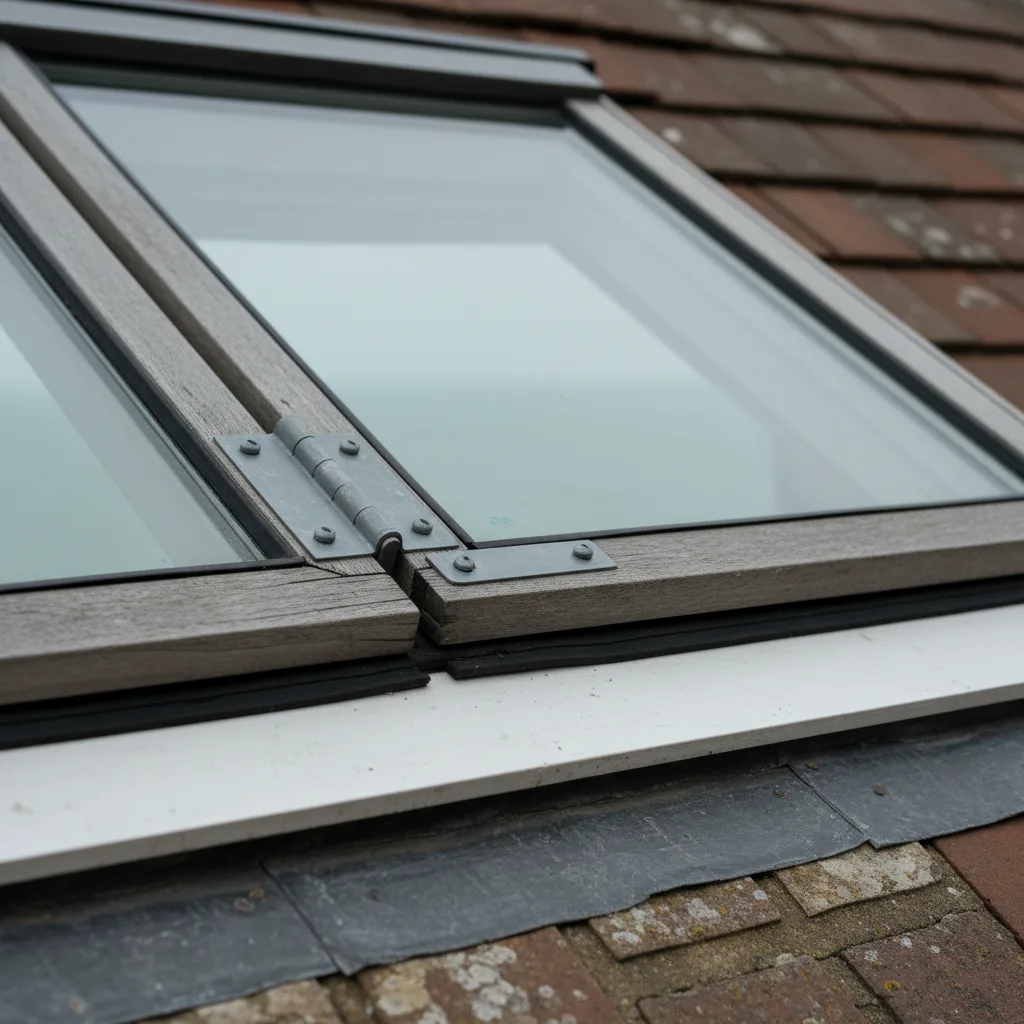
Ironmongery is an assembly of different metals: stainless components, plated steel parts, aluminium frames, sometimes brass or zinc alloy castings.
Put two of those in contact with a salt film between them and you have made a battery. The less noble metal corrodes preferentially, and in a small mechanism the corrosion products are exactly what fills the clearances.
It is why specification matters here rather than only on the structural fixings, and why substituting a generic replacement part into a mechanism is a worse idea on the coast than it is inland.
What we specify
The same principle as everywhere else on a coastal roof, applied to the parts that move.
Stainless where a component is available in stainless. Marine grade coating on the exposed aluminium of the frame and the flashing. Isolation where dissimilar metals have to meet. And where a product line offers a coastal or marine variant, that variant, because it exists for exactly this.
The cost difference across one window is small and it is not recoverable later.
How far inland this applies
It is not a line on a map, and the honest answer is that it is further than people think.
Salt aerosol travels on the prevailing wind, and on this coast that is a south westerly off open water. It reaches a long way over flat open ground and much less far where a town, a belt of trees or rising ground intervenes.
On the seafront at Worthing, Goring, Littlehampton, Bognor or Rottingdean it is not a discussion. A mile or two back, through Broadwater, Durrington, Rustington or Portslade, we fit the coastal specification as standard. And on the open scarp above the plain, exposure puts a site back into the coastal category despite the distance, because nothing has slowed the wind.
The maintenance that actually works
Salt accumulation is cumulative and it is reversible, which is unusually good news in building maintenance.
- Rinse with fresh water. Once or twice a year, over the frame and the visible ironmongery. This is the single most effective thing anybody can do.
- Operate everything fully. Open and close the window fully, and release and re-engage the cleaning catch, a few times a year. A mechanism that moves does not seize.
- Keep the chain track clear on a powered unit, since grit in the track is abrasive as well as corrosive.
- Do not force anything. Stiffness is a signal, and force turns a service item into a broken part.
- Lubricate as the manufacturer specifies, with what they specify. The wrong lubricant attracts grit and makes it worse.
Rinsing, and why nobody does it
It takes five minutes with a hose from the ground or from a window, once or twice a year, and it measurably extends the life of every metal component on the roof.
Rain does some of this on the exposed faces and almost none of it in the sheltered detail under a trim or inside a mechanism, which is precisely where it matters. Almost nobody does it, and it is worth saying anyway because it is free.

What can be replaced and what cannot
A good deal more than people expect, which is the useful message here.
Handles, latches, cleaning catches and gaskets are parts. Friction hinges are frequently parts. Actuators are parts. All of them are ordered against the type and size code on the data plate, and replacing one is a fraction of the cost of replacing a window.
What is not economic is a window old enough that no parts remain available, or one where the frame itself has gone. The plate settles which of those you are in.
Timber frames on the coast
Older units are timber framed, finished internally with lacquer or paint, and that finish is what protects the timber.
On the coast the internal environment matters as much as the external one, because a coastal house is frequently humid. Where the finish was never renewed, the timber at the bottom of the sash is where decay starts, and it is the corner that also holds the most ironmongery.
Polyurethane coated units need nothing internally and are the obvious specification for a replacement on the coast, particularly in a bathroom or a loft shower room.
What we find on a twenty five year old coastal unit
The pattern is consistent enough to be worth setting out, because it tells you what to expect before anyone goes up.
The glass is frequently fine, or has failed at the edge seal for reasons of age rather than corrosion. The frame is chalked, meaning the powder coat has gone matt and powdery and lost its colour, but is structurally sound. The gaskets are hard and no longer sealing. The ironmongery is stiff or partly seized. And the structural fixings are the part that has genuinely gone.
Which means the decision is rarely about the glass. It is about whether the ironmongery and the fixings can be recovered, and whether the frame finish is acceptable to live with for another decade.
Chalking, and what it tells you
Chalking is the breakdown of a powder coat under ultraviolet and salt, and it shows as a matt powdery surface that comes off on a finger.
It is cosmetic in itself and it is a useful indicator, because a frame that has chalked has had years of the exposure that also works on everything mechanical. A chalked frame and stiff ironmongery on the same unit are the same story told twice.
It is also why marine grade coating is specified on the coast rather than standard architectural powder coat. The metal underneath is fine either way; the difference is how long it looks like it should.
Bringing an older window back
Where the frame and the glass are sound, a good deal can be recovered without replacing the unit.
Gaskets can be replaced, which deals with draughts and a good part of the rain noise. Handles, latches and cleaning catches are parts. Stiff hinges sometimes free up with cleaning and correct lubrication, and where they do not they are frequently replaceable.
That is a service visit rather than an installation, and where it is the right answer we will say so rather than quoting for a window somebody does not need.
What a seized window does to the room
A window that has become hard to operate stops being operated, and that has consequences beyond the window.
Ventilation stops happening, so humidity rises. Higher humidity means more condensation on every cold surface in the room, which then gets blamed on the glazing. And where the window is the means of escape from a habitable loft room, a seized mechanism is a safety matter rather than an inconvenience.
That last one is the reason we mention stiffness in a survey rather than noting it and moving on.
Gulls, and the other coastal nuisance
Worth naming because everyone here already knows about them.
Gull droppings are corrosive to some coatings and they are acidic enough to mark glass over time. Nesting material collects at the head of a window and dams water against the flashing. And shell debris dropped onto glass scratches it.
None of it is a specification problem. All of it is an argument for the annual clear and rinse, which deals with the whole list at once.
Buying for the long term
A roof window on a coastal roof is a thirty year purchase, and the specification decisions that matter are the ones that cannot be revisited.
The coating on the frame and the flashing, the grade of the fixings, whether the unit is a coastal variant, and whether the ironmongery is stainless are all set at ordering. The blind, the operation and the maintenance can all be changed. Getting the first list right is what decides whether the window is still working properly in year twenty five.
What we specify on a VELUX
We specify marine grade coating and A4 stainless as standard across the coastal strip and anywhere exposed to the Channel, isolate dissimilar metals in the mechanism, and choose a coastal product variant where the range offers one. On a service visit we operate everything fully rather than only looking at it, and where a part is stiff we say so before it becomes a broken part.
Salt does not rust ironmongery so much as jam it. The remedy is specification, and then five minutes with a hose.
Thinking about this job? We survey across Worthing, West Sussex and the South Downs and give you a fixed price before any work starts, with a 10-year workmanship guarantee.