Vapour control layers, and the damp patch that is not a leak
There is a class of flat roof problem that produces a damp patch on a ceiling, resists every attempt to find a leak, and is fixed by something on the inside of the roof rather than the outside. It is interstitial condensation, and the component that prevents it is the vapour control layer.
This page is about what that layer does, how it gets defeated, and why the symptom is so misleading.
Air carries water, and it carries it through things
Warm air holds water vapour. That vapour is a gas, it is under a pressure of its own, and it moves from where there is more of it to where there is less. In a heated house in winter there is a great deal more of it inside than outside, so it is continuously pushing outward through every part of the building fabric.
Most materials are not airtight and many are not vapour tight either. Plasterboard, timber and insulation all pass vapour at some rate. So the vapour does not stop at the ceiling. It carries on into the roof build-up.
Where it turns into water
As the vapour moves outward through the construction it gets colder, because it is moving toward the outside. At some point in that journey it reaches its dew point and becomes liquid.
Where that point falls decides everything. If it falls outside the construction, the vapour leaves as a gas and nothing happens. If it falls inside the construction, water forms in the middle of the roof, in a place nobody can see and nothing can dry.
What the vapour control layer does
The vapour control layer is a membrane on the warm side of the insulation. It is there to stop the vapour getting into the build-up in the first place.
Warm side, always
It has to be on the inside of the insulation, because the whole point is to stop the vapour before it reaches anywhere cold. A vapour barrier on the cold side traps moisture rather than excluding it, which is worse than none at all.
Continuous, or it does nothing
Vapour finds the gap. A membrane that is ninety five per cent complete does not stop ninety five per cent of the vapour, because the vapour simply goes through the remaining five per cent. Continuity is the whole property.
Sealed at every penetration
Every downlight, every cable, every pipe and every kerb is a hole in it, and each one has to be sealed back to the membrane.
Why the rooflight kerb is the weak point
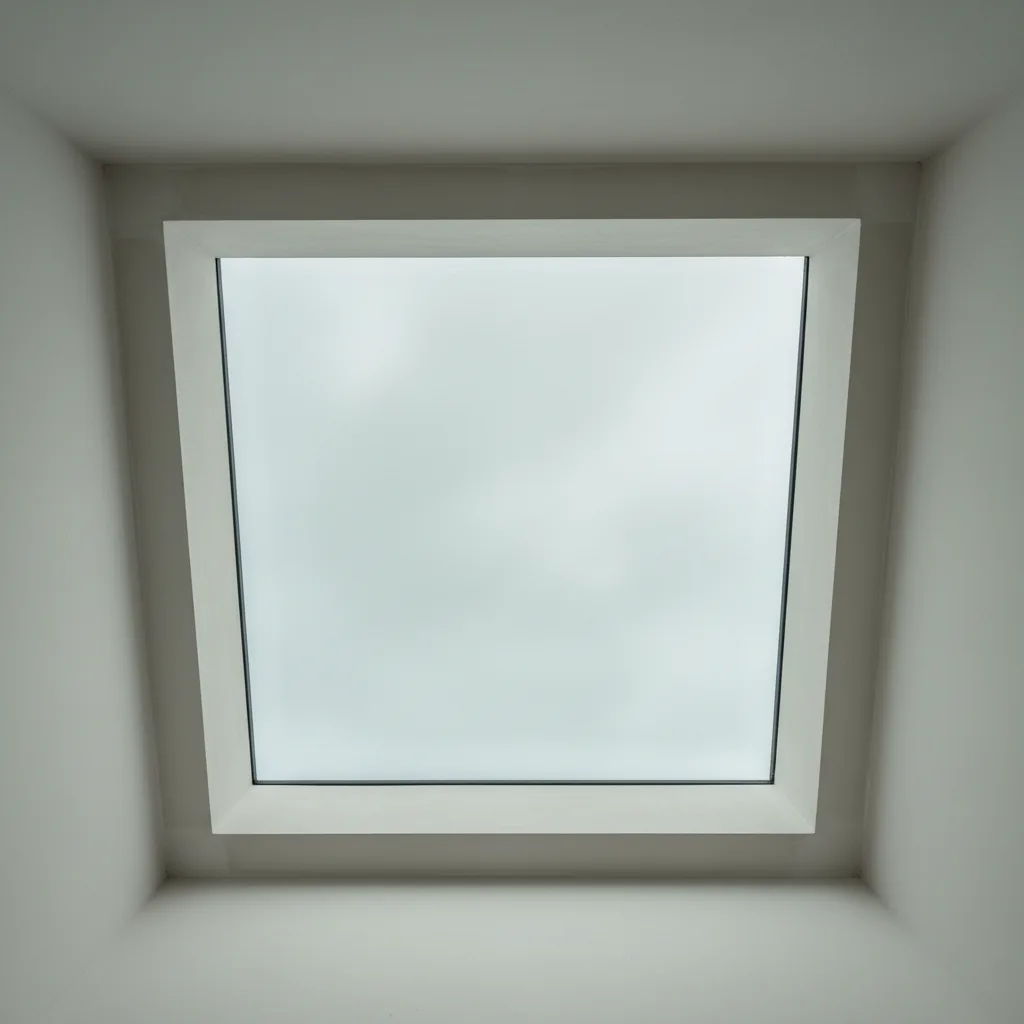
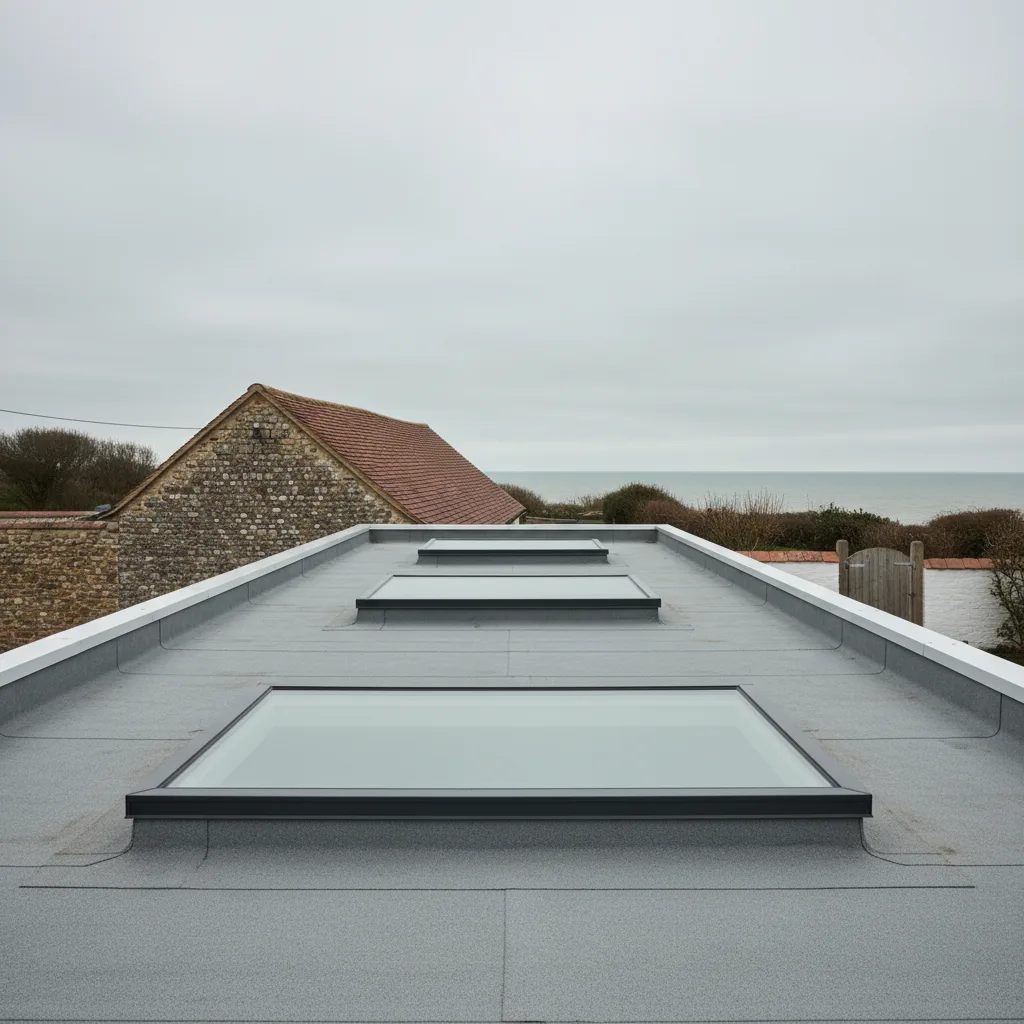
A rooflight kerb is the largest single penetration through a flat roof build-up, and it has the longest perimeter.
The vapour control layer has to be carried up the inside face of the kerb and sealed to the rooflight frame all the way round. Where it is stopped at the deck and simply cut off at the opening, there is a continuous slot running round the whole rooflight through which warm moist air pours into the roof build-up.
That is the defect, and it is invisible the moment the covering goes on.
Why the damp patch is not where the rooflight is
This is the part that misleads people, and it is worth understanding because it is why leaks get chased for years.
Water forms inside the build-up at the cold layer, then runs. It runs along the deck, following the fall of the roof, until it finds a joint, a fixing, a board edge or a low point where it can get through to the ceiling below.
That point can be metres from where the water formed. So the stain appears in the middle of the room, or in a corner, while the actual defect is at the rooflight kerb. Every investigation that starts at the stain is starting in the wrong place.
Telling it apart from a leak
| Observation | Interstitial condensation | Leak |
|---|---|---|
| Timing | Builds through the winter, worst in late winter | Follows rain, often within hours |
| Weather | Cold weather, wet or dry | Wet weather, often one wind direction |
| Summer | Dries up and disappears entirely | Still there in a summer downpour |
| Rate | Slow. A stain that grows over weeks | Fast. Drips, or a stain that appears overnight |
| Position | Frequently away from any obvious detail | Usually traceable to a junction or a penetration |
| Response to a hose test | Nothing | Reproduces it |
The most useful single test is the hose. A leak reproduces under water. Interstitial condensation does not respond to a hose at all, and a negative hose test on a persistent winter damp patch is a strong indication of what you are looking at.
The seasonal signature
Interstitial condensation has a rhythm that no leak has.
It starts in late autumn as the heating goes on. It accumulates through the winter, because the roof takes in more moisture each cold night than it loses in the day. It is at its worst in February and March, when the accumulated total is highest. And it vanishes completely in summer, because the construction dries out.
A damp patch that is dreadful in March and entirely absent in July is telling you what it is.
Downlights, and the hole nobody counts
A ceiling under a flat roof frequently has a dozen downlights in it, and unless each one is a sealed fitting or has a hood over it, each one is a hole through the vapour control layer.
Worse, a downlight is a warm hole. It generates heat, which drives a small updraught, which pushes air through the opening rather than letting it diffuse. A run of unsealed downlights in a kitchen ceiling can put more moisture into a roof than the rest of the ceiling combined.
Where we are opening a ceiling as part of a rooflight installation, this is worth dealing with at the same time, because the access is already there.
Cold decks and the ventilation route
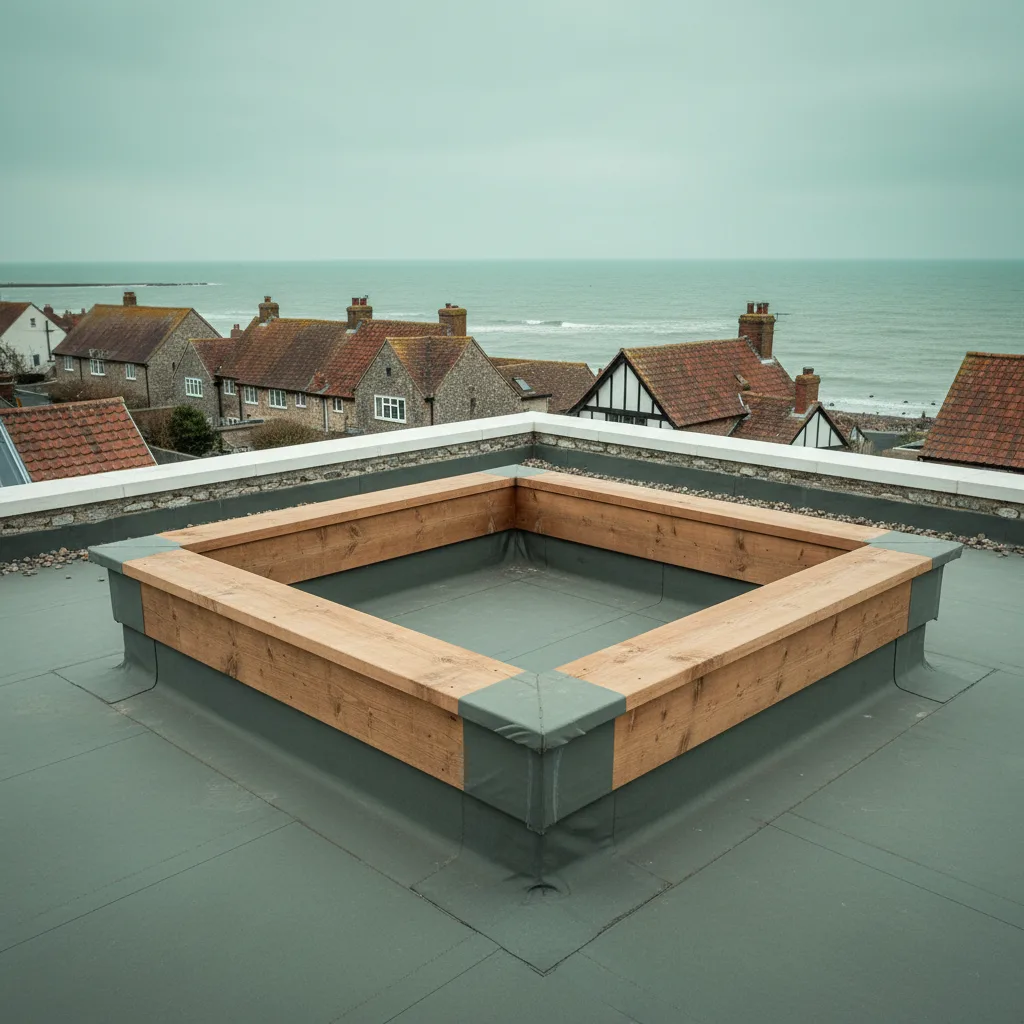
On a cold deck roof, where the insulation is between the joists and there is a void above it, the design relies on that void being ventilated. Moving air through the void carries away any vapour that gets past the vapour control layer.
Two things kill it. Insulation stuffed up tight against the deck, closing the void. And a rooflight kerb built across the void, blocking the cross ventilation path so that one part of the roof no longer breathes.
On a cold deck, positioning the kerb so that the ventilation path continues round it is part of the design rather than an afterthought.
Why it cannot be fixed from outside
This is the hard part of the news.
The vapour control layer is under the insulation, which is under the covering. Reaching it means taking off the covering and the insulation, or taking down the ceiling from below. There is no treatment applied to the top of the roof that addresses it, because the top of the roof is not where the problem is.
Which is why the diagnosis matters so much. Recovering a roof to fix a leak that was never a leak costs the full price of a new roof and changes nothing.
What we do about it on a new installation
- Identify the existing vapour control layer, or establish that there is not one, before quoting.
- Carry it up the inside face of the kerb, without a break.
- Seal it to the rooflight frame all the way round, with a tape or sealant suited to both surfaces.
- Seal every service penetration inside the area being opened up.
- On a cold deck, keep the ventilation path clear past the kerb.
All five are done while the roof is open and none of them is available afterwards.
Where there is no vapour control layer at all
On flat roofs from before the 1980s, and on some later ones, there is no vapour control layer to carry up anything.
Where we are fitting a rooflight into such a roof and the roof is otherwise staying, the honest position is that we can make the rooflight detail as good as it can be and the rest of the roof remains what it is. We say that rather than implying the installation has solved a roof-wide condition.
Where the roof is being recovered anyway, the vapour control layer goes in as part of that work and the problem is addressed properly.
The materials, and what makes a good one
Vapour control layers are not all the same product, and the differences matter at a kerb more than anywhere else on the roof.
Polythene sheet
The cheapest and the most common on older work. It performs well as a vapour barrier and badly as a detail, because it tears, it is difficult to bond reliably to a timber kerb, and taped laps in polythene have a poor record over decades.
Self adhesive bituminous membranes
Far better at a junction, because they stick to what they are laid on and can be dressed up a kerb face and around a corner without a mechanical fixing. This is what we would use where a kerb detail has to last.
Air and vapour control membranes
Reinforced sheets designed to be both airtight and vapour tight, with matched tapes for laps and penetrations. The most reliable of the three at a complex junction, and the easiest to inspect because a properly taped lap is visibly a properly taped lap.
Why the tape is the product
On any of these the membrane itself rarely fails. The laps, the penetrations and the termination at the kerb are where it fails, which means the tape and the workmanship are what is actually being specified.
Air movement matters more than diffusion
There are two ways vapour gets into a roof, and they are not equal.
Diffusion is vapour passing slowly through an intact material under vapour pressure. It is a real mechanism, it is what the vapour resistance figures on a datasheet describe, and on a domestic roof it is the smaller of the two by a wide margin.
Air leakage is warm moist air physically moving through a gap, carrying its vapour with it. It moves vastly more moisture than diffusion does, because a gap passes air freely and a material does not.
That is why continuity is the whole property of a vapour control layer, and why a single unsealed slot round a rooflight kerb outperforms the entire remaining ceiling as a moisture source. Sealing the gaps is worth more than upgrading the membrane.
Humidity in the room is still half of it
Everything above is about excluding vapour from the construction. The other lever is generating less of it in the first place.
An extract fan ducted outside, a cooker hood that vents rather than recirculates, and not drying laundry in the room under the flat roof all reduce the vapour pressure driving the whole mechanism. On a marginal construction that is sometimes the difference between a roof that stays dry and one that does not.
It is never a substitute for the detail, and it is a genuine contributor.
What it does if it is left
Interstitial condensation is slow, which makes it easy to tolerate, and the damage it does is cumulative.
Wet insulation performs at a fraction of its rated value, so the roof gets colder and the condensation gets worse. Timber decking that stays damp through successive winters decays, and a decayed deck is a structural repair rather than a covering one. Fixings corrode. And the ceiling below is repeatedly stained and repeatedly redecorated.
The cost curve on this one is steep and it points one way.
What we want to know on a flat roof
We ask when the patch appears and whether it goes away in summer before we go anywhere near the roof, because those two answers separate the two conditions. Where a hose test is warranted we do one. Where it is interstitial we say so, explain that the fix is inside the construction, and quote the work that actually addresses it rather than a recover that will not.
A stain on a ceiling is evidence of where water came out, and almost never evidence of where it got in.
Thinking about this job? We survey across Worthing, West Sussex and the South Downs and give you a fixed price before any work starts, with a 10-year workmanship guarantee.