Flat roof coverings around Worthing, and how each terminates at a kerb
Five materials cover almost every domestic flat roof in this area, and each one meets a rooflight kerb differently. Knowing which one you have tells you how the junction was made, how it will fail if it does, and what can be done to it without replacing the whole roof.
Identifying what you have from the ground
Most of the time this can be settled without going up.
- Reinforced bitumen membrane. Grey or green mineral finish, visible sheet laps, usually in strips. The most common covering on older extensions here.
- Single ply. Smooth, uniform, usually light grey, with welded seams that are narrow and neat.
- GRP. Smooth, hard, resin coloured, with no seams at all across the field and a distinctive edge trim.
- Liquid applied. Smooth and seamless like GRP but slightly softer looking, and it goes round complex shapes without joints.
- Mastic asphalt. Black, thick, sometimes with a reflective paint or a sand finish, and noticeably heavy looking at the edges.
Reinforced bitumen membrane
The traditional covering, laid in two or three layers with the joints staggered, torched or hot bonded or self adhesive depending on the system and the age.
At a kerb
The membrane is dressed up the kerb face in layers, with an angle fillet at the base so the material is not asked to turn a sharp right angle. The top is terminated under a trim or in a chase.
How it fails
At the laps, and at the top of the upstand where the termination has slipped or the fillet was omitted. Older systems become brittle with age and ultraviolet, and the mineral finish sheds.
What can be done
It patches and repairs readily, which is its great practical advantage. A failed upstand at a kerb can frequently be redressed without touching the field of the roof.
Single ply membrane
A single layer of synthetic sheet, mechanically fixed or fully adhered, with hot air welded seams.
At a kerb
The sheet is welded up the kerb face and terminated under a bar or a trim. Corners are made with prefabricated pieces or hand welded, and the corner welds are the skilled part.
How it fails
At a weld that was not fully made, at a corner, or by puncture. The material itself is durable and the workmanship is what varies.
What can be done
It welds to itself, so repairs are clean and reliable provided the same material is used. A junction at a kerb can be reworked without disturbing the field, and the repair is as good as the original where the welding is competent.

GRP, glass reinforced polyester
Laid wet as a laminate over a plywood deck and cured in place, giving a hard seamless surface. Common on extensions built from the late 1990s onward and widespread across this county.
At a kerb
The laminate is taken up the kerb face and bonded to it, with a trim at the top. Because it is applied wet it forms a continuous skin round the junction, which is genuinely good when done properly.
How it fails
By cracking. GRP is rigid and the deck beneath it is not, so movement between the two, particularly at a junction or a corner, produces hairline cracks that admit water. It is also unforgiving of a deck that was not properly prepared.
What can be done
Cracks can be ground out and relaminated, and the repair is durable if the movement causing it has been addressed. Where the deck itself is moving, the repair recurs.
Liquid applied systems
Cold applied resin systems, reinforced with a fleece, coated in layers to a continuous seamless finish.
At a kerb
The strongest option at a complicated junction, because there are no sheets to fold and no joints to make. It goes round a kerb corner, over an existing trim and into a chase without a seam anywhere.
How it fails
By insufficient thickness, which is a workmanship matter, or by application to a substrate that was damp or contaminated. A properly applied system is very reliable.
What can be done
It bonds to itself, so it repairs and it overcoats. It is also the usual answer where an existing kerb detail on any other covering needs rescuing without stripping the roof.
Mastic asphalt
Poured and floated hot, in two coats, on an isolating layer. Found on larger and older roofs, including a good number of the Regency and Victorian parapet roofs in Brighton and Hove.
At a kerb
Dressed up the face with a solid angle fillet at the base, and turned into a chase at the top. Asphalt makes an extremely robust upstand when it is done well.
How it fails
By cracking with age and thermal movement, by crazing under ultraviolet where it has been left unpainted, and at the top of an upstand where the chase has opened up.
What can be done
It is repaired hot by specialists, which is a diminishing skill, or overcoated with a liquid system, which is now the more common answer.
The comparison in one place
| Covering | Kerb termination | Typical failure | Repairs? |
|---|---|---|---|
| Reinforced bitumen | Layers up the face, angle fillet | Laps, upstand top | Readily |
| Single ply | Welded up the face, bar terminated | Corner welds, puncture | Welds to itself |
| GRP | Laminated up the face, bonded trim | Cracking at movement | Grind and relaminate |
| Liquid applied | Coated continuously, no seam | Thin application | Overcoats itself |
| Mastic asphalt | Dressed up, fillet, chased top | Crazing, chase opening | Hot repair or overcoat |
The rule every one of them shares
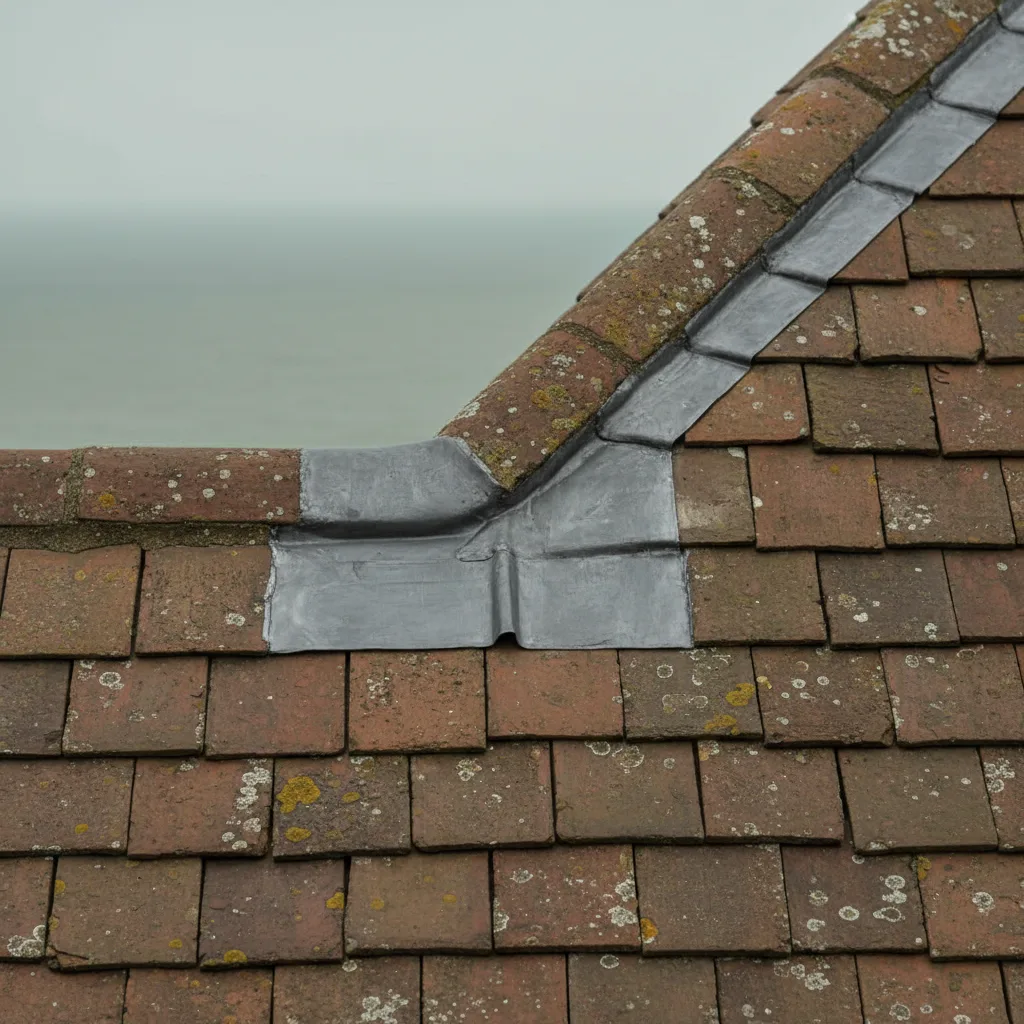
Whatever the material, the covering has to be taken up the kerb face and terminated above the water line. Not level with it, above it, with a margin for driving rain and for a blocked outlet.
That is why kerb height is the dimension we measure at the low corner, and it is the single detail that unites all five systems. A covering terminated too low fails no matter how well it was applied.
The angle fillet, and the detail that unites the sheet systems
Where a covering has to turn from horizontal to vertical at the base of a kerb, it is being asked to make a right angle, and sheet materials do not like right angles.
A sheet folded hard into an internal corner is under stress at the fold for the life of the roof, and it is the point that splits first under thermal movement. The remedy is an angle fillet: a triangular timber or preformed section fixed into the corner, turning one ninety degree bend into two forty five degree ones.
Bitumen and asphalt both need one and both are noticeably worse without one. Single ply generally uses a preformed corner piece serving the same purpose. GRP and liquid systems form their own radius as they are applied, which is one of the reasons they perform well at complicated junctions.
A missing fillet at a kerb base is one of the defects we look for specifically, because it is invisible once the covering is on and it is the origin of a great many upstand failures.
Trims, and the metalwork at the top
Every covering terminates at the top of the kerb under something, and that something is usually metal.
The trim holds the covering down, provides a weather check, and gives the rooflight frame something to sit against. It is also the component that sits fully exposed, on a horizontal surface, in whatever weather the site gets. On a coastal roof it is the part that fails first, and it is frequently specified as an afterthought.
Aluminium trims should be marine grade coated within reach of the Channel, fixed with stainless fasteners, and isolated where they meet a dissimilar metal. A stainless fixing through a plated trim is a plated component in the joint and it will corrode. This is the same argument as the fixings page, applied to a part that nobody thinks of as a fixing.
Mixing materials at a kerb
Where a rooflight is being added to an existing roof, the new work at the kerb has to be compatible with the existing covering, and not everything sticks to everything.
Bitumen to bitumen is straightforward. Single ply to single ply is straightforward provided it is the same polymer, and single ply to bitumen generally is not without a specific interlayer. Liquid systems bond to most substrates and are the usual answer where two materials have to meet.
Getting this wrong produces a junction that looks finished and is not bonded, and it is one of the more common defects we find on rooflights added by a general builder rather than a roofer.
What the coast does to each of them
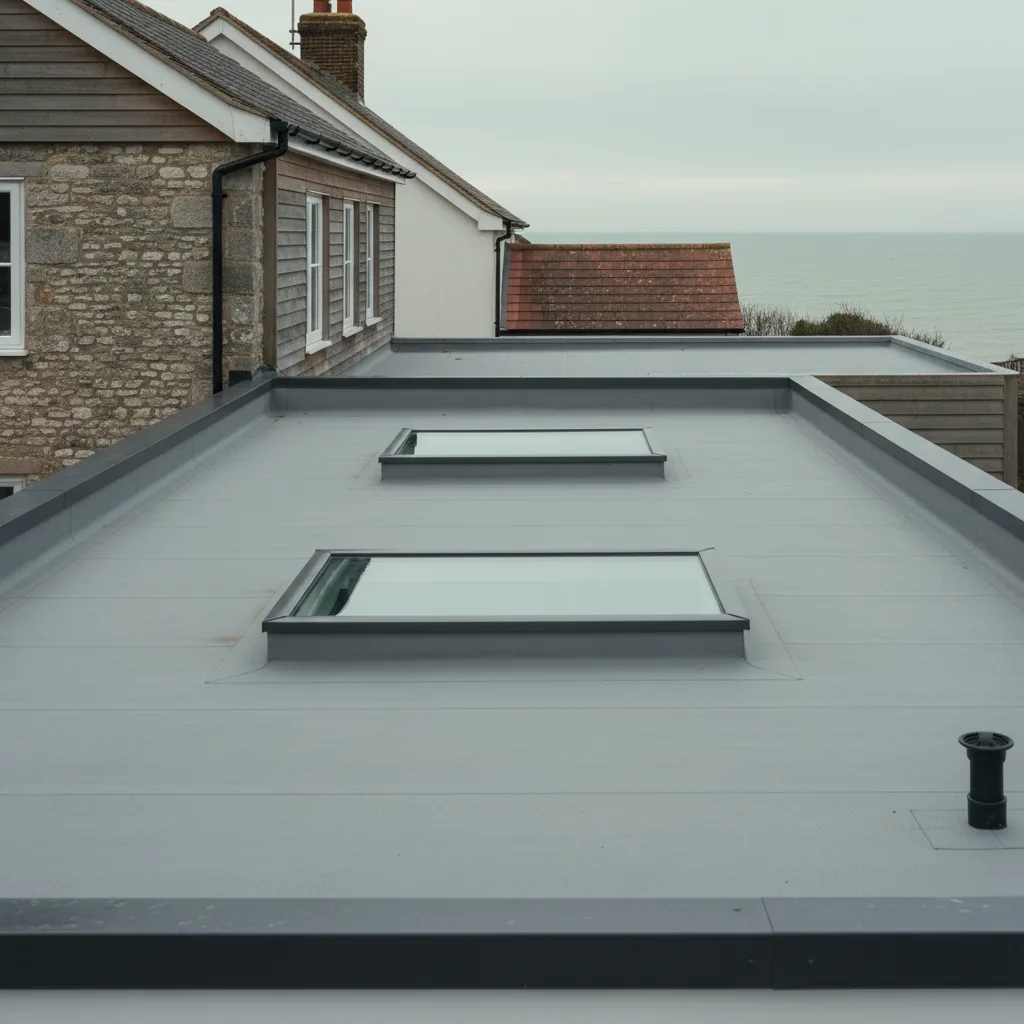
Exposure affects the coverings differently, which is worth knowing on this stretch.
Ultraviolet is the main ageing mechanism for all of them, and the south coast gets plenty. Bitumen and asphalt suffer most from it. Wind uplift matters for mechanically fixed single ply on an exposed roof, where the fixing pattern has to reflect the exposure. Salt affects the fixings and the metal trims rather than the membranes themselves.
Sand and grit carried on the wind abrade a covering slowly, particularly where water concentrates the material into one path.
Guarantees, and what they actually cover
Most modern covering systems come with a manufacturer guarantee, and those guarantees are worth understanding before they are relied on.
They generally cover the material rather than the workmanship, and they are conditional on the system being installed by an approved contractor to the manufacturer specification, with the correct primers, the correct thickness and the correct ancillary components. A single ply roof welded with the right technique and the wrong sheet is not covered. Nor, usually, is a roof where a third party has cut into it afterwards.
That last point matters here. Adding a rooflight to a guaranteed roof means cutting the covering, and doing so without regard to the guarantee terms can void it. Where a roof is still within a manufacturer guarantee we check the terms first, because the correct sequence sometimes involves the original installer rather than us, and finding that out afterwards helps nobody.
How long each lasts
Lifespans depend far more on workmanship, falls and drainage than on the material, so any figure is a range rather than a promise.
Broadly: a well laid modern bitumen system and a well welded single ply both give a long service life; GRP is durable where the deck is rigid and shorter where it is not; liquid systems depend almost entirely on applied thickness; and asphalt outlasts all of them when it was laid well and maintained, which is why hundred year old asphalt roofs still exist.
A roof with standing water on it will underperform every one of these figures, whatever it is made of.
What we identify on a flat roof
We identify the covering at survey, check how it terminates at any existing kerb, and specify a kerb detail compatible with what is actually on the roof rather than with what we would prefer. Where the covering is near the end of its life we say so, because putting a new rooflight into a roof that needs recovering in two years is work done twice.
Five materials, one rule: above the water line, and bonded to what is already there.
Thinking about this job? We survey across Worthing, West Sussex and the South Downs and give you a fixed price before any work starts, with a 10-year workmanship guarantee.