Can you fit a rooflight or skylight on a felt roof?
Yes, and felt is one of the more straightforward coverings to detail a rooflight into. It dresses up an upstand and is bonded or torched to it, and the junction is finished under a trim. The real questions are how old the felt is, how many layers are on the deck, and whether the detail is formed properly rather than sealed with mastic.
How felt terminates at an upstand
Carried up the side and secured near the top, in layers.
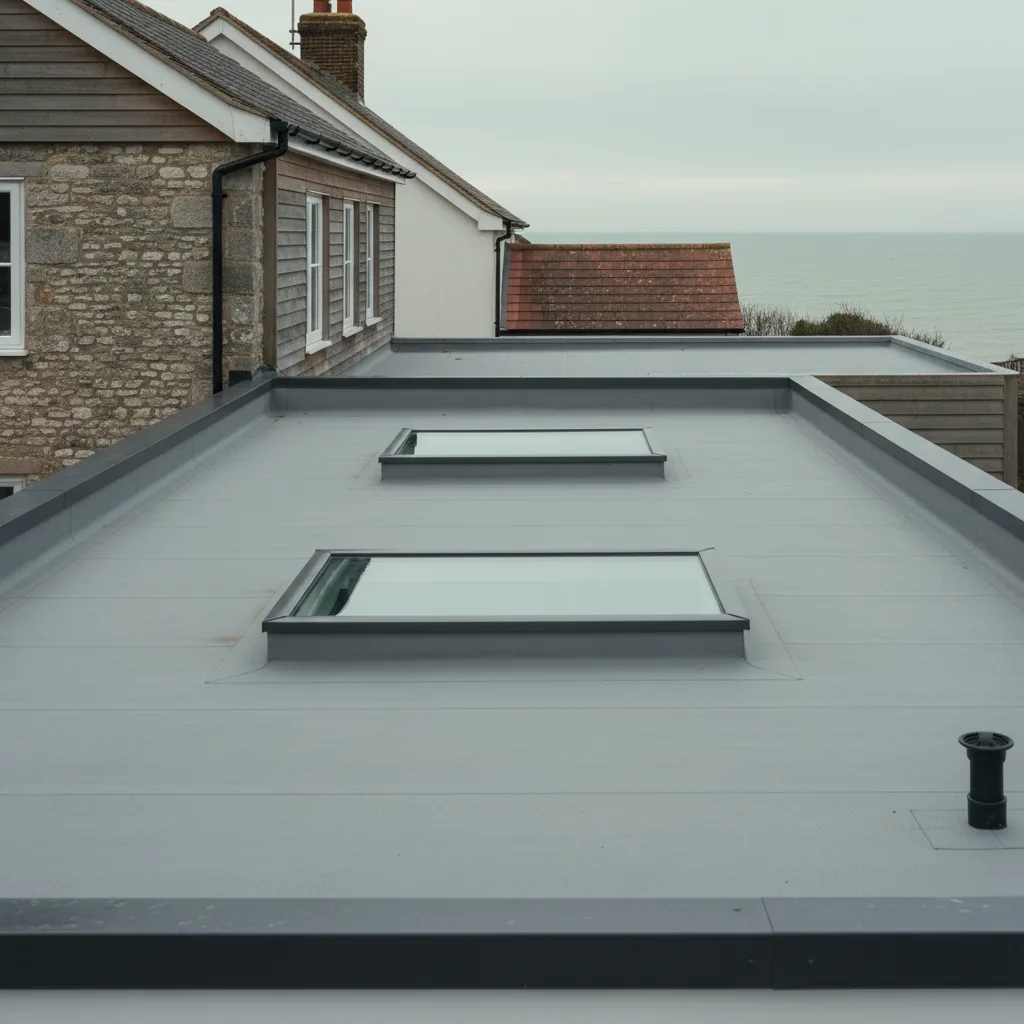
The covering is taken up the face of the kerb with an angle fillet at the base so it does not have to turn a sharp corner, and finished under a trim or a capping.
Done that way it is a durable detail. Lapped up and stuck down with mastic it is not.
The angle fillet
A small component that prevents a common failure.
A triangular fillet at the junction of deck and upstand means the felt turns through two shallow angles rather than one sharp one, which is where it would otherwise crack.
Its absence is one of the things we look for on a roof that has leaked at a kerb.
Built up layers
What a felt roof actually is, and it matters at a detail.
A proper felt roof is two or three layers bonded together, with the upstand receiving the same treatment as the field of the roof rather than a single patch.
Where an upstand has one layer and the deck has three, the upstand is the weak point.
How old is too old
Judged by condition rather than by years alone.
Felt that has gone brittle, lost its mineral surface, blistered, or cracked at the laps is at the end of its life, and fitting a new unit into it is work that will be disturbed.
Where it has a couple of years left, we say so and recommend doing both together.
Overlaid roofs
Extremely common, and it changes the detail.
Many felt roofs have been overlaid rather than stripped, so there are two or three generations of covering on the deck with trapped moisture between them.
Cutting into that reveals what is actually there, and it is one of the things we cannot know before opening up.
Torch on and cold applied
Two ways of bonding it, and both are fine.
Torch on felt is bonded with a gas torch, which is fast and involves a naked flame on a roof. Cold applied systems avoid the flame and take longer to set.
Where a roof adjoins anything combustible, the cold applied route is the sensible one.
Hot works and the fire risk
A genuine consideration and it is managed rather than ignored.
Working with a torch near a timber upstand, a fascia or an old deck carries a real ignition risk, and the standard practice is a fire watch after the work finishes.
On a listed or thatched property, hot works are avoided entirely.
Whether the felt can be patched around a new opening
Yes, and the patch has to be a proper detail rather than a repair.
New felt is bonded into the existing covering with adequate laps, and the upstand is treated as new work rather than as a mend.
A patch that relies on adhesion at a lap will lift, and it will lift at the exposed edge.
What a mastic bead means
That somebody was chasing a leak the detail should have stopped.
Mastic around a kerb on a felt roof is a repair with a date on it, and frequently there are several generations of it.
It tells you the unit has been leaking for a while and the underlying fault was never addressed.
Ponding on felt
Felt tolerates it less well than some systems.
Standing water keeps felt permanently wet, and freeze thaw at a lap or a fillet is how a sound roof starts to fail.
Around a kerb that is exactly the wrong place for it, and the fall is checked before anything is fitted.

Blistering
A sign worth reading, because it says something about the deck.
Blisters form where moisture trapped beneath the covering expands in the sun, which generally means the deck was damp when the felt went on or water has entered since.
It is not fixed by a new rooflight and it is worth knowing about.
Whether to renew the covering instead
Frequently the better answer on an older roof.
Where the felt is near the end of its life, renewing the covering and forming the rooflight opening as part of that work costs less than doing them separately and gives a proper detail throughout.
Other coverings
Each terminates differently, and the principle is the same.
Single ply is welded, GRP is laminated in place, liquid systems are applied wet and reinforced, and asphalt is dressed hot. All go up an upstand; none should be sealed with mastic.
Who does the covering work
Somebody who lays that covering, rather than us improvising.
On a felt roof that is a felt roofer, and on a job where a covering is being renewed we work with one rather than around them.
What we check on a flat roof
We check the age and the condition of the felt before quoting, form the upstand detail in the covering rather than in sealant, and say plainly where a roof would be better renewed than patched.
The whole picture is on the flat roof rooflight installation page.
Thinking about this job? We survey across Worthing, West Sussex and the South Downs and give you a fixed price before any work starts, with a 10-year workmanship guarantee.