Falls, drainage and standing water around a flat roof rooflight
A flat roof is not flat. It is a roof with a small deliberate slope, and everything about how a rooflight performs on it follows from where that slope takes the water and what happens when it does not.
Why there is a fall at all
Water left on a roof does three things, none of them good. It finds any weakness in the covering and sits on it under a small but continuous head of pressure. It grows algae and holds debris, which retains more water. And in winter it freezes, expanding into any joint or lap it has found.
A fall removes it. The intent of a flat roof design is that water arrives at an outlet and leaves, and that it does so quickly enough that nothing stands after rain has stopped.
How much fall
Designed falls on domestic flat roofs are shallow, and they are specified with an allowance built in.
The reason for the allowance is that construction is not perfect. Deflection under load, joists that are not dead straight, and workmanship tolerance all eat into the designed fall, so a roof designed to the bare minimum finishes with less than that in places and frequently with none at all in the worst spot.
Designing in a margin above the minimum is the difference between a roof that drains and a roof that mostly drains.
Where the water goes around a kerb
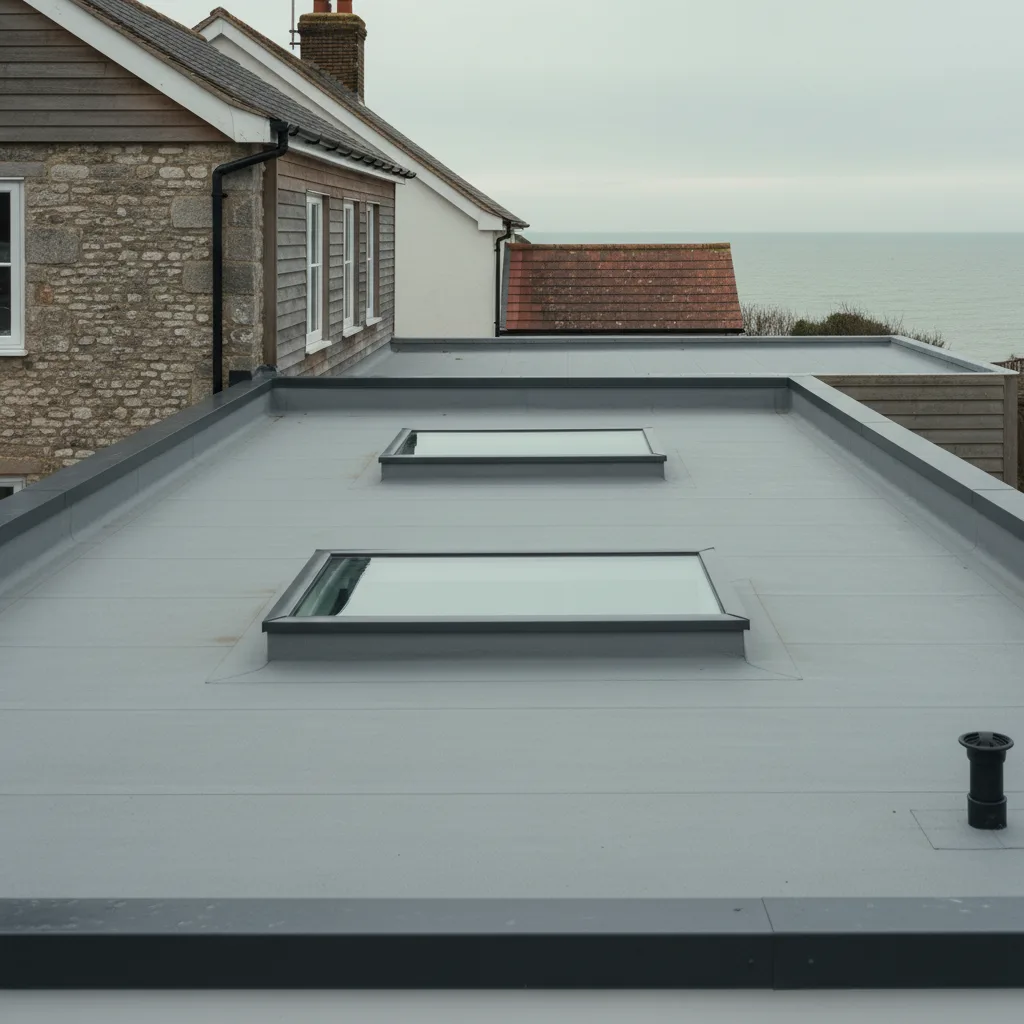
A rooflight kerb is an obstruction standing up out of the roof, and water arriving at it has to go round.
| Side | What arrives | The risk |
|---|---|---|
| Uphill side | Everything draining from above the kerb | Ponding against the upstand, debris damming |
| Downhill side | Nothing. It is in the lee | A dry shadow, and debris that never washes off |
| Both flanks | Water diverted round the obstruction | Increased flow, and scouring of the covering |
| The corners uphill | The concentration point | Where ponding starts and where it is deepest |
The uphill side and its two corners are where every drainage problem around a rooflight begins.
The dam a kerb makes
Put a box across the path of water on a shallow slope and you have made a small dam. Water backs up on the uphill side until it is deep enough to flow round the ends, and the depth it reaches is the depth of the pond that sits there after every shower.
On a roof with generous fall this is a puddle that clears in an hour. On a roof with marginal fall it is standing water that does not clear at all, sitting against the base of the kerb permanently.
This is why kerb height is measured at the lowest point and why a generous clearance matters. It is also why a rooflight positioned across the fall is a worse arrangement than one positioned along it.
Orientation of the unit relative to the fall
Where there is a choice, a rectangular rooflight is better set with its long axis running down the slope rather than across it.
Along the slope, the water meets a short end and diverts round quickly. Across the slope, the unit presents its whole length as a barrier and the water has much further to travel to get past it.
On most extensions this choice is constrained by the room below and by the joists, and where it is genuinely open it is worth taking. It costs nothing and it halves the length of the dam.
Cricket falls and diverting water
Where a rooflight has to sit across the fall, or where it is large enough that diverting round it is a long path, the answer is to build the fall so that water is directed away before it arrives.
A tapered insulation scheme, or firrings on the deck, can create a small ridge on the uphill side of the kerb that splits the flow and sends it down either flank. It is the same principle as a chimney cricket on a pitched roof, and it removes the ponding rather than managing it.
This has to be designed with the roof rather than added afterwards, which is another reason the rooflight position belongs in the conversation before the roof is built.
Outlet position
An outlet is the low point the whole roof drains to, and where it sits relative to the rooflight decides a great deal.
- An outlet on the opposite side of the roof from the rooflight means all the water passes the kerb to get there.
- An outlet on the same side as the rooflight, downhill of it, means the water has a short path and the kerb is not in the way of most of it.
- Two outlets are better than one, because a single blocked outlet is a flooded roof.
- An overflow set above the normal water line gives you a visible warning that the outlet has blocked, before the roof is carrying a load it was not designed for.
What standing water actually does
Ponding is frequently dismissed because the roof does not leak, and the damage it does is slower than that.
It holds debris, which holds more water and grows a biological layer that retains moisture permanently. It exposes the covering to continuous saturation, which shortens the life of most materials and is particularly hard on laps and welds. It loads the deck, because water is heavy and a pond deflects the deck further, which deepens the pond. And in a hard frost it expands into every joint it has found.
None of that produces a leak this year. All of it shortens the roof.

Debris, and the coastal complication
Debris is what turns a marginal fall into a blocked one, and the sources here are specific.
Inland, in the Weald and around the wooded parts of Storrington and West Chiltington, leaf fall is the dominant one and it is seasonal and heavy. On the coast it is different: fine grit and sand carried on the wind, gull feathers and nesting material, and moss growing where the fine material has held moisture.
Sand and grit are the worse of the two, because they are fine enough to pass into an outlet and settle in the pipe rather than blocking visibly at the grating.
Clearing the roof, and how often
- Twice a year is the sensible rhythm for most roofs: after leaf fall, and again in spring.
- The outlet and its grating first, because everything else follows from that.
- The uphill side of the rooflight kerb and its two corners, which is where debris accumulates whether or not there are trees.
- The downhill side, which never washes itself because nothing flows there.
- After any storm, on a coastal property, because a single blow can put a season of grit onto a roof.
This is a ten minute job that prevents most of what we get called out to.
How the fall is actually built
There are three ways to put a slope on a flat roof, and which one was used changes what can be adjusted later.
Firrings on the deck
Tapered timber strips laid over the joists before the deck goes down. The traditional method, cheap, and fixed once the deck is on. Adjusting the fall afterwards means lifting the deck.
Tapered insulation
The insulation itself is cut to a taper, so the slope is formed in the layer above the deck. This is the flexible option, because a scheme can be designed round obstructions and can divert water past a rooflight kerb. It is the method that makes a cricket fall straightforward.
Sloping the structure
The joists themselves are set to a fall. Common on new build, rare on a retrofit, and the most robust of the three because nothing above it can go wrong.
Why it matters at a rooflight
On a recover, where the deck is staying and the insulation is being replaced, tapered insulation is the only one of the three available. That is frequently the moment a long standing ponding problem around an existing kerb can finally be designed out.
Water inside the kerb, and the detail people forget
Almost all of this page is about water on the roof outside the kerb. There is a smaller problem inside it.
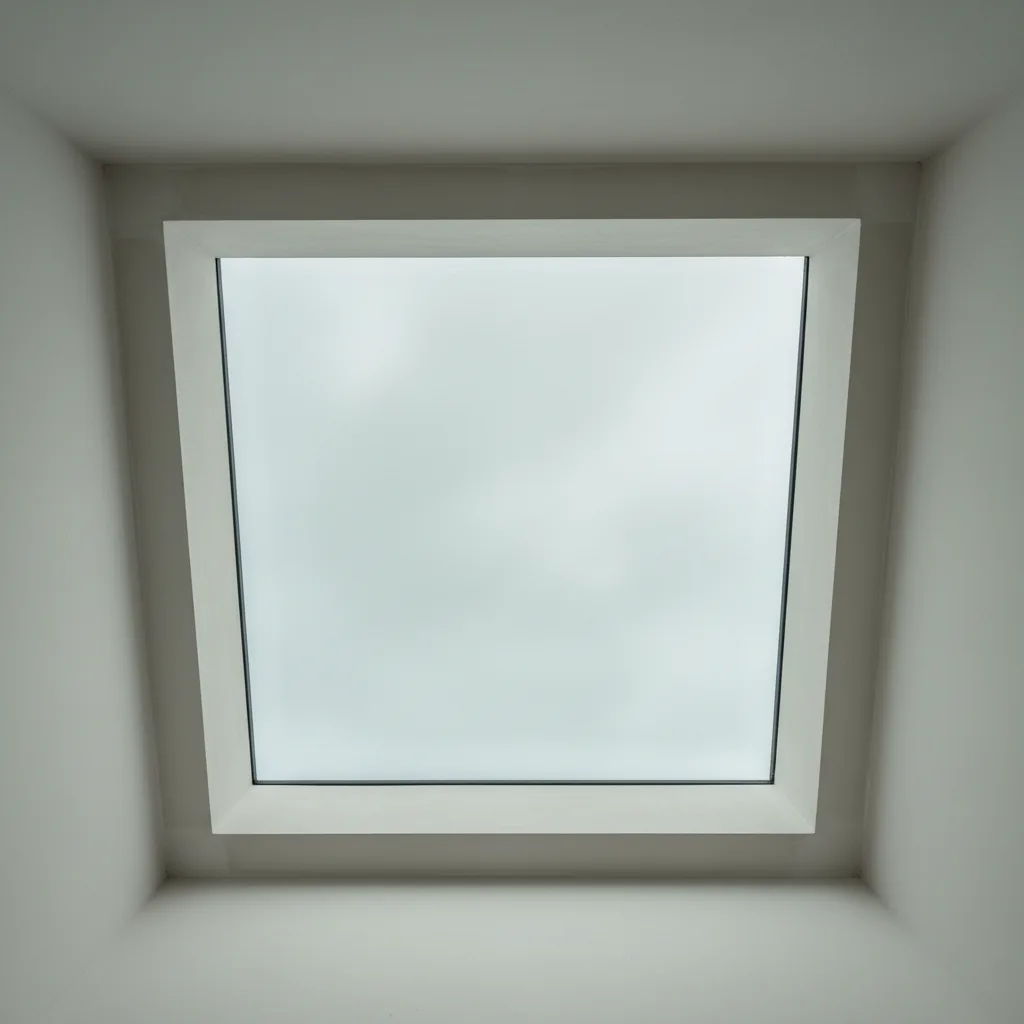
A rooflight frame sheds water off the glass onto its own perimeter, and on a flush glazed unit that water runs to the low corner of the frame and off it. Where the frame drainage path is obstructed, by a bead of sealant applied with good intentions or by debris that has collected in a corner, water sits inside the frame instead of leaving it.
The symptom is water appearing at one corner only, in rain, on a unit that is otherwise sound. It is usually the frame drainage rather than a seal, it is easy to clear once identified, and it gets misdiagnosed as a failed unit more often than anything else on a flat roof.
Reverse falls, and how they happen
A reverse fall is a section of roof sloping away from the outlet, and it is not usually a design error. It is usually deflection.
A deck that sags under its own load, under a water load, or around a new opening that was trimmed without enough attention to the trimmer size, creates a low point where the design had a slope. Water then collects in that low point permanently.
Around a rooflight the risk is specific: the opening is a discontinuity in the deck, and if the trimmers deflect more than the joists either side of them, the roof develops a dip exactly where the kerb is. That is a structural detail rather than a roofing one, and it is covered on the structural openings page.
Reading a roof for ponding
The evidence is visible on a dry day, which is when we survey.
Ponding leaves a tide mark: a ring of fine silt and darker discolouration at the edge of where the water sat. Algae and moss grow inside that ring and not outside it. On a bitumen roof the surface within the ring frequently looks different in texture from the rest.
Those marks tell you where water stands, how deep, and how often, without waiting for rain. On a survey around a rooflight the first thing we look for is a tide mark on the uphill side of the kerb.
Getting it right on new work
Where the roof is being built or recovered as part of the job, the drainage and the rooflight get designed together rather than in sequence.
That means the outlet position is chosen knowing where the rooflight will be, the falls are set with a margin over the minimum, the kerb is given clearance measured at its lowest corner, and where the unit sits across the flow the tapered scheme diverts water round it.
Every one of those is free at design stage and expensive afterwards.
What we survey on a flat roof
We survey on a dry day and read the tide marks, check the fall with a level rather than by eye, look at the outlet and where it sits relative to the opening, and take the kerb clearance at the low corner. Where a roof ponds against a kerb we say so and say why, because putting a new rooflight into standing water buys you a new unit and the same problem.
A rooflight is only ever as good as the roof draining round it.
Thinking about this job? We survey across Worthing, West Sussex and the South Downs and give you a fixed price before any work starts, with a 10-year workmanship guarantee.