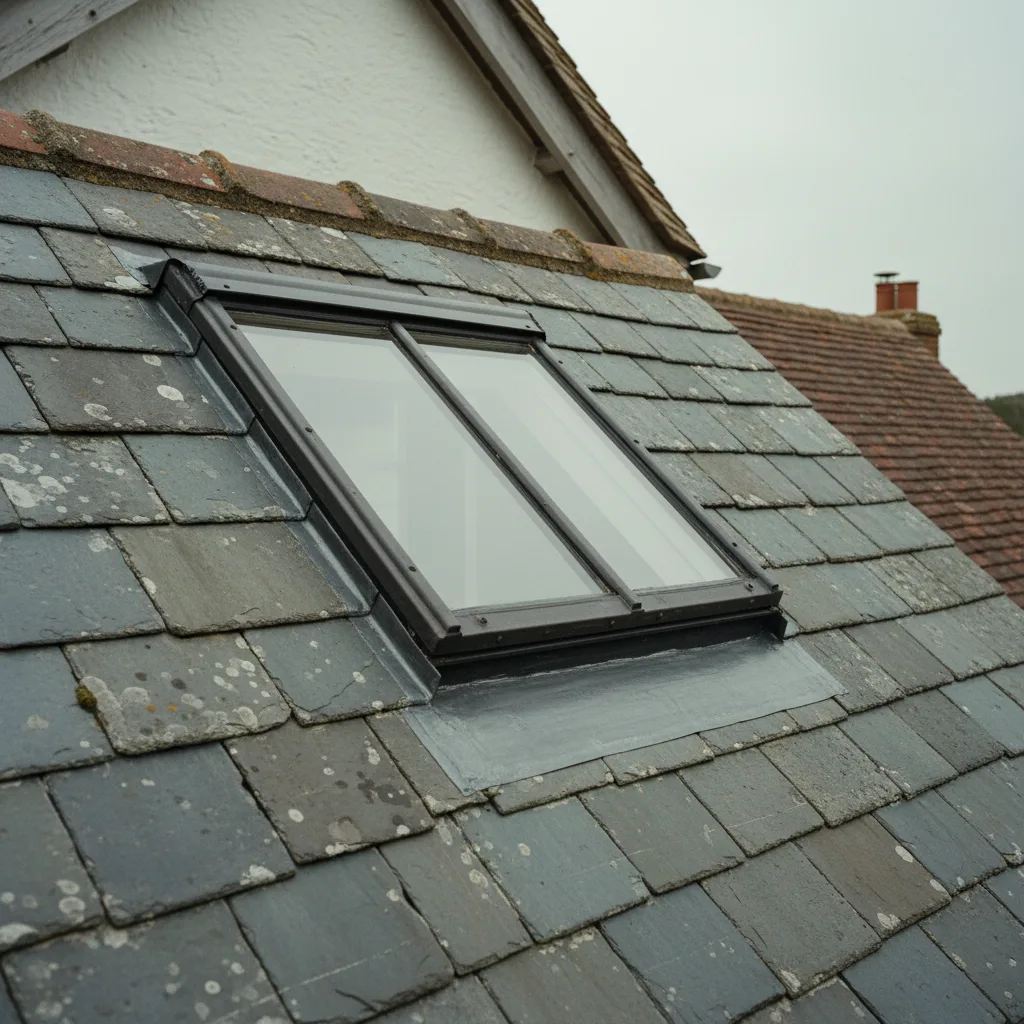
A conservation rooflight is a slim, low profile unit designed to sit flush within the plane of a roof covering rather than on top of it, usually with a steel or steel faced frame, a dark finish and a central glazing bar, so that it reads as a nineteenth century cast iron rooflight rather than a modern addition.
Why the type exists
Because Victorian roofs already had rooflights, and they looked a particular way.
Cast iron rooflights were fitted in large numbers through the nineteenth century to light lofts, workshops and service stairs. They were small, they had a single bar, they sat low in the covering, and they were dark.
A conservation rooflight reproduces that appearance while performing to current standards. It exists because planning authorities want new openings on historic roofs to look like something the building might always have had.
The four things that define one
Flush, slim, dark, and barred. A standard rooflight is none of those.
How flush it actually sits is on how flush does a conservation rooflight sit. What the bar is doing is on do conservation rooflights have glazing bars. The finish is on what colour are conservation rooflights.
What they are made of
Generally steel, or steel faced, rather than the aluminium or plastic a standard unit uses.
Steel gives the slim sections that make the profile possible, and the right weight and appearance. It also means the coating specification matters, particularly near the coast, where a slim section has less metal between the weather and the fixing.
Timber framed versions exist and suit some buildings, particularly where the frame will be seen from inside a room with exposed structure.
How they are installed
Set down into the covering rather than onto it, which is the part that takes the time.
The covering is opened, the frame is bedded so its top surface sits within the thickness of the tile or slate, and the weathering is formed around it with soakers dressed to the courses as they actually lie.
On a hand made covering with a varying gauge that is careful work rather than a kit, which is why the labour on one of these is a larger share of the job than on a standard unit.

Sizes, and why they are small
Worth knowing before anybody plans a room around one.
These units come in modest sizes by modern standards, because the originals were modest and because a large flush unit in an old roof stops reading as an original feature.
Where more light is wanted, two smaller units set to the rhythm of the elevation below generally look better and are received better than one large one.
Performance
Modern, and it is worth saying because the appearance suggests otherwise.
Current conservation units are double glazed with a low emissivity coating and meet the thermal standards a replacement has to meet. The detail is on are conservation rooflights double glazed.
Whether they open
Many do, and it is a specification choice rather than a property of the type.
Fixed units are slimmer and cheaper, and an opening version is available across most ranges. Which suits a room, and what it means for ventilation, is on do conservation rooflights open.
Who makes them
A small number of specialist manufacturers rather than the big roof window names, which is worth knowing when comparing quotes.
Ranges differ in section depth, in how the bar is formed, in whether the frame is steel throughout or steel faced, and in the finishes available. Those differences are visible at close range and invisible from a street.
Which matters most depends on whether the unit will be seen from a pavement or from inside a room, and it is worth looking at one rather than choosing from a brochure.
How they weather over time
Well, on a sheltered inland roof, and it is worth asking about near the coast.
A slim steel section has less metal and less coating between the weather and the fixing than a bulky aluminium frame does, so the coating specification carries more of the burden.
Inland that is a non-issue over an ordinary service life. On an exposed coastal slope it is the reason to specify the coating and the fixings up rather than the unit down.
The catch nobody mentions
Minimum pitch, and it rules the product out more often than any other factor.
Conservation units carry a minimum pitch below which the manufacturer will not warrant them, and the shallow rear additions on old cottages frequently fall below it.
It is taken with a level at survey rather than judged from the ground, because it decides whether this product is available at all on the slope somebody wants.
Where they are required
Not everywhere, and it is worth being precise.
On a listed building, and on a visible slope inside a conservation area, one is frequently what an application needs. On a rear slope out of public view, or on an undesignated building, it is a choice.
Which situation an address is in is on do I need permission for a rooflight in a conservation area.
What they cost, in shape
More than a standard unit of the same size, for the frame material and the smaller production volumes.
What actually drives the total is generally the roof rather than the unit, and that is on how much does a conservation rooflight cost.
What we specify as standard on a designated roof
We specify conservation units wherever a slope is visible in a designated area, and we say plainly where one is not required, so that nobody pays for an appearance they did not need.
The whole picture is on the conservation rooflight installation page.
Thinking about this job? We survey across Worthing, West Sussex and the South Downs and give you a fixed price before any work starts, with a 10-year workmanship guarantee.