Can I replace an old rooflight or skylight in a conservation area?
Usually yes, and usually with no application at all. Replacing an existing rooflight in the same opening, with a unit that does not project materially further above the plane of the roof, is generally not development for planning purposes. It is also the best opportunity anybody gets to improve how a roof looks.
Why it is generally not a planning matter
Because nothing about the roof is being altered in the sense the system cares about.
The opening already exists, its size is unchanged, and the new unit occupies the same position. Where the projection is the same or less, there is no material change in appearance.
Where that stops being true
Three situations, and all are avoidable. Enlarging the opening. Fitting a unit that stands materially higher than what came out. And moving the position, even slightly, which makes it a new opening and a closed one.
Each of those is a fresh proposal rather than a replacement.
The projection trap
The one that catches modern replacements out.
A current insulated unit on a proper upstand can stand higher than the thin plastic dome it replaces, and on a designated slope that difference is what turns a replacement into development.
It is measured rather than assumed, and the method is on what is the 150mm rule.
If the building is listed
Then the answer changes entirely. Consent is needed for alterations to a listed building regardless of the planning position, and replacing a rooflight generally counts unless it is genuinely like for like repair.
Where the existing unit is itself an unsympathetic later addition, replacing it with a better one is frequently welcomed.
The opportunity nobody takes
The reason this is our favourite job in a designated area.
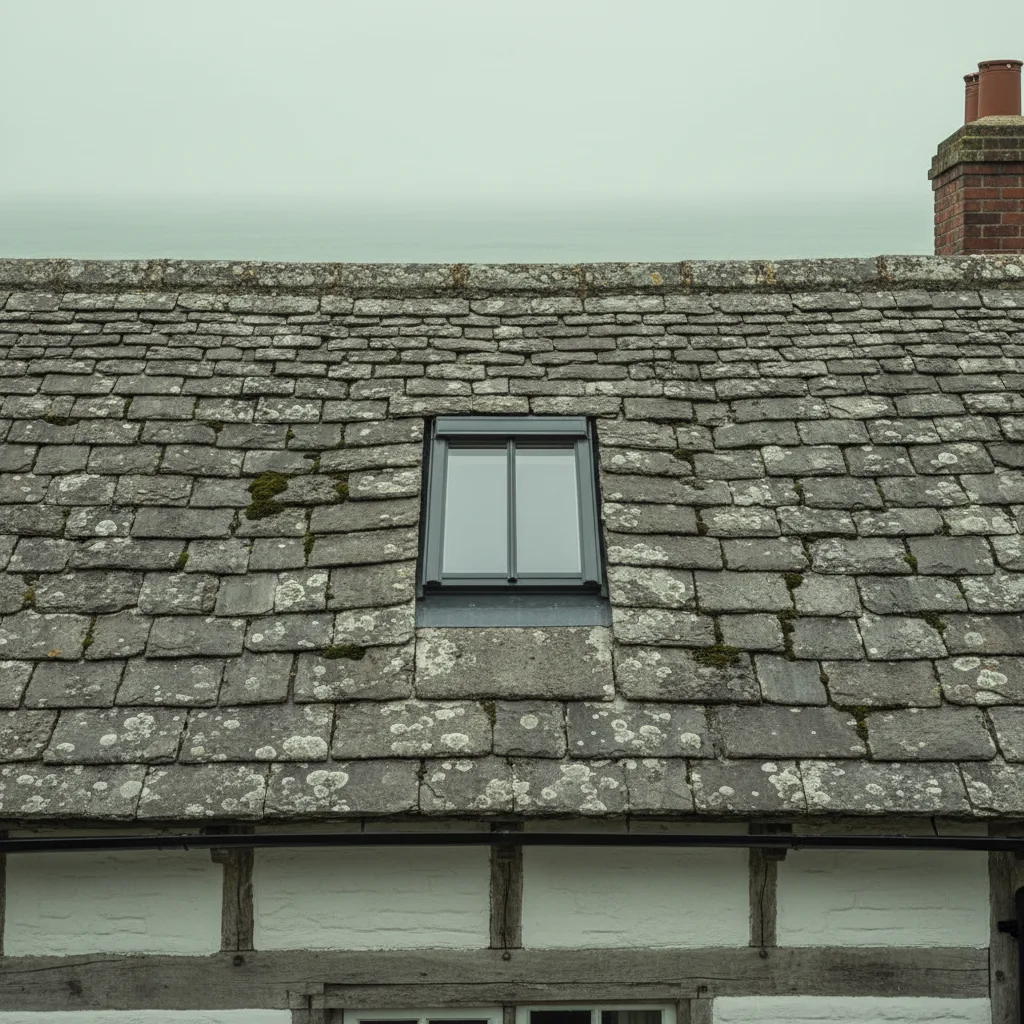
Most of what we are replacing is a standard flanged unit fitted decades ago, standing proud of a covering, in a pale finish, on a slope everybody can see.
Swapping it for a flush dark unit in the same opening improves the roof, needs no application, and costs little more than a like for like replacement.
Why an officer welcomes it
Because the outcome is better than what is there.
Where an application is needed for some other reason, a proposal that removes an unsympathetic unit and puts a better one in its place is the easiest kind to approve.
It is worth saying explicitly in a submission rather than leaving it to be noticed.
Whether the opening will suit a modern unit
The practical question, and it decides the cost.
Old openings were formed to suit the unit going in, and current products come in different sizes. A like for like fit is frequently a made to size order rather than a catalogue one.
That is a lead time rather than a problem, and it is settled at survey.
What we find when the old one comes out
The line that cannot be priced in advance.
A unit that has leaked for years leaves soft timber, torn felt and failed batten ends around the opening, none of it visible until the unit is off.
We price the known work and say clearly what would be extra if the substrate is bad.
Reusing the flashing
Generally a false economy on an old installation.
Twenty years of weather works the soakers, and the underlay collar is usually the part that has failed. Reusing an old kit to save a modest sum is how a sound new unit leaks at a detail nobody replaced.
Building Control
Worth checking, because it is a separate question from planning.
A replacement into an existing opening is not normally notifiable, and the new unit still has to meet the limiting thermal standard, which any current product does comfortably.
What that standard is is on the limiting U-value for a replacement rooflight.
Ventilation the old unit was providing
A requirement that catches replacements out repeatedly.
Where a room’s background ventilation came through the old rooflight, the replacement has to provide it, and not every unit carries a vent.
It is checked at survey, because discovering it at fitting means the wrong unit or a room that no longer complies.
Repair rather than replacement
The cheaper answer, and we would rather offer it.
Where a frame is sound and a sealed unit has misted, the glazing can frequently be changed alone. Where ironmongery has seized, it is a part.
Age is a poor guide: a well fitted unit of twenty five years can be sound and a badly fitted one of eight can be finished.
Doing several at once
Worth considering where a house has more than one ageing unit.
The survey, the access and the scaffold are shared, and the units match rather than nearly matching, which on a visible run of roof is worth having.
Timing it with other work
The cheapest moment for a replacement, and it is worth waiting for.
Where a roof is due to be recovered, a rooflight replaced during that work is a fraction of the cost of one done alone, because the covering is off and the scaffold is up.
Where a re-roof is within a couple of years we will say to wait, and where a unit is leaking now we will weather it in the meantime.
Removing one altogether
An option nobody offers and it is occasionally right.
Where an old unit is badly placed, lights nothing useful, and is the most conspicuous thing on a visible slope, taking it out and reinstating the covering is a legitimate answer.
On a listed building it is frequently the one an officer would most like to hear.
How we treat it on a designated roof
We treat a replacement as a chance to improve the roof rather than to repeat what was there, and we say where a repair would serve better than a replacement.
The wider designation position is on do I need permission for a rooflight in a conservation area.
Thinking about this job? We survey across Worthing, West Sussex and the South Downs and give you a fixed price before any work starts, with a 10-year workmanship guarantee.