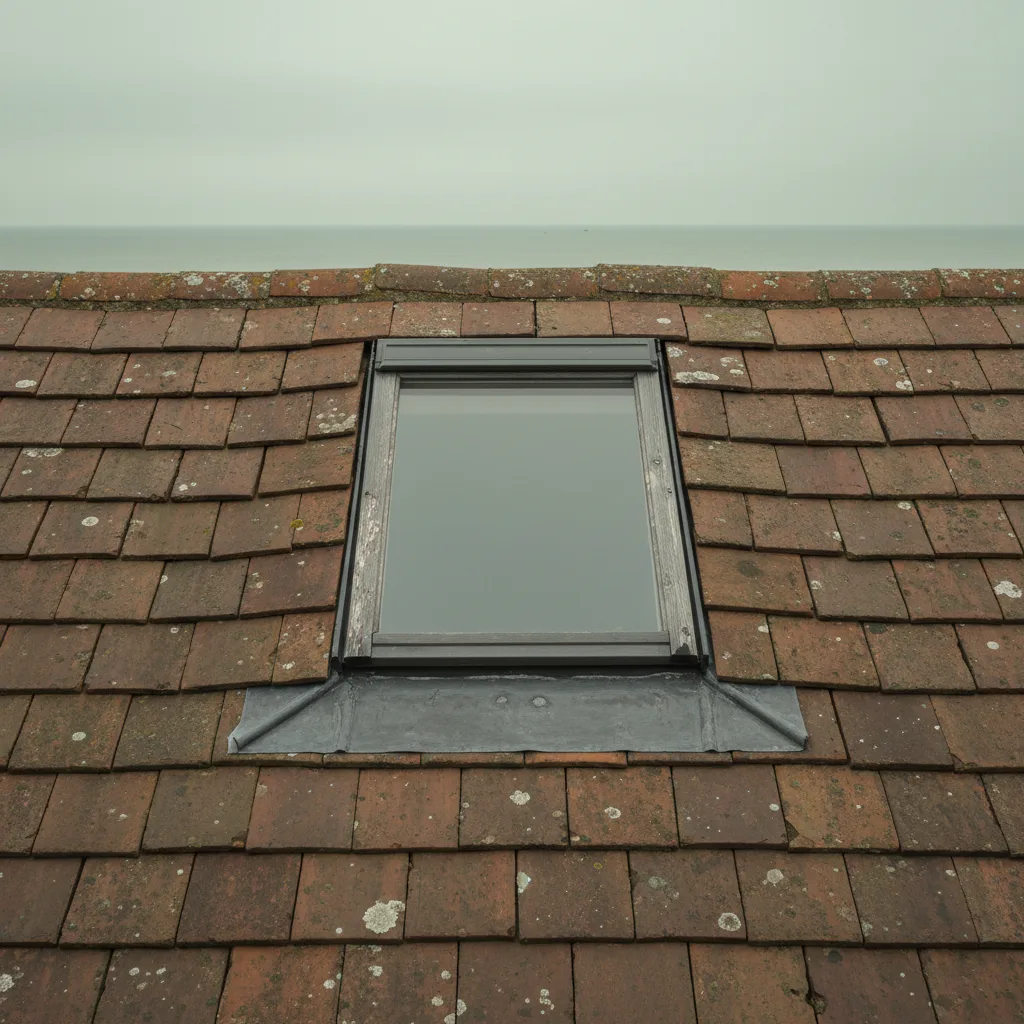
A flashing kit is the set of preformed components that weathers a roof window into the surrounding covering. It has four parts: an apron below the window, soakers interleaved up each side, a head flashing above, and an underlay collar tying the roofing membrane to the frame. It is ordered separately from the window and it is chosen by the covering, not by the window.
The four parts
Each doing a different job, and all four are needed.
The apron carries water from the sill out onto the covering below. The soakers weave between the tiles or slates up each side. The head flashing takes water arriving from above around the window. The underlay collar connects the roofing membrane beneath the covering to the frame.
Why the collar matters most
Because it is the second line of defence and nobody sees it.
Any covering lets some water past in driven rain, and the underlay carries it away. Where a window interrupts that layer, the collar has to carry the membrane around the frame and out onto the covering below.
A kit fitted without the collar looks finished and has no second line at all.
Why the kit is matched to the covering
Because coverings have different profiles and different thicknesses.
A flat covering like slate needs a kit with slim soakers that sit tight. A profiled tile with a deep roll needs a kit that follows that roll rather than bridging it.
The wrong kit leaves a void under every roll, which is a channel for driven rain.
The main kit types
Broadly three, plus the special cases. A flat profile kit for slate and other coverings up to a modest thickness. A profiled kit for tiles with a roll, up to a stated depth. And a recessed kit that sets the window deeper into the covering.
Which suits what is on flashing kits and roof coverings across Sussex.
Combination kits
For two or more windows installed together.
Where units sit side by side or stacked, a combination kit weathers the junction between them with a designed detail rather than two separate kits butted together.
It has to be ordered as such at the outset, because it is not two ordinary kits.
Recessed kits
The option that changes appearance rather than performance.
A recessed kit sets the window lower into the plane of the covering, which reduces the projection and the shadow line considerably.
On a slope visible in a designated area it is occasionally what makes a proposal acceptable.
Insulation collars
A separate component and worth having. An insulation collar fits around the frame between it and the trimmed opening, closing the gap that would otherwise be a cold bridge running the perimeter.
It is what prevents water forming along a frame on winter mornings, and it is frequently omitted.
What a kit does not cover
The irregular coverings, and this is where craft takes over.
Hand made clay tile with a varying gauge, Horsham stone, and heavily undulating old roofs are outside what any preformed kit assumes.
There the weathering is made up in lead and dressed to the courses as they actually lie.
When lead replaces a kit
On stone and on the oldest coverings.
A dressed lead detail follows unit thicknesses and course changes a preformed apron cannot, and it is repairable rather than sealed.
What that involves is on Horsham stone slab roofs.
How a kit fails
Rarely on the day, and reliably in driven rain from one direction.
A flat kit on a profiled tile does not leak in ordinary rain. It leaks when wind pushes water up under the rolls it never sealed.
Which is why the fault appears two winters later and is hard to trace back.
Sealant around a kit
Evidence of a problem rather than part of the detail.
A properly fitted kit needs no mastic. A bead around one is somebody chasing a leak the kit should have stopped.
Where we find it, we look for the wrong kit rather than a failed seal.
Reusing an old kit
A false economy on any installation more than a decade old.
Soakers work in the covering over years, and the underlay collar is generally the part that has perished. Reusing a kit to save a modest sum is how a new window leaks at an old detail.

Ordering the right one
It is matched to the window size as well as the covering.
A kit for the right covering and the wrong frame size does not fit, so the size code and the covering are both needed before ordering.
What to ask an installer
Two questions.
Which kit they are ordering and why, and whether it includes the underlay collar and an insulation collar.
An installer who cannot say what covering profile the kit is for is guessing.
Multiple coverings on one roof
Common on an extended house, and it catches people out.
Where a house has slate at the front and concrete tile at the back, two windows on two slopes need two different kits.
How a kit is installed
From the bottom up, which is the order water runs.
The underlay collar goes on first and is dressed to the membrane. Then the apron at the sill, then the soakers working up each side interleaved with the covering, then the head flashing last.
Doing it in that order means every component laps over the one below it. Fitting the head first and working down produces laps facing the wrong way.
What a good one looks like when finished
Almost invisible, and that is the test.
The covering runs up to the frame with no gaps under the rolls, the soakers are hidden between the tiles, and there is no sealant anywhere.
A kit you can see the components of has generally not been dressed in properly.
What we identify on a pitched roof
We identify the covering profile at survey and order the kit against it, with the underlay collar and an insulation collar as standard rather than as extras.
The whole picture is on the roof window installation page.
Thinking about this job? We survey across Worthing, West Sussex and the South Downs and give you a fixed price before any work starts, with a 10-year workmanship guarantee.