Two rooflights can be quoted with U-values that look a long way apart and perform almost identically, because the two figures are measuring different things. This is the single most common way rooflight quotations are not comparable.
The two figures
Centre pane describes the middle of the glass, away from the edges, where the coating and the gas fill are doing their work undisturbed. It is a property of the glass build-up.
Whole unit describes the entire product as installed: the glass, the edge of the sealed unit, the frame, and how they interact. It is a property of the rooflight.
The whole unit figure is always worse than the centre pane figure, and the gap between them is where most of the interesting engineering sits.
Why the edge is worse
At the perimeter of a sealed unit the two panes are held apart by a spacer bar, and that spacer bridges from the warm inner pane to the cold outer one.
Whatever the spacer is made of conducts heat across that gap, short circuiting the cavity that the rest of the unit relies on. Traditional aluminium spacers are excellent conductors, which is precisely the wrong property in that position.
So there is a band around the edge of every sealed unit that performs worse than the middle, and on a small unit that band is a large proportion of the total.
Why the frame is worse again
The frame is not glass, it has no cavity, and it has to be structural.
An aluminium frame without a thermal break would be a direct metal path from inside to outside. Current frames have a low conductivity section built into the profile to interrupt that, which works well and still performs worse than a triple layer of glass and gas.
A timber frame conducts less than aluminium and brings its own maintenance considerations. Either way, the frame is the poorer performing part of the product.
Why size changes the answer
| Unit | Proportion that is edge and frame | Effect on whole unit figure |
|---|---|---|
| Small | High | Whole unit figure much worse than centre pane |
| Medium | Moderate | A meaningful gap |
| Large | Low | The two figures converge |
The consequence is counterintuitive and worth stating plainly: for the same glass and the same frame, a large rooflight has a better whole unit U-value than a small one, because proportionally less of it is perimeter.
Which means comparing the whole unit figures of two units of different sizes tells you as much about their sizes as about their quality.
The comparison problem
Two quotations arrive. One states a figure that looks excellent, the other a figure that looks ordinary. It is entirely possible that the first is a centre pane figure and the second a whole unit figure for the same glass in a better frame.
There is no way to tell from the number itself. The only remedy is to ask which figure it is, and to compare like with like.
It is a two minute question and it is the difference between a comparison and a guess.
What to ask for
- Which figure is this, whole unit or centre pane?
- If whole unit, at what size? The figure changes with size.
- What is the frame material and does it have a thermal break?
- What spacer is in the unit, and is it warm edge?
- Is the figure for the product as I am ordering it, including any opening light?
Five questions, and any supplier who cannot answer them straightforwardly is a supplier worth a second look.
Opening lights make it worse
An opening rooflight has more frame than a fixed one of the same size, because the opening light has its own frame inside the outer one.
More frame means more of the poorer performing material and a longer perimeter, so an opening unit generally has a worse whole unit U-value than a fixed unit of identical size and glass.
That is a reason to specify fixed where ventilation comes from elsewhere, and it is not a reason to avoid opening units where ventilation is actually needed.
Which figure the regulations use
Building Regulations work in whole unit terms, because the regulation is about the heat lost by the building rather than by the glass.
So the figure that matters for compliance is the whole unit one, and a centre pane figure quoted against a regulatory limit is comparing two different quantities. Any current product from a reputable supplier clears the limiting standard on a whole unit basis comfortably, so this is rarely a difficulty in practice.
It matters more when comparing products than when satisfying a regulation.
How the figures are arrived at
Whole unit figures are calculated to a standard method, or measured, and the method accounts for the glass, the spacer, the frame and the proportions at a defined reference size.
Because there is a defined method, figures from different manufacturers calculated the same way are genuinely comparable. What is not comparable is a calculated figure against a marketing figure, or a figure at one reference size against a figure at another.
Asking for the basis is not pedantry. It is the only way the numbers mean anything.
Where the improvement actually comes from
Once a unit has a low emissivity coating and an argon fill, which every current product does, the remaining gains are mostly at the edge and the frame rather than in the middle of the glass.
Which is why warm edge spacers matter disproportionately, why frame design has improved more than glass in the last twenty years, and why a well designed slim frame in a well designed section outperforms a chunky one with identical glass.
The middle of the glass has been close to solved for some time. The perimeter is where the differences are.
Comparing a rooflight with a window
People occasionally compare the U-value of a rooflight with that of a vertical window and conclude the rooflight is poor. It is not a fair comparison, and the reason is physics rather than product quality.
Heat rises, so the air against a horizontal or near horizontal pane is warmer than the air against a vertical one, and convection in the cavity behaves differently when the cavity is lying down rather than standing up. A unit tested horizontally will give a worse figure than the identical unit tested vertically.
Which means a rooflight and a window quoted with the same number are not performing the same, and a rooflight with a slightly worse number may be the better piece of engineering. Where a figure is quoted for overhead use, it should say so.
Pitch, and where the figure was measured
Following from that, the angle a unit is tested at matters, and it is not always stated.
A lantern at a genuine pitch behaves more like a vertical window than a flat rooflight does, because the cavity is inclined and convection within it is less vigorous. So the same glass gives a different whole unit figure in a flat rooflight, a shallow one and a lantern.
It is a modest effect and it is one more reason to ask what the basis of a quoted figure is rather than treating a number as a number.
The kerb, which no figure includes
On a flat roof rooflight there is a component that no U-value describes at all, and it can undo the rest.
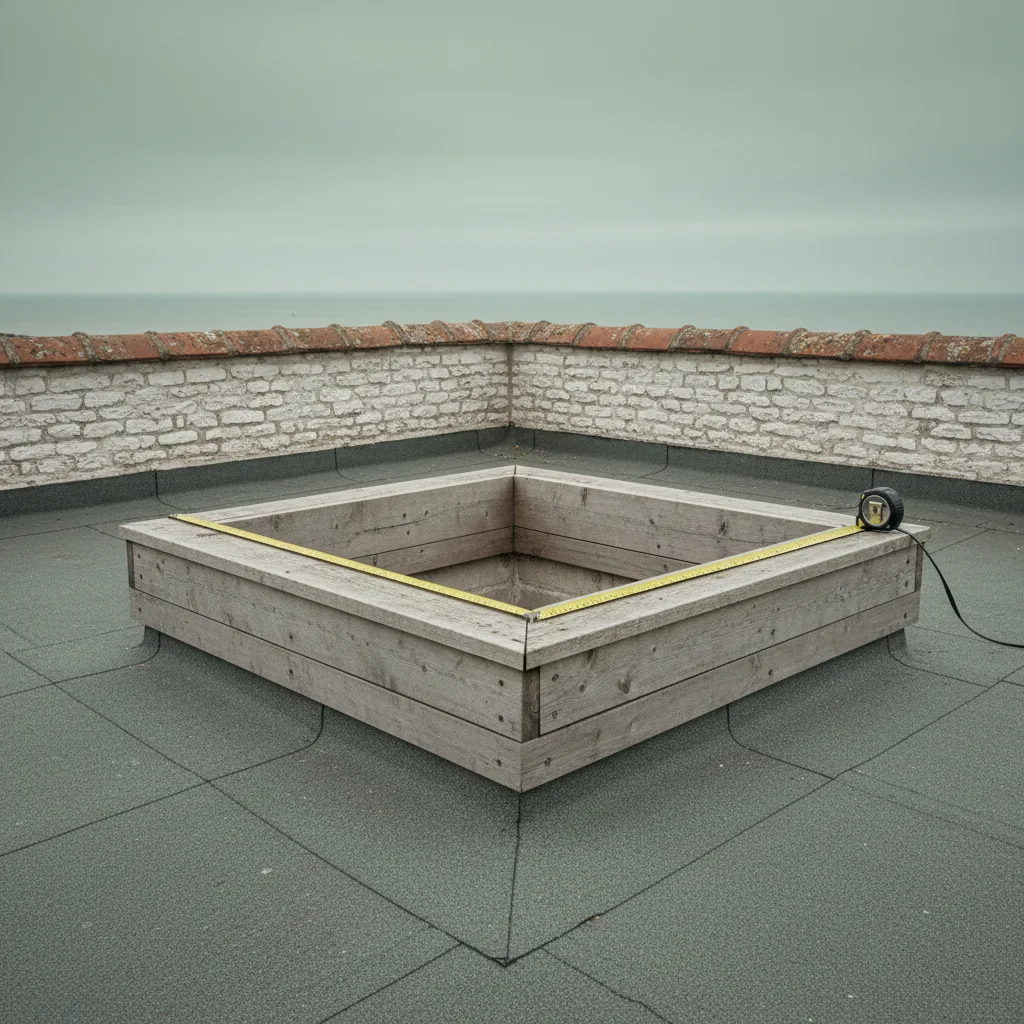
The kerb the unit sits on is a box standing up out of the roof. Where its outer face was never insulated, it is a thermal bridge running the whole way round the opening, and it loses more heat than the difference between a good unit and an excellent one.
Specifying a better U-value onto an uninsulated kerb is paying for performance the installation then gives away. The kerb detail is covered on the thermal bridging page and it is the higher priority of the two.

Linear thermal transmittance
The heat lost at a junction, as distinct from through a surface, has its own measure and it is worth knowing the concept exists.
It describes the extra heat lost per metre of a junction because of its geometry and materials, and the junction between a rooflight frame and the surrounding construction is exactly the kind of thing it covers.
You will rarely see a figure for it on a domestic quotation. What it tells you is that the junction is a real quantity rather than a detail, which is the same conclusion the kerb paragraph above reaches from the other direction.
What the difference is worth in a room
It is worth keeping this in proportion.
Between two current rooflights of similar type, the difference in whole unit U-value is generally modest, and on a domestic extension its effect on a heating bill is small. What is not small is the difference between a well insulated kerb detail and none, or between a modern unit and a 1980s one.
So the honest priority order is: replace an old unit, insulate the kerb properly, then optimise the U-value. Doing the third without the second is the common error.
Where the published figure and your roof differ
A whole unit figure is calculated for a unit in a defined arrangement, and a real installation differs from that in ways worth knowing.
The figure assumes the unit is installed as the manufacturer intends: seated properly, insulation continuous to the frame, no gaps at the perimeter. Where it is fitted onto an uninsulated kerb, or with a gap left at the frame, the installed performance is worse than the figure regardless of what was bought.
Nobody measures this afterwards, which is why it goes unnoticed. The published figure describes the product, and the installation decides whether you get it.
Comfort rather than cost
The better argument for a good U-value is not the bill. It is the surface temperature.
A better performing unit has a warmer inner pane, which means less condensation on it, less radiant cold falling into the room from overhead, and no cold draught dropping off the glass when the heating goes off. In a room with a large area of overhead glazing that is a genuine difference in how the space feels.
That is the thing people notice, and it is not visible in a bill.
What we state
We state which figure we are quoting, whole unit or centre pane, and at what size. We specify warm edge spacers and thermally broken frames as standard, and we say plainly when the kerb detail matters more than the unit specification, because on most replacements it does.
Where two quotations genuinely cannot be reconciled, the useful move is to ask both suppliers for the same figure at the same size on the same basis. A supplier who can produce that in an email is one whose numbers mean something.
A U-value without its basis is a number rather than a figure. Ask which one it is.
Thinking about this job? We survey across Worthing, West Sussex and the South Downs and give you a fixed price before any work starts, with a 10-year workmanship guarantee.