There is a band an inch or two wide around the edge of every sealed unit that performs worse than the rest of it. What that band is made of decides how cold it gets, and on an overhead unit the consequences are directly above whatever is beneath.
What the spacer is doing
A sealed unit is two panes held apart by a spacer bar running round the perimeter, sealed to both. The spacer sets the cavity width, holds the assembly rigid, carries the desiccant that keeps the cavity dry, and forms part of the seal that keeps the gas in and moisture out.
It is four jobs in one component, and for decades the material that did all four best was aluminium.
Why aluminium is the wrong material there
Aluminium is an excellent conductor of heat. In almost every other part of a window that is a manageable property. In the spacer it is precisely wrong, because the spacer is the one component bridging directly from the warm inner pane to the cold outer one.
Everything the cavity is doing to slow heat transfer is short circuited at the perimeter by a metal bar joining the two panes. The gas fill and the low emissivity coating are working across the middle of the unit and being bypassed at the edge.
It is a thermal bridge in miniature, running the whole way round every pane.
What a warm edge spacer is instead
A spacer made of a material with much lower thermal conductivity: a structural foam, a thin stainless section formed so the conduction path is long and narrow, or a composite of polymer and metal foil.
All of them do the same four jobs and conduct far less heat while doing them. The name describes the outcome rather than the material, which is why there is no single thing called warm edge.
The cold line, and where it shows
The consequence of a conductive spacer is a band of colder glass at the perimeter of the pane.
In cold weather that band is the first surface in the room to fall below the dew point, so condensation forms there first: a strip of mist an inch or two in from the frame, with clear glass in the middle.
That pattern is diagnostic. Misting at the perimeter only, clearing toward the centre, is the signature of a conductive spacer rather than a problem with the unit or with the room.
Why it matters more overhead
On a vertical window, condensation at the glass edge runs down into the frame drainage and away.
On a rooflight it is on a surface above your head. Water that forms there runs to the lowest point of the frame and, where the volume exceeds what the frame drainage takes or where that path is blocked with dust, over the edge onto the reveal and eventually into the room.
So the same amount of perimeter condensation that is a nuisance in a wall is a drip in a roof, and it gets reported as a leak.
Two cold edges, not one
It is worth separating two things that produce the same symptom in almost the same place, because they have different fixes.
| The glass edge | The frame and reveal | |
|---|---|---|
| Cause | A conductive spacer in the unit | Insulation not carried up to the frame |
| Where | On the glass, a band in from the frame | On the frame itself and the plaster |
| Fix | A new unit with a warm edge spacer | An insulation collar, opening up |
| Retrofittable | Only by replacing the glass | Only by opening the roof |
Both are common on units over twenty years old, and both frequently appear together, because a unit of that age predates both practices.
What it is worth in the U-value
The improvement from a warm edge spacer appears in the whole unit figure rather than the centre pane one, because the centre pane figure does not describe the edge at all.
On a small unit, where the perimeter is a large proportion of the total, the improvement is proportionally greater. On a large one it is smaller. Which is another reason a whole unit figure has to come with a size attached.
It is a modest improvement in absolute terms and it is very cheap, which makes it one of the best value items on any glass specification.
The surface temperature argument is the better one
The heat saved is real and small. The change in the temperature of the glass at the perimeter is what people actually notice.
A warmer edge means less condensation, which means no water running off the perimeter of an overhead unit, no repeated staining at the head of a reveal, and no mould growth on the plaster there over years.
That is the argument for warm edge on a rooflight: not the bill, the water.
Where the desiccant lives
Inside the spacer is a desiccant that absorbs any residual moisture in the cavity, which is what keeps the unit clear rather than misting internally from day one.
Its capacity is finite. Over decades, as the seal slowly admits moisture, the desiccant saturates and the unit begins to mist between the panes. That is the normal end of life of a sealed unit rather than a defect.
A warm edge spacer does not change that mechanism. What it does change is the temperature at which the glass surface reaches dew point, which is a different problem entirely and is frequently confused with it.

Structural silicone and the second seal
The spacer is only part of the edge. Outside it there is a secondary seal, generally silicone or polysulphide, which bonds the two panes together and does the structural work of holding the unit as an assembly.
On an overhead unit that seal is carrying the weight of the outer pane against gravity for the life of the installation, which is a duty it does not have in a wall. It is one of the reasons overhead units are specified and warranted differently.
It is also why an overhead sealed unit should be built for the purpose rather than being a window unit installed horizontally.
The black line and what people ask about
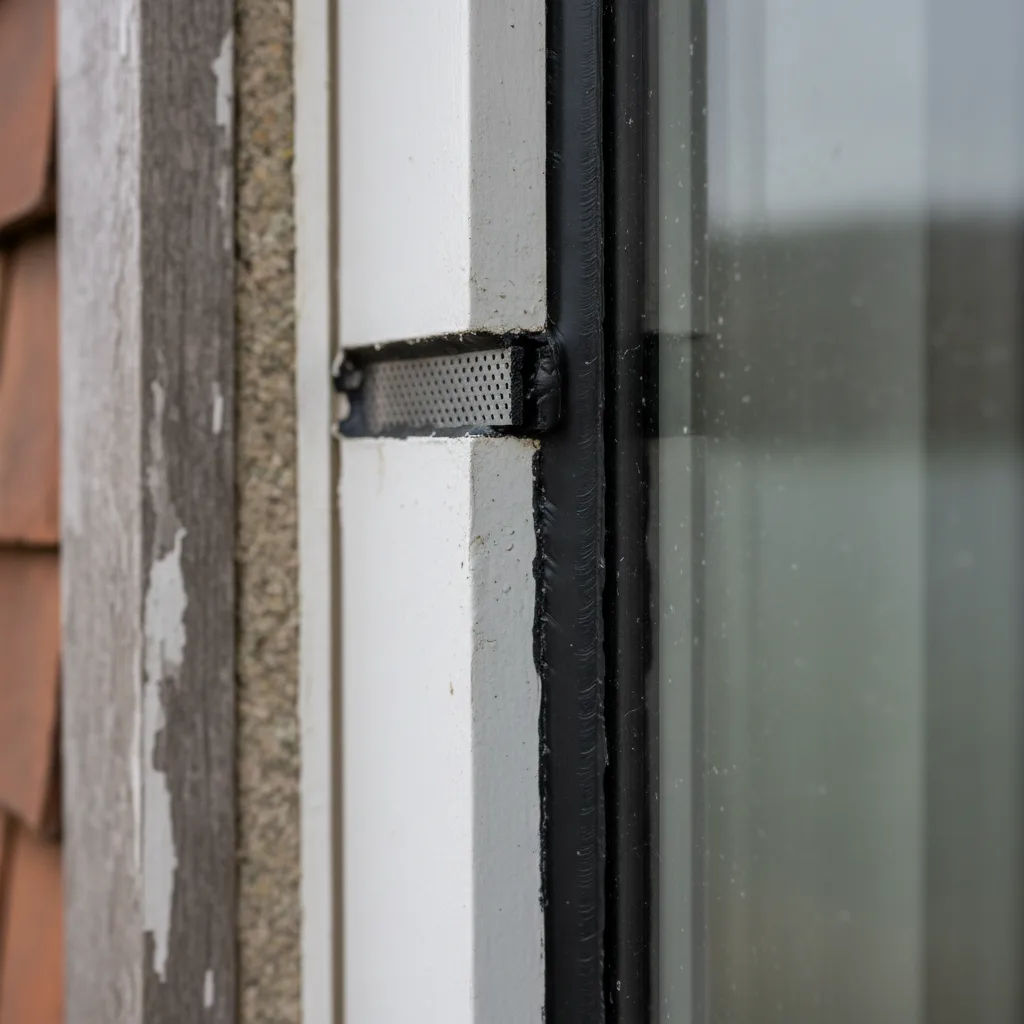
Looking into the edge of a sealed unit you can see the spacer, and warm edge spacers are usually black or a dark grey rather than the bright aluminium people are used to.
On a slim framed rooflight, where a little of the spacer is visible past the frame, that reads as a fine dark line round the glass. Most people prefer it to a bright metallic one, and it is worth knowing it is deliberate rather than a mark.
Triple glazing has two of them
Three panes means two cavities and two spacers, so the edge effects are doubled in count.
Warm edge matters more rather than less in a triple glazed unit, and specifying triple glazing with aluminium spacers gives away a good part of what the third pane was bought for.
Where triple glazing is being considered, the spacer question is part of the same conversation.
Asking for it
It is standard on most current products and it is not universal, particularly at the cheaper end and on some older product lines still in circulation.
It costs very little as an option and it is not retrofittable: changing the spacer means changing the sealed unit. So it is a question to ask before ordering rather than a thing to discover afterwards.
The question is simply whether the unit has a warm edge spacer, and any supplier should be able to answer it in a sentence.
What to expect on an old unit
On a rooflight from the 1980s or 1990s, expect an aluminium spacer, no argon, and frequently no low emissivity coating either.
Which means the perimeter misting that owner has lived with for twenty years is not a fault to be diagnosed but a characteristic of the unit, and it is one of the things that improves immediately on replacement.
It is worth mentioning at survey, because people frequently assume perimeter condensation is something they are doing wrong.
The materials, and what differs between them
Warm edge is an outcome rather than a material, and the products that achieve it take different routes.
- Structural foam. A closed cell foam section with a vapour barrier film. Very low conductivity, flexible enough to be formed round corners in one continuous piece.
- Thin walled stainless. Metal, and shaped so the conduction path is long and the section thin. Rigid, dimensionally stable, and considerably better than aluminium despite being metal.
- Polymer with a foil barrier. A plastic section carrying a thin metal film for gas retention. Low conductivity, and the film is doing the sealing job the plastic cannot.
All three are a substantial improvement on aluminium. The differences between them are smaller than the difference between any of them and a conventional spacer, which is why the useful question is whether the unit has warm edge at all rather than which kind.
Corners, and where a spacer is joined
A spacer runs round four sides and has to turn four corners, and how that is done varies.
A flexible spacer can be bent round a corner in one continuous piece, so there is no joint. A rigid one is either cut and joined with a corner key, or notched and bent. A joint is a potential weak point for gas retention and a small local increase in conduction.
It is a detail rather than a decision, and it explains why perimeter condensation on some units appears at the corners before it appears along the edges.
Where it sits in the priorities
Warm edge is a small, cheap improvement that should simply be specified rather than debated.
It does not compete with the larger items: an insulated kerb, a sealed vapour control layer, the right solar control for the orientation. It sits alongside argon fill as something that costs almost nothing and should be on every order.
The mistake is not choosing against it. The mistake is not asking, and getting an aluminium spacer by default.
What we specify on the glazing
We specify warm edge spacers as standard on everything we order, and say so on the quotation rather than leaving it implied. Where a customer reports misting at the perimeter of an older unit we identify which cold edge it is, the glass or the frame, because the two have different fixes and only one of them is the window.
Where a room has an older unit misting at the perimeter every winter and no other complaint, that is a replacement worth doing on comfort grounds rather than on energy ones. The heating saving will not pay for it. Not wiping a windowsill every January, and not repainting a reveal every few years, is what actually changes.
The middle of a sealed unit has been close to solved for years. The edge is where the remaining differences are.
Thinking about this job? We survey across Worthing, West Sussex and the South Downs and give you a fixed price before any work starts, with a 10-year workmanship guarantee.