Roof windows on the Downs, where wind loading drives the fixings
A roof window sits in the plane of the roof rather than standing above it, which makes its wind behaviour quite different from a lantern. The window itself is rarely the vulnerable part. What is vulnerable is the covering around it and the flashing that connects the two.
This page is about what an exposed downland position does to that junction and what we specify because of it.
Where the load comes from on a pitched roof
Wind arriving at a pitched roof produces positive pressure on the windward slope at steeper pitches, and suction almost everywhere else: on the leeward slope, at the ridge, along the verges and most severely at the corners.
Suction is what lifts things off roofs. On a tiled or slated roof it acts on individual units, trying to lift the tail of each one out of its lap, and it acts most strongly at the perimeter zones.
Why the covering matters more than the window
A roof window is a rigid framed unit fixed with brackets into the rafters or trimmers on both sides. It is, structurally, one of the better anchored things on the roof.
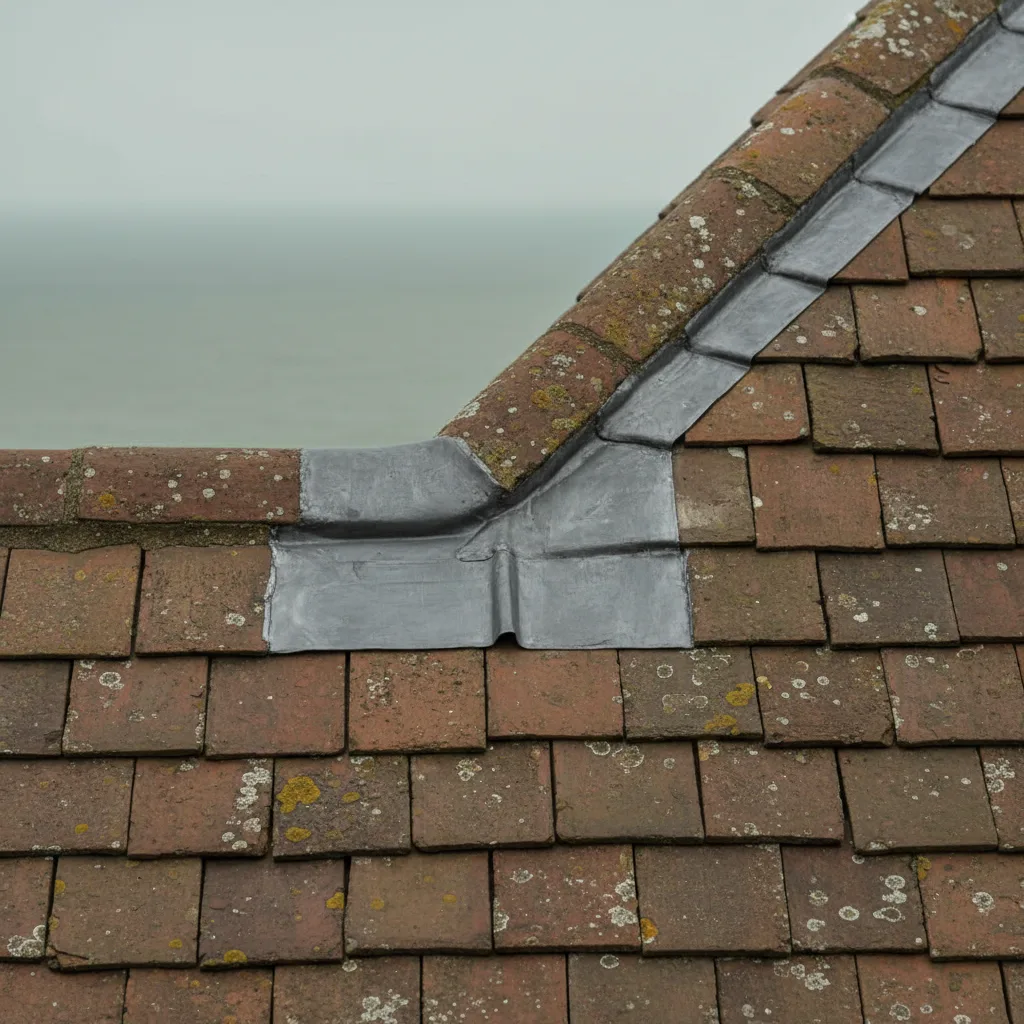
The covering around it is a set of individual slates or tiles, each held by a nail, a nib or a clip, relying on its own weight and its lap for the rest. And the courses immediately around a window are the ones that have been cut, refitted and interleaved with flashing, which makes them the least securely held on that slope.
So the failure on an exposed roof is not the window coming out. It is tiles lifting next to it, or a flashing section peeling back, and then water getting in where the covering used to be.
What raises the load here
| Factor | Effect | Where |
|---|---|---|
| Topography | Wind accelerates up a slope and over a crest | Findon, High Salvington, Poynings, Fulking, Pyecombe |
| Altitude | Basic wind speed rises with height above sea level | The scarp villages, Findon Valley, Salvington |
| Open terrain | No shelter upwind across open downland | Any site with fields to the south west |
| Roof pitch | Steeper roofs take more positive pressure, shallower more suction | Varies house to house |
| Position on the slope | Suction peaks at verges, ridge and corners | Any window near an edge |
These compound rather than add. A house on the scarp above Findon Valley sits several hundred feet higher than one in central Worthing four miles away, on open ground, facing a south westerly that has crossed open sea and is then lifted by the slope.
Position on the roof
The single free decision that reduces the load is where the window goes.
Suction is lowest in the middle of a large slope and highest at the verge, at the ridge and at the corners. A window set well in from the edges sits in the quietest part of the roof; one set close to a verge sits in the peak zone.
On a cut roof there is frequently latitude in the horizontal position, constrained mainly by the rafters. Where there is, moving the window in from the edge costs nothing and materially reduces what the surrounding covering has to resist.
Fixing the window itself
A roof window is fixed with brackets to the rafters or trimmers either side, and on an exposed site the specification tightens in predictable ways.
- The full complement of brackets, at the spacing the manufacturer specifies, rather than the number that seemed sufficient.
- Fixings into structural timber, not into battens.
- Stainless rather than plated, because these are cyclically loaded fixings in salt laden air.
- The trimming itself properly made, since the brackets are only as good as what they fix into.
None of that is exotic. It is doing what the instructions say on a roof where it matters.
Securing the covering around it
This is where the real work is on an exposed roof, and it is the part most likely to be skimped.
Every tile or slate that was lifted to fit the window has to go back as securely as it came off, and on an exposed roof that means mechanically fixed rather than relying on weight and lap. Tiles that were nailed get nailed. Tiles that were clipped get clipped. Slates get a proper tingle or clip where the nail hole is no longer accessible.
A single tile put back loose next to a window is the one that lifts, and once one goes the ones around it are exposed.
The flashing kit under load
A flashing kit is a set of thin metal pieces held by laps and by a modest number of fixings, and wind gets under thin metal.
On an exposed site the head flashing and the top corners are the parts that peel, because that is where suction is highest and where the kit has the least material holding it. Fixing the kit properly at the head, at the specified centres, with stainless fasteners, is what keeps it there.
A kit that has started to lift is visible from the ground as a slightly raised line above the window, and it is worth reporting early because it is a small job at that stage.
Driving rain, which comes with the wind
Wind and water arrive together, and the same exposure that raises the uplift raises the driving rain.
That makes the underlay collar more important on an exposed roof than anywhere else, because wind driven rain pushed past a lap is exactly what the underlay is there to catch. A window on the scarp fitted without a collar will find the defect within its first autumn.
Exposure therefore drives two specifications at once: how the thing is held down, and what catches the water that gets past it.
Salt, at this distance inland
It is tempting to assume that six miles inland removes the coastal specification, and on this coast it does not, because the ground rises.
The prevailing south westerly crosses open water, crosses a narrow coastal plain, and is then lifted up the scarp. It carries salt with it the whole way. A house on the slope above Findon Valley is taking sea air that has been accelerated rather than filtered.
We specify from the exposure of the site rather than from the distance to the beach, and where it is marginal we specify up, because the cost difference across one window is small.

The National Park overlap
Twelve of the towns we cover sit inside the South Downs National Park, where the National Park Authority is the planning authority rather than the district council.
Those twelve are largely the same places that are most exposed, so a roof window at Poynings, Fulking or Amberley frequently has both a structural conversation and a planning one attached to it. The two are independent and both are worth having before anything is ordered.
Pitch, and how it changes the load
The pitch of the roof changes which kind of load dominates, and it is worth knowing which case your roof is.
On a steep roof, above roughly thirty degrees, the windward slope takes positive pressure pushing inward. That is a load the covering resists well, because it is being pushed onto its battens rather than lifted off them.
On a shallow roof the wind passes over more like an aerofoil and the windward slope takes suction too. Every slope is then in uplift, and every tile is being lifted rather than held. Shallow pitched roofs on exposed sites therefore need more mechanical fixing of the covering than steep ones, which is counterintuitive to most people.
The pitch is measured at survey rather than estimated, because the difference between twenty five and thirty five degrees changes both this and the flashing kit that can be used.
Verges and the edge of the roof
The zones where suction peaks are narrow bands along the edges of each slope, and they are worth picturing before choosing a position.
The band runs along the verge at each gable, along the ridge, and along the eaves, and the corners where two of those bands meet are the most severe points on the whole roof. The middle of a slope, well away from all of them, is the quiet zone.
On a semi detached or terraced house the gable verge may be the only edge, and on a detached house there are two. Either way, keeping a window a good distance in from a verge puts it in a substantially lower load zone at no cost, and it is a decision available only before the opening is formed.
Debris arriving on the roof
Wind on the scarp carries more than air, and a roof window takes what arrives.
Small branches from mature planting, gravel lifted from a nearby flat roof, and hail driven at an angle rather than falling vertically. The outer pane is toughened as standard, which handles all of it, and on a genuinely exposed downland site a thicker outer pane is an inexpensive change at ordering.
The inner pane is laminated on any overhead glazing regardless, which is the answer to anything that does get through.

Noise, and what is normal
An exposed roof window makes sounds, and knowing which ones mean something saves worry.
A low note in a strong wind is air moving over the roof and is not a fault. Rain on glass is louder overhead than at a window and is ordinary. What is worth reporting is a rattle or a tick under load from one point, which usually means a fixing or a cap has worked loose, and a change in the sound over a season, which frequently means a gasket has hardened.
Working on an exposed roof
Exposure changes the installation as much as the specification.
Work is planned around the wind as closely as around the rain. Slates and tiles are not handled in a strong wind, because a slate acts as a sail. Temporary covering on an exposed roof is fixed rather than weighted, because weighted sheeting leaves in the first gust. And the roof is opened and closed within the day.
Practically that means these jobs are more weather dependent than the same work in a sheltered valley, and moving a start date is better than opening a roof into a poor forecast.
Maintenance that actually matters
- Once a year, look at the flashing line above the window from a safe position for anything standing proud.
- Check for slipped or lifted tiles around the opening after any severe blow.
- Clear moss and debris from the head of the window, where it dams water against the flashing.
- On a coastal or scarp site, rinse the frame with fresh water when convenient.
- Operate the window fully a few times a year, so the mechanism does not seize.
None of it needs a specialist. What it needs is somebody looking once a year rather than nobody looking for fifteen.
Inland is not the same as sheltered
The instinct is that distance from the sea equals shelter, and on this stretch it is only half true.
A bungalow at Ferring takes a strong, sustained, unaccelerated wind on flat ground. A cottage at Fulking, six miles further from the water, takes a wind that has been lifted and accelerated by several hundred feet of chalk scarp. Neither is served by a rule based on mileage.
What we look at on a pitched roof
We look at the topography, the exposure and the position on the slope at survey and set the fixing specification from what we find rather than from a default. We refix every tile or slate around the opening mechanically, fit the full complement of brackets into structural timber, use stainless throughout, and fit the underlay collar without exception.
On an exposed roof the window is the strong part. Everything we do is about the covering around it.
Thinking about this job? We survey across Worthing, West Sussex and the South Downs and give you a fixed price before any work starts, with a 10-year workmanship guarantee.