A roof window opens in one of two ways, and the choice is not a preference. It follows from where the window sits in the roof, how tall the room is, what is under it, and whether it has to serve as a means of escape.
The two actions
Centre pivot
The sash rotates about a pivot roughly halfway up the frame. As the top swings out, the bottom swings in. The window ends up with its top half outside the plane of the roof and its bottom half inside the room.
Top hung
The sash is hinged at the top and swings outward like a casement, so the whole opening light moves away from the room. Most top hung windows also pivot for cleaning, releasing to rotate fully.
The bottom swinging into the room
This is the defining characteristic of a centre pivot and the source of most of its disadvantages.
When the window is open, the lower part of the sash occupies space inside the room, projecting down and inward from the pivot. Anything in that space is in the way: a person standing at the window, a desk under it, a bed head, a shelf.
On a low set window in a loft room, where the sill is at waist height or lower, that lower sash comes into the room at exactly the height where a person or a piece of furniture is.
Where each one goes
| Situation | Centre pivot | Top hung | Why |
|---|---|---|---|
| High in the roof, out of reach | Yes | Awkward | Pivot is easy to operate with a pole |
| Low set, over a desk or a bed | Poor | Yes | Nothing swings into the room |
| Standing at the window for the view | Poor | Yes | You can stand right up to the opening |
| Means of escape | Rarely suitable | Usually required | The clear opening has to be unobstructed |
| Low pitch roof | Yes | Limited | A top hung sash has less swing at low pitch |
| Cleaning from inside | Yes, rotates fully | Yes, on most models | Both, but check the specific unit |
Escape, which decides it where it applies
Where a loft has been converted into a habitable room, one window in it usually has to serve as a means of escape, and that imposes a clear openable dimension set by regulation rather than by preference.
A centre pivot rarely provides it, because the pivoted sash sits across the middle of the opening when open and the clear space above and below it is each less than the whole. A top hung window swings clear, so the entire opening is available.
That is why escape rooflights are almost always top hung, and it is why the escape requirement has to be established before the window is chosen rather than after. It is covered in full on the escape windows page.
Headroom, and where the window sits on the slope
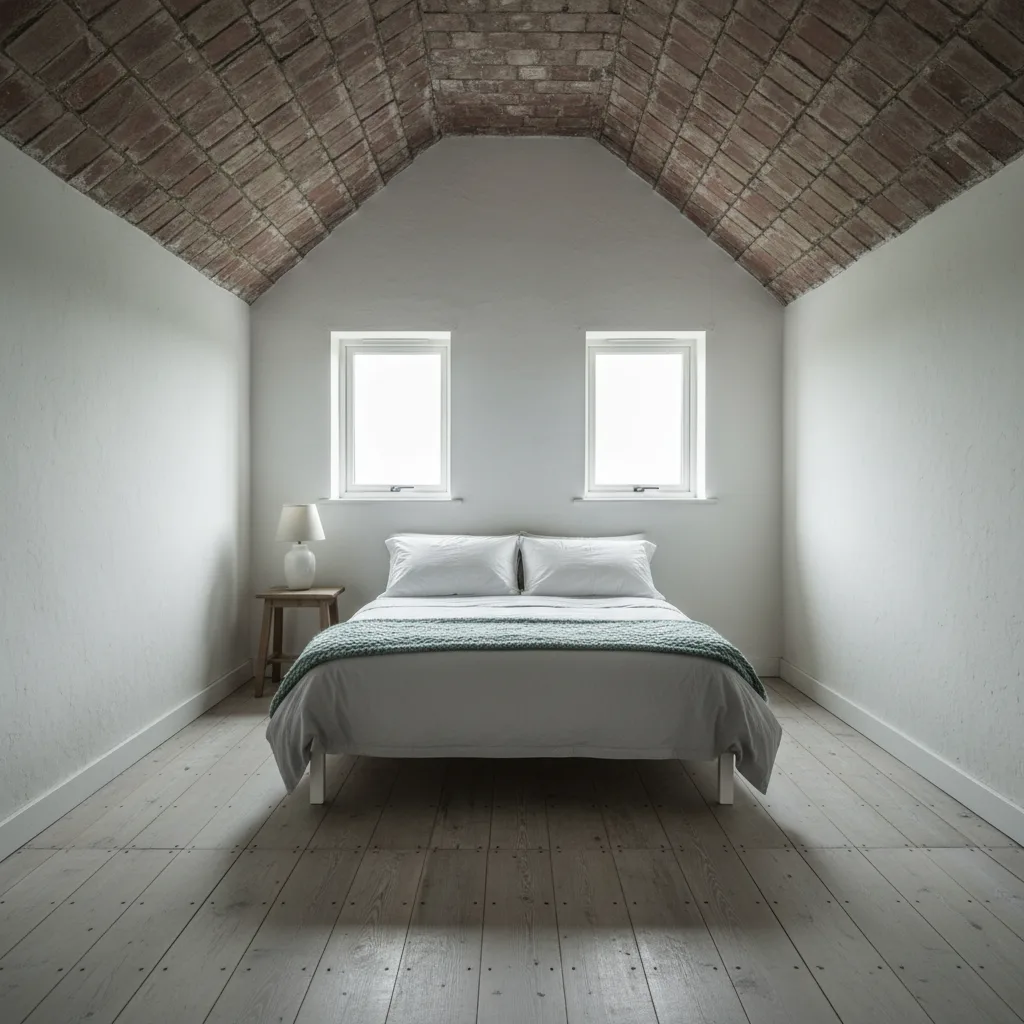
The position of the window up the slope changes which action makes sense, and it is the practical driver in most loft rooms.
A window set high in the roof is out of reach and is operated by a pole or by a motor. A centre pivot with its control bar at the top is easy to reach with a pole from below, and the fact that the bottom swings in is irrelevant when the bottom is above head height.
A window set low, where the sill is at sitting or standing height, is within reach and the swing into the room becomes the dominant issue. That is where top hung belongs.
The view
People underestimate how much of the value of a roof window is the view rather than the light, particularly on this coast where a rear slope frequently looks toward the sea or the Downs.
With a top hung window you can walk up to the opening, lean out slightly and look. With a centre pivot the lower sash is in the way, and the experience is looking through the top half of a window at arm’s length.
Where the view is a reason for the window, top hung is the answer and it is worth the constraints that come with it.
Furniture, and planning the room
The room is usually designed after the window is fitted, and it should be the other way round.
A desk under a roof window is one of the most pleasant places to work in a house, and it is incompatible with a centre pivot at that height. A bed with its head under the slope is very common in a loft conversion, and again the pivot sash arrives exactly where the pillow is.
Asking what goes under the window, at survey, settles the action in most rooms.
Cleaning
Both types can be cleaned from inside on most current models, and the mechanisms differ.
A centre pivot rotates through to bring the outer face inside, and it is held there by a catch. A top hung window releases from its hinges and then rotates in the same way, which is a slightly more deliberate operation.
Neither requires going onto the roof, which is the point. On a coastal roof where salt film builds continuously, being able to clean from inside is worth having and is a reason to prefer a modern unit over an old one that cannot.

Low pitch roofs
On a shallow slope a top hung sash has less room to swing before it is close to the roof surface, so the opening angle is reduced and the ventilation with it.
Manufacturers state a minimum pitch for each action, and top hung units generally need more pitch than centre pivot ones. On the shallower slopes of a 1960s roof, or a rear addition with a low pitch, the pivot may be the only action available.
This is checked against the actual measured pitch rather than assumed from the look of the roof.
Ventilation performance
For a given opening area a top hung window gives a slightly better airflow, because the whole opening is clear and air is not divided round a sash sitting in the middle of it.
A centre pivot has a useful characteristic of its own, though. Because the top opens outward and the bottom opens inward, it produces air movement in two directions at once, which some people find gives better circulation in a small room.
Both types normally carry a trickle vent that works with the window closed, which is what provides background ventilation year round.
Bathrooms and en suites
A loft bathroom is one of the more common places a roof window goes, and it has particular requirements.
Ventilation matters more here than anywhere, because a bathroom generates a great deal of vapour in short bursts. An opening window at the highest point of the room removes it effectively.
Privacy is generally not an issue overhead, which is one of the pleasures of a roof window in a bathroom, unless the property is overlooked from higher ground, which on the slopes above Worthing and in the Brighton terraces is worth checking.
Operation, and what is within reach
Reach is a practical measurement rather than a guess, and it is worth taking at survey.
A control bar at the top of a window is comfortably reachable up to a certain height and needs a pole above that. A pole gives usable reach up to a point and becomes awkward beyond it. Above that, electric operation is the answer, and on this coast a rain sensor with it is worth having because weather arrives quickly.
Cable routes for an electric unit are decided before the ceiling closes, which is one more thing that belongs in the conversation early.
Blinds
Both actions take blinds, and the fitting differs slightly.
Blinds fitted at the time of installation are neater than blinds added later, because the fixings are made into the frame before the linings are finished. On a centre pivot the blind rotates with the sash, which works well. On a top hung unit the blind stays with the sash as it swings.
Where a blind is likely to be wanted at any point, specifying it with the window is better value than adding it in two years.
The mechanism, and what ages
The action is also a mechanism, and mechanisms wear. It is worth knowing what is doing the work in each.
- Pivot bearings. On a centre pivot these carry the whole sash and are in constant use. Good ones last decades; they are the component that eventually loosens.
- Friction hinges. On a top hung unit these hold the sash at whatever angle it is left at. When they weaken, the window will not stay open.
- The catch or handle. The most used part of either type and the one most likely to need replacing first.
- Gaskets. Common to both. They harden with age and are what starts letting draughts and noise through.
- The cleaning catch. On both types, the mechanism that lets the sash rotate through. Rarely used, and it seizes if it never is.
On a coastal roof every one of those is in salt air, which is the argument for stainless and for occasional operation of the parts that would otherwise sit still for years.
Replacing like for like
Where an old roof window is being replaced, the temptation is to order the same action as the one coming out, and that is worth questioning rather than assuming.
The original choice was frequently made by a builder rather than by the person who lives in the room, and it was frequently made before the room had a use. A loft that was a boxroom in 1990 and is a bedroom now may have a centre pivot where a top hung window is what the room now needs.
Where the opening is the same and the pitch allows it, changing the action at replacement costs nothing extra and is one of the few opportunities to correct a decision made decades ago.
Fixed units, the third option
Not every roof window needs to open, and a fixed unit is worth considering where ventilation is provided elsewhere.
A fixed window is cheaper, quieter in rain, better sealed against air leakage, and has no mechanism to age. Where a room already has adequate ventilation and no escape requirement, and where the window is high in the roof where nobody would open it anyway, a fixed unit is frequently the better specification.
It is rarely offered and it is worth asking about.
What we want to know on a pitched roof
We ask what goes under the window and whether the room is a habitable loft room before recommending an action, because those two answers settle it in most cases. We measure the pitch and the reach rather than estimating them, and where an escape opening is required we say so at survey and specify accordingly.
The action is decided by the room, and it cannot be changed once the window is in.
Thinking about this job? We survey across Worthing, West Sussex and the South Downs and give you a fixed price before any work starts, with a 10-year workmanship guarantee.